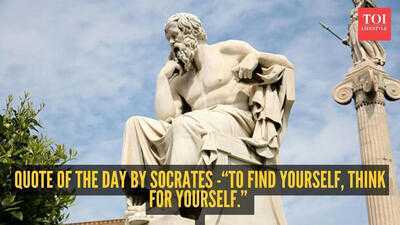
At first glance, this quote sounds simple, almost obvious. Of course we should think for ourselves, right? But when you really sit with it, you realize it’s not that easy. Most of us go through life absorbing opinions - from family, friends, social media, culture - without even noticing. So what Socrates is really saying hits deeper: if you want to understand who you truly are, you have to step away from all that noise and start forming your own thoughts.
Let’s break it down in a more real, everyday way.
What does “find yourself” even mean?
People often say “I’m trying to find myself,” but it can feel vague. It’s not like you’re lost somewhere and need directions. Finding yourself is more about understanding your values, what matters to you, what you believe in, and how you see the world.
It’s knowing what feels right to you - not what looks right to others.
And that’s where the second part of the quote comes in: “think for yourself.”
Why thinking for yourself is so hard
We like to believe we’re independent thinkers, but the truth is, we’re heavily influenced by our surroundings.
Think about it:
We often choose careers based on what’s “respectable”
We form opinions based on what’s trending
We judge success based on what society celebrates
None of this is necessarily wrong. But if you never question it, you might end up living a life that doesn’t actually feel like yours.
From a young age, we’re taught what’s “right” and “wrong,” what’s “good” and “bad.” Over time, these ideas become so ingrained that we stop questioning them.
That’s why thinking for yourself isn’t just about having opinions - it’s about questioning where those opinions came from.
The difference between reacting and thinking
A lot of what we call “thinking” is actually just reacting.
You see something online, and you instantly agree or disagree. You hear someone’s opinion, and you adopt it because it sounds convincing. That’s not really thinking - that’s absorbing.
Thinking for yourself takes a bit more effort. It means pausing and asking:
Do I actually believe this?
Why do I feel this way?
Would I still think this if no one else did?
It’s slower, sometimes uncomfortable, but much more honest.
Finding your voice in a loud world
Today, we’re constantly surrounded by opinions—Instagram, Twitter, YouTube, news, podcasts. Everyone has something to say, and it’s easy to get swept up in it.
The challenge is not losing your own voice in the process.
When you don’t think for yourself, you start living on autopilot. You follow trends, adopt beliefs, and make choices without really checking in with yourself.
But when you do start thinking independently, something shifts. You become more aware of your choices. You stop doing things just because “everyone else is doing it.”
That’s when you start feeling more like yourself.
It’s okay to question everything (even what you’ve always believed)
One of the biggest fears people have is questioning their own beliefs. It can feel unsettling, like you’re pulling the rug out from under your own identity.
But questioning doesn’t mean rejecting everything. It just means examining it.
Maybe you’ll realize some beliefs still make sense to you—and that’s great. But maybe you’ll also find things that don’t quite fit anymore.
That’s growth.
Socrates himself was known for asking questions - lots of them. He believed that questioning is how you get closer to truth. Not by blindly accepting what you’re told, but by thinking it through.
Thinking for yourself doesn’t mean ignoring others
It’s important to clarify this: thinking for yourself doesn’t mean shutting everyone else out or assuming you’re always right.
It’s not about being stubborn or dismissive. It’s about being thoughtful.
You can listen to others, learn from them, even change your mind—but the key is that the final belief is yours, not something you just borrowed.
There’s a difference between being influenced and being controlled.
The confidence that comes with it
When you start thinking for yourself, you slowly build confidence - not the loud, showy kind , but a quieter, steadier kind.
You’re less shaken by what others think because you’ve actually thought things through. You’re not just following the crowd, so you don’t feel the same pressure to keep up.
This doesn’t mean you’ll never doubt yourself. You will. But even that doubt becomes part of your thinking process, not something that completely throws you off.
It can feel lonely at times
Let’s be honest, thinking for yourself isn’t always easy or comfortable.
There will be moments when your views don’t match the people around you. When you feel like the odd one out. When it would be easier to just agree and move on.
And sometimes, you might even question yourself: “Am I overthinking this?”
But that discomfort is part of the process. It means you’re not just going along with things - you’re actually engaging with them.
Over time, you’ll find people who respect that, even if they don’t always agree with you.
Small ways to start thinking for yourself
You don’t have to suddenly question everything overnight. It can start small.
Pause before forming an opinion
Ask yourself why you believe something
Be open to changing your mind
Spend time alone without constant input
Reflect on your choices and what drives them
Even small moments of self-reflection can make a big difference.
So, what does it really mean?
At its core, Socrates’ quote is about ownership - owning your thoughts, your beliefs, your choices.
Because when you don’t think for yourself, you’re basically living someone else’s version of life. And no matter how “successful” that looks from the outside, it can feel empty on the inside.
But when you do think for yourself, even if your path looks different or uncertain, it feels more real. More yours.
Finding yourself isn’t a one-time thing. It’s an ongoing process. You’ll keep evolving, and your thoughts will change over time.
But as long as those thoughts are truly yours - formed through reflection, curiosity, and honesty - you’re on the right track.
Because in the end, “finding yourself” isn’t about discovering something hidden.
It’s about creating a version of yourself that actually feels true.
Contact to : xlf550402@gmail.com
Copyright © boyuanhulian 2020 - 2023. All Right Reserved.