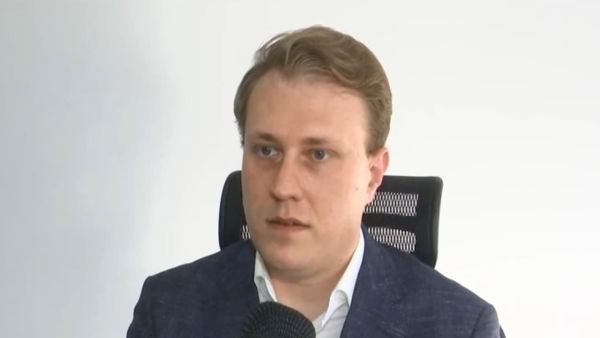
Rocklink India has opened a lithium-ion battery recycling facility in Sikandrabad, Uttar Pradesh. The plant has a 10,000-ton input capacity to produce blackmass and recycle critical minerals like cobalt, nickel, lithium, and rare earths.
Rocklink India has opened a lithium-ion battery recycling facility in India as part of its efforts to build a domestic ecosystem for recycling of critical and rare earth minerals, said Leonard Ansorge, Director, Rocklink India Private Ltd.

Commenting on the key development for the company in India, Ansorge told ANI, "(Today is) the opening of our facility as well as the opening of our first lithium-ion battery recycling plant here in India," on the sidelines of the launch of the facility at Sikandrabad industrial area in Bulandshahar district of Uttar Pradesh, nearly 60 km from the national capital New Delhi.
Plant Capacity and Focus
He said the plant has been designed with significant processing capability. "Capacity here as installed of today is 10,000 tons of input capacity, which enables us to produce up to 5,000, 6,000 tonnes of blackmass," he said.
Rocklink India is engaged in the recycling of particular raw materials, mainly focusing on lithium-ion batteries as well as permanent magnets, he said. He added that the plant is capable of handling a wide range of battery inputs. "The raw material that we process here are batteries. So lithium ion batteries, all types," he said. "So the two groups that we focus on is the batteries and the magnets. That relates or translates into cobalt, nickel, lithium, manganese, as well as the rare earth, which are lanthanides, neodymium, dysprosium, and terbium," he added.
Recycling's Role in India's Mineral Demand
On the potential contribution of recycling to India's rare earth demand, Ansorge said, "At the end of the day, there is no real data available in the markets right now. It's quite early to say that, but in general, my estimate would be around 5% of the total demand and growth that we are foreseeing in the Indian market could be potentially covered by recycling," he said.
He, however, clarified that recycling alone cannot meet the country's requirements. "However, it will never turn the picture overall, so the primary refining of materials will always be required to catch up with the demand in the Indian market for NdFeB magnets," he said. Ansorge added that demand for magnets is rising globally. "There is obviously a CAGR growth of probably 10% plus, as you see that in the global markets as well," he said.
Future Expansion and Scalability
On future expansion, Ansorge said the facility has been built with scalability in mind. "So the plant was made for future capacity, for future volumes available in the markets," he said, adding that the company plans to introduce dry processing capabilities to handle scrap from upcoming cell manufacturing units in India.
"So we expect that the capacity of the wet processing plant is sufficient for the materials available in the next couple of years. However, we want to add dry processing plants that enable us to treat the scrap that will rise from the cell manufacturing companies that are now being commissioned in India," he said. He also indicated plans to expand operations geographically. "As of now, we're still looking into a site in southern India... however, we focus on expanding that site here in the first place," he said.
Rare Earth Processing Goals
On rare earth processing, Ansorge said the company is working towards adding further capabilities. "We try to play our part here as well, establishing a research laboratory, partnering with our long-term partner, BatX Energies, to develop a rare earth processing plant that will be established in around one year at this site as well," he said.
Industry Challenges and Market Dynamics
Highlighting industry challenges, he said the availability of raw material remains a constraint. "In rare earth and in batteries, it's a supply of materials... there is still a quite dependency on the informal sector," he said, adding that volumes for magnet processing are currently limited.
Ansorge also pointed to evolving market dynamics, noting that demand for finished products in India remains limited. "We are seeing a relatively weak demand for the finished products... the market is not developed yet," he said, adding that some refined materials are currently being exported due to a lack of domestic demand.
Future Outlook and Growth Projections
He said the company expects strong growth in processing volumes going forward. "We hope to increase our process volumes two to three times every year. The capacity is enough. It's just a matter of the availability of materials in the markets," he said.
On the broader outlook, Ansorge said India's recycling sector is still at a nascent stage but showing progress. "I see that India is still in the very beginning... it went from there is no recycling to there is ongoing refining within three years," he said, expressing confidence that the ecosystem will continue to develop into a more formal and mature market.
Government Push for Self-Reliance
India's requirement for rare earth permanent magnets is around 4,000 tonnes annually, projected to nearly double by 2030, with critical mineral needs for electric vehicles, defense, and electronics driving high import dependence, according to the government data.
The government of India is pushing for 6,000 MTPA integrated rare earth permanent magnets production by 2030, supported by a Rs 7,280 crore incentive scheme to augment self-reliance, the data showed. (ANI)
(Except for the headline, this story has not been edited by Asianet Newsable English staff and is published from a syndicated feed.)Contact to : xlf550402@gmail.com
Copyright © boyuanhulian 2020 - 2023. All Right Reserved.