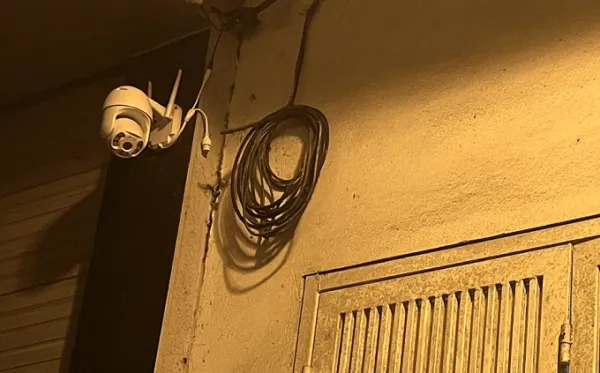
The conflict began in October 2025, when the neighbor across the hall installed a 360-degree camera covering the corridor and the entrance to Thanh’s apartment in Phu Tho Hoa Ward in Ho Chi Minh City.
His neighbor turned down his request to tilt the camera downward saying it would not “provide enough security monitoring.”
The building management instructed the neighbor to remove the camera from the shared wall and moved to their doorframe, but the way to Thanh’s home remained within view.
After 45 days and a failed mediation meeting, Thanh said the constant surveillance made daily life uncomfortable: “My own home feels like prison, as if every move is being watched.”
In early April he put his apartment up for sale.
Plants covering the front of Nguyen Tien’s house. Photo courtesy of Nguyen Tien |
Nguyen Tien, 24, in Thu Duc Ward faced a similar issue. Though her residential area had security guards and street cameras, a neighbor installed two cameras close to her wall and pointing toward her house to “watch the car parked outside.”
Unable to negotiate due to past conflicts, Tien asked the resident manager to step in. The cameras were tilted more toward the street but still covered the entire space in front of her home. She responded by planting trees, putting up a beach umbrella to block the view and keeping her curtains closed.
The issue of “security cameras pointed at neighbors’ homes” has been sparking heated debate on social media, with some arguing that wider camera angles improve security and others worrying about privacy and the risk of sensitive images being shared.
On March 2 a Read reader asked whether a neighbor’s camera pointing at their door and living space violated privacy rights. The post received more than 6,000 responses, with 79% saying the neighbor was in the wrong.
Since 2024 more than 20 complaints about similar situations have been filed on the iHanoi app.
Diep Nang Binh, head of Tinh Thong Law Firm, says these concerns are justified. “The space in front of a home, the yard and private pathways are where personal activities take place. Being recorded 24/7 makes people feel unsafe.”
Under the 2015 Civil Code, privacy and image rights are protected by law. Regulation 13/2013 states that personal data can only be processed with legal justification.
While people have the right to install cameras to protect their property, they cannot turn someone else’s living space into a surveillance area, and violators may be required to stop and pay compensation.
Lawyers also warn against resolving such disputes through violence or property damage, which could lead to criminal charges.
Nguyen Dong also of Ho Chi Minh City chose a different approach to resolving this problem. Five years ago, after a neighbor installed a camera pointing at his yard, he mounted a small mirror that reflected sunlight directly into the lens, casting a glare.
A few days later the neighbor removed the camera and installed window bars instead. Dong says: “I didn’t damage anything. I just found a way to protect my family’s privacy,”
Binh advises camera owners to respect others’ privacy, limiting recording to their own property. Those affected should first try peaceful solutions such as adjusting the camera angle or setting up a privacy mask. If that fails, they should collect evidence and file written complaints with local authorities.
Nguyen Long, 60, of Hanoi faced backlash in 2024 after installing a camera. He says: “I had no intention of invading anyone’s privacy, but my house is only three meters wide. No matter how I adjusted it, the camera still faced neighbors’ homes.”
He later changed the camera’s viewing angle public and promised not to share footage, easing tensions.
Contact to : xlf550402@gmail.com
Copyright © boyuanhulian 2020 - 2023. All Right Reserved.