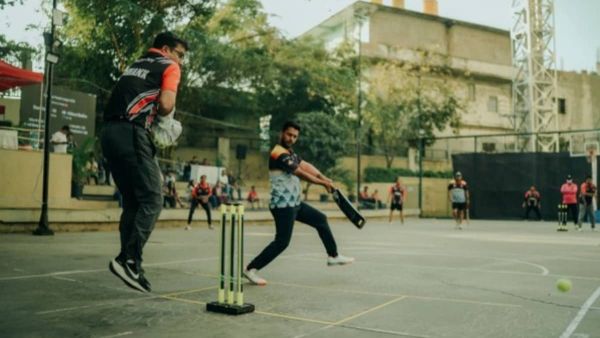
While the IPL sells franchises for thousands of crores and fills stadiums with celebrities, a quiet revolution is happening on a basketball court in HSR Layout, and it might be the most important cricket story nobody is talking about.
Let's be honest about what Indian cricket culture has become.
Every April, the country stops. Offices empty out by 7 PM. Families rearrange dinner around a broadcast schedule. Social media becomes one long, rolling argument about strike rates and captain selections. The IPL is not just a tournament anymore, it is a shared national religion, complete with its own gods, its own mythology, and its own economy worth billions of dollars.
And somewhere in all of that spectacle, something got lost.
The ordinary Indian cricketer. The one who does not have an agent, or a franchise contract, or a Wikipedia page. The one who grew up dreaming of playing at the highest level and, like 99.9 per cent of the country, never got there. The one who is now 32, sitting in a Bengaluru apartment after a ten-hour shift, watching someone else play the game he loves on a screen.
Varun Karat wants to give that person their moment back.
The Problem With Putting Cricket on a Pedestal
India's relationship with cricket has always been emotional to the point of irrationality. But the IPL era has done something subtler and more damaging than mere obsession: it has made cricket feel like something that happens to other people.
The production values are cinematic. The players are global celebrities. The cheerleaders, the commentary boxes, the post-match analysis shows, every element of the IPL experience is designed to position cricket as elite entertainment, consumed passively from a couch or a corporate hospitality box.
The side effect of this, largely unexamined, is that participation has quietly declined among urban adults. Why would you drag yourself to a dusty maidan on a Sunday morning to play a scrappy game with mismatched equipment when the version of cricket you've been trained to love looks like a Marvel production?
Karat has a word for what this culture has created: spectators. And he is in the business of turning spectators back into players.
"Every Indian has a dream to play at the highest level," he says. "We have experienced the thrill of stepping onto the pitch and leading a team. We understand the emotional weight of the game. What we are doing is making sure that dream doesn't die just because you didn't make it to the IPL."
What CPL26 Actually Challenges
The Community Premier League is not anti-IPL. It does not position itself as a protest movement or a corrective to commercial cricket. It is shrewder than that.
Instead, CPL26 borrows everything that makes the IPL compelling, the professional infrastructure, the strategic formats, the drama, the ceremony, and relocates it inside the residential communities where ordinary Indians actually live.
The Decision Review System. Official team jerseys. ICC-aligned bowling regulations. Grand closing ceremonies. A prize pool. A genuine group stage with knockout drama. CPL26 is not asking participants to settle for a lesser version of cricket. It is telling them: you deserve the full experience. And you can have it three kilometres from your front door.
This edition features residential societies from across Bengaluru competing across two weekends, April 25–26 and May 2–3, at the Atal Bihari Vajpayee Stadium in HSR Layout. The format is box cricket, played in a tightly enclosed arena where walls, fences, and even a rogue overhanging tree are active parts of the game. Eight players take the field at any time from a squad of 10 to 14. Every batter is capped at 10 balls in the league stage, a deliberate design choice that ensures the game belongs to the whole team, not just its best two batsmen. The prize pool is Rs. 1 lakh.
Registration costs Rs. 1,000 per player. That number matters. It is not a casual pick-up game. It is not a corporate off-site with rented equipment and no stakes. It is a tournament you pay to enter, train for, and take seriously, because seriousness, Karat has found, is exactly what people are hungry for.
The Players the IPL Never Made Room For
Walk through the CPL26 team roster and you will find the cricketers that India's official cricket ecosystem quietly gave up on.
There is the society captain who spends his weekdays managing enterprise AI systems and his weekends obsessing over field placements. There are teams like the Greenage Allstars and Guardians, named, branded, and captained with the kind of pride that most cricket boards reserve for national squads. There are fathers who played serious club cricket in their twenties and quietly shelved that part of themselves when life got complicated, now lacing up their shoes again because someone finally built a stage worth performing on.
These are not hobbyists. They are cricketers who never stopped loving the game. They simply ran out of places to play it with any dignity.
CPL26 gives them that place. And it gives their communities a reason to show up and watch, which turns out to be its own kind of revolution. Because when your neighbour is the one batting, when the person in the next apartment is the one running in to bowl the final over, cricket stops being something that happens on television and becomes something that happens to you.
The Blueprint, If It Works
Britz Sports Management's ambitions extend well beyond Bengaluru.
Karat has a five-year plan to take the CPL model to other Indian metros, cities where the same urban density, the same corporate exhaustion, and the same IPL-saturated media environment have produced the same result: millions of cricket lovers who haven't held a bat in years.
The civic establishment is beginning to pay attention. The Bruhat Bengaluru Mahanagara Palike has extended support. Local MLA Sri M. Sathish Reddy has publicly backed the initiative. Sponsors, Basil, IZee, Amba LG, Fruits N Desserts, have recognised that a hyper-local, deeply engaged audience is a marketing opportunity that a thirty-second IPL spot cannot replicate.
If the model scales, what Britz is building is not just a league. It is an alternative infrastructure for Indian cricket, one that does not depend on talent scouts, state associations, or broadcast rights. One that is owned, run, and celebrated by the communities it serves.
The Question Worth Asking
Here is the thing about the IPL that its admirers rarely say out loud: for all its brilliance, it has made most Indians feel like they are on the wrong side of a velvet rope. You can watch. You can cheer. You can buy the jersey. But the game, the real game, is not for you.
CPL26 is making a different argument entirely.
It is saying: the real game is exactly for you. You, the software engineer in HSR. You, the parent in Greenage. You, the 34-year-old who still dreams about the cover drive you hit in a college tournament a decade ago.
Varun Karat is not trying to compete with the IPL. He is trying to remind India that cricket was always a participation sport before it became a spectator one, and that somewhere between the auction tables and the franchise valuations, we forgot that the game is most alive when ordinary people are playing it.
CPL26 opens April 25. The velvet rope is down.
Contact to : xlf550402@gmail.com
Copyright © boyuanhulian 2020 - 2023. All Right Reserved.