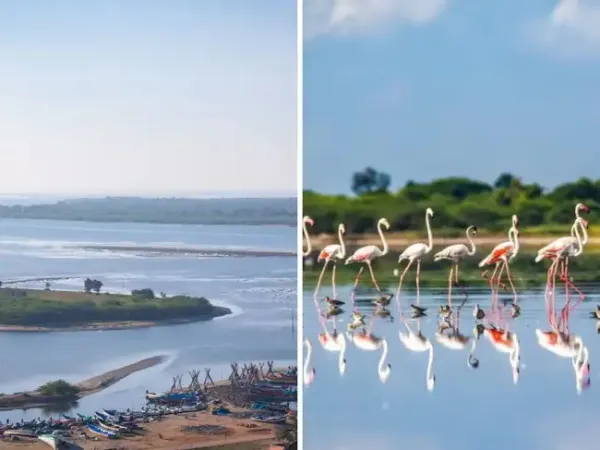
There are places that feel almost unreal, where nature seems to pause and paint the landscape in colours you would not expect to see in real life. Not far from the hustle of southern cities, a vast waterbody quietly transforms into something surreal during certain seasons. What looks like an ordinary lagoon from a distance suddenly becomes a shimmering stretch of pink as thousands of birds gather in perfect harmony. This striking natural phenomenon has once again drawn attention online, thanks to a recent post highlighting its beauty.
Supriya Sahu, IAS, recently took to X to share visuals and details of this extraordinary scene unfolding at Pulicat Lake in Thiruvallur district near Chennai.
She described how flamingos gather in large numbers at Pulicat Lake, creating a breathtaking spectacle as their pink hues reflect across the water's surface. The result is a landscape that appears almost painted, with movement, colour, and light blending into what she called a living canvas. Pulicat Lake holds significant geographical and ecological importance. It is India’s second-largest brackish water lagoon, after Chilika Lake, and is uniquely positioned along the border of Tamil Nadu and Andhra Pradesh. This vast stretch of water plays a crucial role in supporting biodiversity and maintaining coastal ecological balance.
Reason behind lake's transformation
One of the key reasons behind the lake’s seasonal transformation is its location along the Central Asian Flyway, a major migratory route used by birds travelling across continents. This makes Pulicat a critical stopover point for migratory species seeking food and rest during long journeys.
The nutrient-rich mudflats of the lake act as natural feeding grounds, offering an abundant supply of resources that attract thousands of flamingos each season. These birds travel from distant regions, returning annually in large flocks that gradually tint the water and sky with shades of pink. As the flock settles and moves across the shallow waters, the visual effect becomes even more dramatic. The reflection of their feathers against the calm surface creates a shifting palette of pink tones that changes with light, time of day, and movement of the birds.
For wildlife enthusiasts and photographers, Pulicat Lake becomes a living frame of motion and colour during this period. The scene is not static but constantly evolving, as flocks take off, land, and shift positions across the lagoon. Supriya Sahu IAS, highlighted this delicate ecological balance and natural spectacle, drawing attention to the importance of preserving such habitats that support migratory birds across continents. Her post also included a video shared in collaboration with the Tamil Nadu Forest Department, showcasing the scale and beauty of the gathering.
Pulicat Lake continues to remain one of the most important wetlands in southern India, not just for its biodiversity but also for the way it connects geography, migration, and seasonal transformation into a single visual experience.
Internet reacts
Internet users reacted with admiration and excitement after seeing visuals of flamingos at Pulicat Lake. Many called it a breathtaking natural spectacle, with one user humorously dubbing it a “flamingo walk” instead of a catwalk, highlighting how surreal the scene looked.
Others shared personal experiences of visiting the lake, describing it as an incredible sight to witness the birds in large numbers. Some users reflected on the calming beauty of nature, comparing it to other serene wildlife moments and calling it almost meditative.
A few expressed surprise that such a phenomenon exists so close to home, wondering why people travel abroad when India itself offers such rich natural wonders. There were also appreciative comments praising the officials and forest teams for preserving and showcasing the ecosystem. Overall, the reactions blended wonder, pride, and a renewed appreciation for local biodiversity.
Supriya Sahu, IAS, recently took to X to share visuals and details of this extraordinary scene unfolding at Pulicat Lake in Thiruvallur district near Chennai.
She described how flamingos gather in large numbers at Pulicat Lake, creating a breathtaking spectacle as their pink hues reflect across the water's surface. The result is a landscape that appears almost painted, with movement, colour, and light blending into what she called a living canvas. Pulicat Lake holds significant geographical and ecological importance. It is India’s second-largest brackish water lagoon, after Chilika Lake, and is uniquely positioned along the border of Tamil Nadu and Andhra Pradesh. This vast stretch of water plays a crucial role in supporting biodiversity and maintaining coastal ecological balance.
Reason behind lake's transformation
One of the key reasons behind the lake’s seasonal transformation is its location along the Central Asian Flyway, a major migratory route used by birds travelling across continents. This makes Pulicat a critical stopover point for migratory species seeking food and rest during long journeys. The nutrient-rich mudflats of the lake act as natural feeding grounds, offering an abundant supply of resources that attract thousands of flamingos each season. These birds travel from distant regions, returning annually in large flocks that gradually tint the water and sky with shades of pink. As the flock settles and moves across the shallow waters, the visual effect becomes even more dramatic. The reflection of their feathers against the calm surface creates a shifting palette of pink tones that changes with light, time of day, and movement of the birds.
For wildlife enthusiasts and photographers, Pulicat Lake becomes a living frame of motion and colour during this period. The scene is not static but constantly evolving, as flocks take off, land, and shift positions across the lagoon. Supriya Sahu IAS, highlighted this delicate ecological balance and natural spectacle, drawing attention to the importance of preserving such habitats that support migratory birds across continents. Her post also included a video shared in collaboration with the Tamil Nadu Forest Department, showcasing the scale and beauty of the gathering.
Pulicat Lake continues to remain one of the most important wetlands in southern India, not just for its biodiversity but also for the way it connects geography, migration, and seasonal transformation into a single visual experience.
Internet reacts
Internet users reacted with admiration and excitement after seeing visuals of flamingos at Pulicat Lake. Many called it a breathtaking natural spectacle, with one user humorously dubbing it a “flamingo walk” instead of a catwalk, highlighting how surreal the scene looked.Others shared personal experiences of visiting the lake, describing it as an incredible sight to witness the birds in large numbers. Some users reflected on the calming beauty of nature, comparing it to other serene wildlife moments and calling it almost meditative.
A few expressed surprise that such a phenomenon exists so close to home, wondering why people travel abroad when India itself offers such rich natural wonders. There were also appreciative comments praising the officials and forest teams for preserving and showcasing the ecosystem. Overall, the reactions blended wonder, pride, and a renewed appreciation for local biodiversity.