
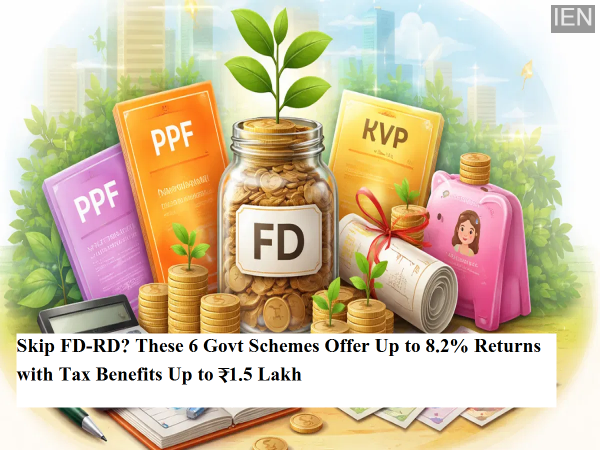
Looking Beyond FD? Government Schemes Offer Higher Returns
For investors seeking safe and stable returns, Fixed Deposits (FDs) and Recurring Deposits (RDs) have traditionally been the go-to options. However, several government-backed small savings schemes are currently offering higher interest rates—up to 8.2%—along with tax benefits, making them increasingly attractive in 2026.
These schemes not only provide guaranteed returns but also help in tax saving under Section 80C, making them a strong alternative for long-term investors.
Top Government Schemes and Their Returns
Here are some of the most popular small savings schemes and their current interest rates:
- Sukanya Samriddhi Yojana – 8.2%
- Public Provident Fund – 7.1%
- National Savings Certificate – 7.7%
- Kisan Vikas Patra – 7.5%
- Post Office Monthly Income Scheme – 7.4%
- Post Office Savings Deposit – 4.0%
In comparison, major banks are offering FD interest rates in the range of 6.25% to 6.66%, which is lower than most of these schemes.
Where Do You Get Better Returns?
If your primary goal is higher returns, small savings schemes clearly have an edge over FDs. The difference of even 1–2% can significantly boost your earnings over the long term due to compounding.
However, choosing an investment option should not be based on returns alone.
Lock-In Period: Flexibility vs Commitment
One major difference between FDs and government schemes is liquidity:
- NSC: 5-year lock-in
- PPF: 15-year lock-in
- SSY: Long-term lock-in until maturity
On the other hand, FDs offer:
- Flexible tenure options
- Premature withdrawal (with penalty)
- Easier access to funds
If you may need money in the short term, FDs provide better flexibility.
Tax Benefits: A Key Advantage
Taxation plays a crucial role in investment decisions:
- FD Interest: Fully taxable as per your income slab
- Small Savings Schemes:
- Eligible for ₹1.5 lakh deduction under Section 80C
- Some schemes like PPF offer tax-free returns
This makes government schemes more tax-efficient for long-term investors.
Which Option Should You Choose?
The right choice depends on your financial goals:
- Choose small savings schemes if you want:
- Higher returns
- Tax savings
- Long-term wealth creation
- Choose FDs if you prefer:
- Liquidity and flexibility
- Short-term investment
- Easy withdrawal
Experts often recommend a balanced approach, combining both options in your portfolio.
Final Takeaway
Government-backed small savings schemes are currently offering better returns than traditional FDs, along with tax benefits. However, they come with longer lock-in periods.
Before investing, assess your financial goals, liquidity needs, and risk tolerance. A well-diversified portfolio that includes both FDs and small savings schemes can help you maximize returns while maintaining financial security.
Contact to : xlf550402@gmail.com
Copyright © boyuanhulian 2020 - 2023. All Right Reserved.