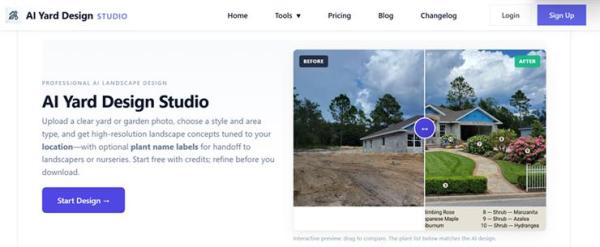
Redesigning a yard sounds simple until you try to explain what you want. “More welcoming, ” “cleaner, ” “less maintenance, ” and “better for entertaining” are all real goals, but they do not translate cleanly into layout, materials, or planting plans. The hardest part is not inspiration—it is shared clarity: making sure what you imagine is what everyone else understands before you order plants, rent equipment, or sign off on a proposal.
That is why “visualize first” has become the default workflow for many homeowners and small-project leaders. And it is also why an AI landscape design tool can be genuinely useful—not as a substitute for professional site work, but as a fast bridge from your real lot to a credible concept you can critique, refine, and discuss.
Why a single photo is the right starting point
Most failed outdoor conversations share a missing ingredient: a common reference that is anchored to your property. Magazine photos are beautiful, but they are not your slope, your fence, your mature tree, or your driveway connection. A site photo fixes that baseline. The photo does not need to be “professional, ” but it should be complete enough to design from.
Include the relationship between the house and the yard, major boundaries, existing hardscape, and any tree canopy that truly matters. If you crop too tightly, you may get an attractive fantasy garden that ignores circulation and context. If you capture too little light detail, you may need a second shot—but one strong, wide, daylight image is often enough to begin.
What an AI landscape design tool actually changes in the workflow
Traditional options look like this: you collect ideas, you try to describe them, you maybe sketch, you browse Pinterest, you hire help—or you stall. An AI landscape design tool compresses the early loop. Instead of debating adjectives for a week, you generate outputs that are directly tied to your uploaded image, then compare variations.
The point is not “perfect on the first try.” The point is iterating while decisions are still cheap: swapping styles, adjusting density, testing a more formal approach versus a relaxed one, or tightening the planting palette before you commit money.
Where AI Yard Design Studio fits (and how to use the platform on ai-yard-design.com)
If you are looking for a platform built around residential yards and gardens—rather than generic image play—a strong place to start is AI Yard Design Studio. The flow matches how people already think about outdoor work: identify the area you are redesigning, choose a design direction, add practical constraints, generate a concept, refine. In practice, treat the tool like a design studio session:
- Upload your yard photo as the source truth.
- Choose the area type (for example, front yard, backyard, side yard, pool surroundings, or garden-focused zones). This matters because each zone has different priorities—privacy along a side lot line is not the same problem as arrival appeal at the front.
- Pick a style or visual direction that matches your taste, then add short notes that turn taste into requirements: dog-friendly surfaces, low maintenance, keep an existing tree, more screening, fewer sharp edges, and so on.
- Generate, compare, and refine. The best outcomes usually come from deliberate iteration—adjust one variable at a time so you learn what is driving the look.
If you are new to the platform, sign-in and credits workflows on ai-yard-design.com are designed so you can explore without treating the first render like a final contract drawing. Think “directional visualization, ” not “permits in a box.”
Make the output more realistic with location-aware thinking
Yards are local systems. Sun exposure, winter hardiness, typical materials, and common planting palettes vary by region. If your AI landscape design tool supports a location or climate hint, use AI Yard Design Studio. It will not replace checking availability at a nursery, but it can reduce the classic mismatch where a concept looks gorgeous—and completely wrong for your conditions.
From pretty pictures to something you can build (or price)
The moment an AI concept becomes valuable is when it helps someone else respond with specifics. If you can label major moves—primary path, main entertaining surface, bed geometry, key screening, focal planting—you can bring that to a landscaper as a visual brief. Some higher-quality generation settings emphasize plant identification-style labeling for exactly this handoff: a numbered legend can help a nursery propose substitutions without starting from zero.
Still, keep the boundary clear: concept imagery accelerates planning and alignment. Drainage, utilities, structural work, permitting, and construction sequencing remain real-world steps. The win is fewer expensive misunderstandings early, not pretending a render is a site survey.
A simple quality checklist before you fall in love with one image
Before you treat an output as “the plan, ” ask:
- Does it respect the hard boundaries you photographed (fences, property lines, fixed structures)?
- Does circulation feel plausible for how you use the space?
- Is maintenance honest for your lifestyle?
- Does the palette feel believable for your climate once you sanity-check it locally?
If something is off, refine rather than restart. Good AI workflows behave like conversation: tighten constraints, regenerate, compare.
Who benefits most
This approach works especially well if you are preparing a refresh (new beds, reorganized planting, better front-yard presence, a more usable backyard), if multiple stakeholders need to align visually, or if you want to arrive at a contractor meeting with direction rather than a blank shrug. It is less magical if you only have misleading photos, if you refuse iteration, or if you expect AI to silently solve grading and drainage without human verification.
Conclusion: visualize first, then build with confidence
If you want a smoother landscape redesign, stop negotiating in pure adjectives. Start with a clear yard photograph, use an AI landscape design tool to explore real directions on top of your actual site, and use the best concepts to drive decisions while they are still reversible. On ai-yard-design.com, AI Yard Design Studio is built for that exact sequence: from photo to outdoor concept, from concept to conversation, and from conversation to a project that finally moves forward.
Contact to : xlf550402@gmail.com
Copyright © boyuanhulian 2020 - 2023. All Right Reserved.