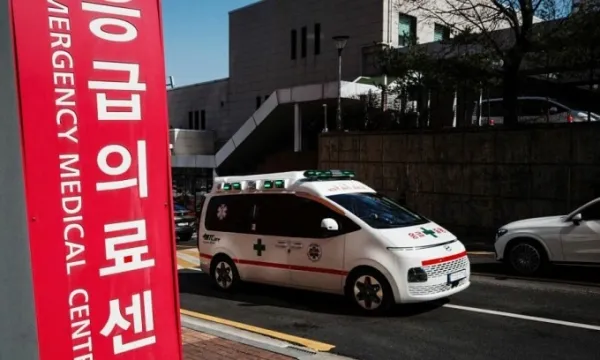
The woman, who was staying at a hotel in Daegu, began experiencing severe abdominal pain on the evening of March 1. Her husband contacted a local obstetrics and gynecology clinic at 10:16 p.m. but was advised to go to a university hospital because she had no prior medical records at the clinic.
Around 1 a.m. the next day, as the pain intensified, the husband called emergency services. An ambulance arrived 10 minutes later but was forced to remain on-site for 50 minutes. Paramedics contacted seven major hospitals in Daegu, all of which refused to accept the patient.
According to the Maeil Business Newspaperthe hospitals cited reasons such as “no obstetricians” and “lack of facilities to accommodate newborns,” for the refusals.
The husband decided to drive his wife himself to Bundang Seoul National University Hospital, their usual medical facility. Along the way, the family continued calling nearby hospitals for help.
The husband noted that his wife had previously undergone a cervical cerclage to prevent preterm birth. As she went into labor in the car, he said the lives of both the mother and the two babies were hanging by a thread.
The search for medical help was further complicated by poor coordination. While the husband drove, his mother repeatedly contacted emergency services in the Gyeongbuk and Chungbuk regions.
At 3:20 a.m., they rendezvoused with a rescue team, but the patient handover was delayed due to miscommunication between the emergency units. It was not until 4:42 a.m. that the woman was transferred to another ambulance to speed up the journey to Bundang. By that time, rescue logs indicated that her water had broken and her blood pressure was dropping sharply.
The woman arrived at Bundang Seoul National University Hospital at 5:35 a.m., more than four hours after the initial emergency call. The mother survived, but the first baby, delivered via cesarean section, died less than a day later due to oxygen deprivation.
The second baby is currently receiving intensive care in the neonatal intensive care unit (NICU) with a diagnosis of brain injury, according to broadcaster KBS.
The government has since launched an investigation into the situation.
An official from the Ministry of Health and Welfare was cited by KBS as saying: “We take this matter very seriously. After the pilot program for reforming the emergency patient transfer system ends, we plan to expand it nationwide.”
The family plans to file a damages lawsuit against the state.
The number of emergency patients being refused by medical facilities due to shortages of staff, equipment, and hospital beds is rapidly increasing in South Korea. Data from the National Medical Center shows that the number of cases labeled “unable to accept patient” more than doubled, jumping from nearly 59,000 in 2023 to nearly 120,000 last year.
Contact to : xlf550402@gmail.com
Copyright © boyuanhulian 2020 - 2023. All Right Reserved.