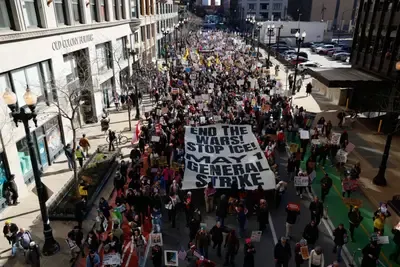
The April 5 Nationwide Strike 2026, widely promoted under the banner of “General Strike 2026” or Strike26, has emerged as a significant grassroots-led movement aimed at creating large-scale economic disruption across the United States. Organizers are calling on citizens to stay home from work and school, avoid spending at major corporations, and participate in community-driven protests. Positioned as part of a broader and continuing campaign that began earlier in the year, this strike reflects growing public mobilization around economic and social demands, while raising questions about its potential impact on daily life, business activity, and public systems.
Understanding the Purpose and Strategy Behind Strike26
The April 5 Nationwide Strike 2026 is being framed by its organizers as a deliberate escalation in a long-term campaign designed to exert economic pressure through collective action. Unlike traditional labor strikes led by a single union or centralized leadership, Strike26 represents a decentralized movement where participation is voluntary and driven by local communities. This structure allows flexibility, enabling individuals, groups, and organizations to engage in ways that align with their circumstances.
At the heart of the movement is the idea of “mass disruption.” Organizers argue that if a significant number of people simultaneously reduce their participation in the economy, the cumulative effect can draw attention to broader issues and demands. Supporters are encouraged to stay home from work or school where possible, limit their spending, and avoid purchasing from large corporate retailers. Instead, there is a strong emphasis on supporting small and local businesses, which organizers view as more community-oriented and less representative of large-scale economic systems they seek to challenge.
The campaign also promotes participation in protests, marches, and mutual aid networks. These activities are intended not only to demonstrate solidarity but also to build alternative systems of support within communities. Organizers have openly acknowledged that inconvenience is part of the strategy, suggesting that temporary disruption can lead to longer-term awareness and change. Even partial participation, such as skipping a single workday or avoiding discretionary spending, is seen as contributing to the overall impact.
The April 5 action builds on a previous nationwide strike held earlier in the year, indicating that this is not an isolated event but part of a sustained effort. By maintaining momentum through repeated actions, the movement aims to keep public attention focused on its objectives and encourage broader participation over time.
Potential Nationwide Impact and Uncertainty Around Participation
The potential impact of the April 5 Nationwide Strike 2026 largely depends on the level of participation, which remains uncertain due to the decentralized nature of the movement. If a substantial number of individuals take part, several aspects of daily life across the United States could experience noticeable disruptions.
Workplaces may see reduced attendance as employees choose to stay home in solidarity with the strike. This could affect productivity in both private and public sectors, particularly in industries that rely heavily on daily workforce presence. Similarly, schools and educational institutions might witness lower attendance levels, although there are no official directives mandating closures.
Retail activity is another area likely to be affected. With organizers urging people to avoid major corporations, large retail chains could experience a decline in foot traffic and sales for the day. This reduction in consumer spending is a central objective of the strike, as it directly targets economic activity. At the same time, local and small businesses may see a relative increase in support, aligning with the movement’s emphasis on community-based commerce.
Transportation systems could also face disruptions in areas where participation is high, particularly if protests or marches take place. While there are no confirmed shutdowns of public transit systems, localized slowdowns are possible depending on the scale of demonstrations. Delivery services and other logistics operations may experience delays if workforce participation is affected.
Despite these potential impacts, it is important to note that no official announcements have been made regarding mandatory closures of businesses, schools, or public services. The voluntary nature of the strike means that its effects will vary significantly from one city to another. In some areas, daily life may continue with minimal disruption, while in others, higher participation could lead to more visible changes.
The decentralized structure of Strike26 also means that there is no single organization controlling or coordinating all activities. Instead, the movement consists of a broad coalition of unions, advocacy groups, and individual participants. This lack of centralized leadership allows for diverse forms of participation but also makes it difficult to predict the overall scale and impact of the strike.
As the April 5 Nationwide Strike 2026 unfolds, it represents a unique form of civic engagement that blends economic action with grassroots organizing. Its success or limitations will likely depend on how many people choose to participate and how effectively the movement’s message resonates across different communities.
The post April 5 Nationwide Strike 2026 Sparks Economic Disruption Fears as Participation Calls Grow Across the United States | Cliq Latest appeared first on CliQ INDIA.
Contact to : xlf550402@gmail.com
Copyright © boyuanhulian 2020 - 2023. All Right Reserved.