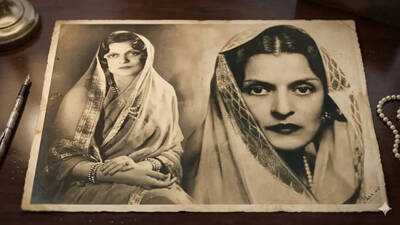
In pre-independence India, few women exhibited the determination to carve their own paths like Indira Raje, later known as Maharani Indira Devi (February 19, 1892 – September 6, 1968). Born into the affluent Baroda royal family, she eventually became the Maharani of Cooch Behar during the princely states era. Indira was the daughter of Maharaja Sayajirao Gaekwad III and his second wife, Chimnabai II, and she was raised in the luxurious Lakshmi Vilas Palace. Her upbringing was progressive, influenced by her mother’s efforts to uplift women through education and the abolition of the purdah system. Indira was notably the first Indian princess to pursue formal education.
Her independent mindset clashed with her engagement to Madho Rao Scindia, the Maharaja of Gwalior, which she found unacceptable. At just 18, she was expected to marry a man 20 years her senior, who had already been married. As historian Manu S Pillai noted, this engagement would confine her to a life of strict purdah as a junior wife, a stark contrast to her previously liberated lifestyle.
During the Delhi Durbar of 1911, she met Prince Jitendra Narayan, and it was love at first sight. The grand event, attended by King George V and Queen Mary, marked a significant moment in Indian history, gathering 50,000 attendees from various princely states.
Indira resolved to marry only Jitendra, despite the potential fallout of breaking her engagement. She boldly informed her fiancé of her decision, leading to a scandal as wedding preparations were underway. Her parents disapproved of her marrying into the Cooch Behar royal family, which practiced Brahmo Samaj, contrasting with their orthodox Hindu beliefs. The Gaekwads were among the most prestigious royal families in India, while the Cooch Behar royals held a lower status.
Despite her father's initial resistance, Indira and Jitendra continued their romance in secret for two years. Ultimately, her father relented but changed his mind at the last moment. With no suitable suitors from prominent royal families willing to marry her due to her known love affair, Indira was discreetly sent to London to wed Jitendra. On August 25, 1913, they married at the Buckingham Palace Hotel, receiving congratulations from the English monarchy, and their wedding photo graced the front page of the Daily Mirror.
After Jitendra ascended as Maharaja of Cooch Behar following his brother's death, they had five children together. Tragically, Indira became a widow at the age of 30 when Jitendra passed away due to alcoholism. However, she emerged as a strong leader, serving as the Queen Regent from 1922 to 1936 for her minor son. Indira defied the traditional expectations of widows, choosing to live a vibrant life instead of one of solitude and prayer.
Her daughter, Maharani Gayatri Devi, described her mother as an extraordinary woman, embodying beauty, wit, and warmth. Indira popularized the chiffon saree from Lyon and was known for her extravagant lifestyle, including ordering numerous pairs of shoes from Salvatore Ferragamo. She was a beloved figure in European high society, often seen with her bejeweled tortoise, a symbol of her flamboyant personality. Indira Devi's legacy is that of a trailblazer who paved the way for future generations of women.
Contact to : xlf550402@gmail.com
Copyright © boyuanhulian 2020 - 2023. All Right Reserved.