Orion spacecraft carrying the Artemis II crew has sent back the first high-resolution images of Earth as the mission progresses on its journey around the Moon, Nasa said.
According to Nasa, mission commander Reid Wiseman took the “spectacular” images after the crew completed a final engine burn that placed the spacecraft on a trajectory towards the Moon.
The first image, titled “Hello, World”, shows a vast expanse of the Atlantic Ocean, outlined by a thin atmospheric glow as Earth eclipses the Sun. Green auroras are visible at both poles. The planet appears inverted in the image, with the western Sahara and the Iberian Peninsula on the left, and the eastern part of South America on the right. A bright object identified by Nasa as Venus can be seen at the bottom right.
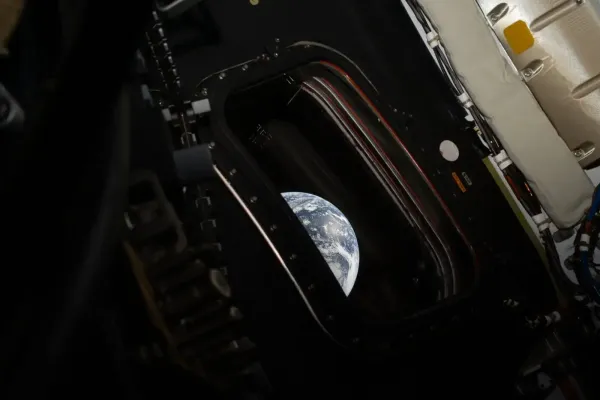
The images were captured following the successful completion of a trans-lunar injection burn early on Friday, which propelled the Orion spacecraft out of Earth’s orbit. The four astronauts aboard are travelling more than 200,000 miles towards the Moon.
Artemis II is currently on a looping trajectory that will take the crew around the far side of the Moon before returning to Earth. The mission marks the first time since 1972 that humans have travelled beyond Earth’s orbit.
For Artemis II, the Orion spacecraft is equipped with 31 cameras designed to capture the mission from multiple angles. These include external cameras mounted on the solar arrays and internal cabin cameras documenting crew activity. The imaging systems are expected to record key moments such as launch, solar array deployment and the spacecraft’s journey around the Moon.
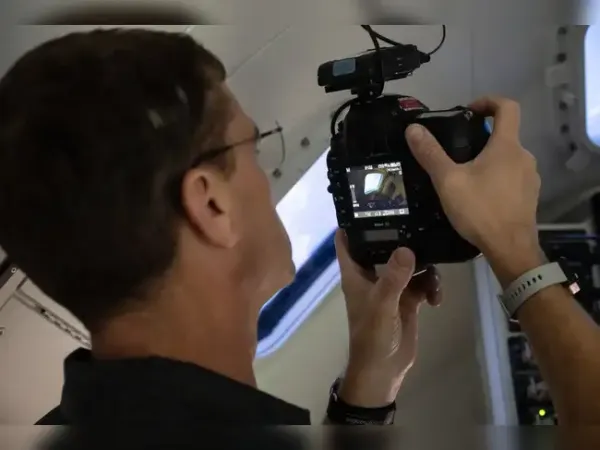
A dedicated optical navigation camera will photograph Earth and the Moon to help Orion determine its position in deep space. In addition, handheld Nikon Z9 cameras allow the crew to capture high-resolution images through the spacecraft windows.
The spacecraft is expected to pass the far side of the Moon on 6 April and return to Earth on 10 April.
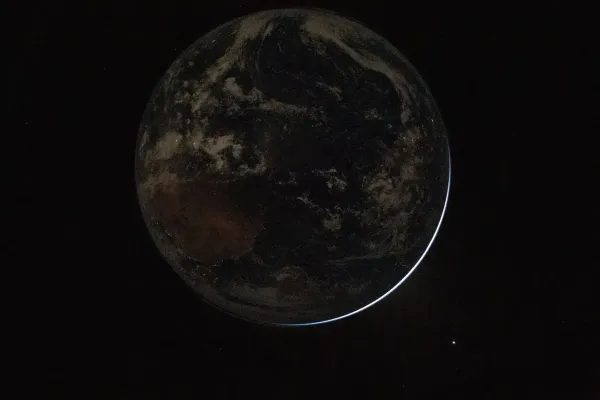
Additional images shared by Nasa show the contrast between Earth’s day and night sides, with visible electric lights from human activity. One image highlights the boundary between day and night, known as the terminator, cutting across the planet.
Nasa said two of the images were taken minutes apart, with differences in appearance attributed to camera settings. A longer shutter speed in one image captured more reflected light from Earth, while a shorter exposure in the other emphasised the planet’s night-time illumination.
According to Nasa, mission commander Reid Wiseman took the “spectacular” images after the crew completed a final engine burn that placed the spacecraft on a trajectory towards the Moon.
The first image, titled “Hello, World”, shows a vast expanse of the Atlantic Ocean, outlined by a thin atmospheric glow as Earth eclipses the Sun. Green auroras are visible at both poles. The planet appears inverted in the image, with the western Sahara and the Iberian Peninsula on the left, and the eastern part of South America on the right. A bright object identified by Nasa as Venus can be seen at the bottom right.
NASA on X: Good morning, world! We have spectacular new high-resolution images of our home planet, all of us looking back through the Orion capsule window at our Artemis II astronauts as they continue their journey to the Moon.
The images were captured following the successful completion of a trans-lunar injection burn early on Friday, which propelled the Orion spacecraft out of Earth’s orbit. The four astronauts aboard are travelling more than 200,000 miles towards the Moon.
Artemis II is currently on a looping trajectory that will take the crew around the far side of the Moon before returning to Earth. The mission marks the first time since 1972 that humans have travelled beyond Earth’s orbit.
For Artemis II, the Orion spacecraft is equipped with 31 cameras designed to capture the mission from multiple angles. These include external cameras mounted on the solar arrays and internal cabin cameras documenting crew activity. The imaging systems are expected to record key moments such as launch, solar array deployment and the spacecraft’s journey around the Moon.
A dedicated optical navigation camera will photograph Earth and the Moon to help Orion determine its position in deep space. In addition, handheld Nikon Z9 cameras allow the crew to capture high-resolution images through the spacecraft windows.
The spacecraft is expected to pass the far side of the Moon on 6 April and return to Earth on 10 April.
NASA: In this image of Earth taken by the Artemis II crew, we can see the electric lights of human activity. In the lower right, sunlight illuminates the limb of the planet.
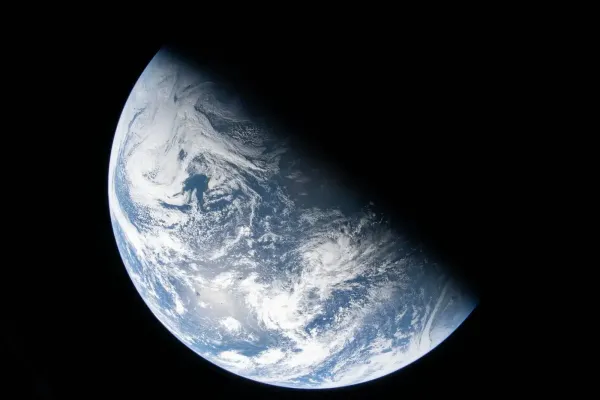
Additional images shared by Nasa show the contrast between Earth’s day and night sides, with visible electric lights from human activity. One image highlights the boundary between day and night, known as the terminator, cutting across the planet.
Nasa said two of the images were taken minutes apart, with differences in appearance attributed to camera settings. A longer shutter speed in one image captured more reflected light from Earth, while a shorter exposure in the other emphasised the planet’s night-time illumination.
In this image, also taken from the Orion capsule, we see the divide between night and day, known as the terminator, cutting across Earth. Whether awake or dreaming, we're all here on this planet together.