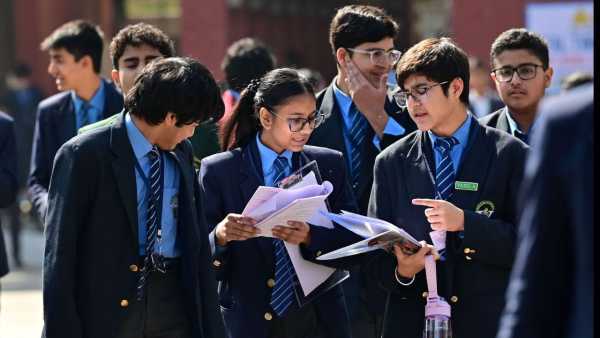
New Delhi: The Central Board of Secondary Education (CBSE) has introduced a third language from Class 6, starting this academic session (2026-27). The subject will be included in the Class 10 board examination by 2031 under a phased rollout of the three-language formula.
The new secondary school curriculum was released on Thursday, which will lay out a roadmap for 2031 and aligns with the National Education Policy, as per which the students have to learn three languages instead of two up to Class 10.
What’s three language formula?
Under the new scheme, the students will have to choose three languages: R1, R2 and R3. R1 will be the student’s primary language, R2 will be secondary, while R3 will be marked as a third language. As per the NCF-SE-2023 recommendations, out of the three, two have to be native languages.
Another addition is that the same language cannot be studied at multiple levels simultaneously. The third language will be added from Class 6 in 2026-27 session and will extend progressively to Class 10 by 2030-31.
CBSE Chairperson Rahul Singh clarified that the third language is not mandatory for students immediately. He said, “R3 level textbooks will be introduced in Class 6 this year. They will write their board exams in 2031, and that’s when the entire scheme will change, and the three-language formula will be entirely implemented.”
English to be treated as foreign language
The Board has listed 44 language options, which include all languages mentioned in the Eighth Schedule of the Constitution. A major shift includes English being added as a foreign language, which means that as per the three-language framework, a student cannot choose both English and a foreign language in Class 10 board exams.
The exam pattern is also set to be changed in phases. Singh said that the 2027 board exams will be the last as per the current language textbooks. In 2028, exams will be held for two days, one each for R1 and R2. From 2031 onwards, exams will be held over three days for R1, R2 and R3.
Two-level system for Mathematics and Science
Another major addition is the introduction of a two-level system for Mathematics and Science from the 2026-27 academic session. This will replace the current model for Class 9 students.
All students will be appearing for a common 3-hour, 80-mark examination. Those opting for higher proficiency will take an additional one-hour, 25-mark advanced paper, which will test higher-order thinking skills and conceptual understanding of the students.
The marks of the advanced paper will not get added to the overall aggregate score. Mr. Singh said, “For those who have cleared the advanced level, there will be a section in the marksheet with a description of the rubrics… Those who don’t clear it… there will be no mention.”
The first examination under this scheme will be held in 2028.
Other crucial changes
The addition of new compulsory areas at the secondary stage includes art education, vocational education and physical education. Other than this, Computational Thinking (CT) and Artificial Intelligence (AI) will also be introduced but in a phased manner, first as internally assessed modules and then as a compulsory board subject by 2029.
Social Sciences will see updated textbooks with more focus on competency-based learning. With the assessment pattern remaining similar, the practical approach will be added through case studies, map work and data analysis.
The Board will also offer 22 scheduled Indian languages in the Class 9 curriculum from this session. As per the information shared by CBSE Director Pragya Singh, the third-language textbooks will be developed in collaboration with NCERT. The relaxation has been given to CBSE board abroad which may offer one Indian language instead of two required in Indian schools.
Contact to : xlf550402@gmail.com
Copyright © boyuanhulian 2020 - 2023. All Right Reserved.