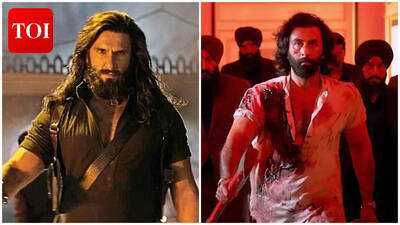
Ram Gopal Varma explains the difference between Ranveer Singh's Dhurandhar and Ranbir Kapoor's Animal: 'You don't look up to...'
Ram Gopal Varma has opened up about the impact of Aditya Dhar 's Dhurandhar and its sequel Dhurandhar: The Revenge starring Ranveer Singh , drawing a sharp comparison with Sandeep Reddy Vanga 's Animal starring Ranbir Kapoor and explaining why the former has left a deeper impression on him.
In a recent interaction with Galatta Plus, the filmmaker spoke about scale, storytelling, and how Dhurandhar 2 breaks conventional filmmaking patterns.
‘Animal is still within a template’Explaining the difference between the two films, Varma said, “See, the difference I’ll tell you... Animal is still another version of The Godfather. Instead of Michael Corleone, you have Ranbir Kapoor. It’s still a father-son story where the father is attacked and the son takes over. It’s within that template.”
“Dhurandhar... I don’t believe it is like that. The nearest example I can give is something on the scale of a James Bond kind of film,” he added.
‘Dhurandhar’s scale is too big’He further highlighted how scale plays a key role in setting the film apart. “Animal didn’t have that scale. The villains were more ordinary. The shock element was in the scenes and characterisation of Ranbir Kapoor. But Dhurandhar’s scale is too big,” he said.
‘You don’t look up to Animal’s hero, but you do to Hamza’Speaking about characterisation, Varma said, “Nobody will look up to Ranbir Kapoor in Animal. You enjoy his performance, you are shocked by what he does.”
“But characters like Shiva or Michael Corleone—you look up to them. Same thing with Hamza,” he added.
He emphasised that the protagonist in Dhurandhar stands out because of his understated nature. “Most of the time, Hamza doesn’t explain himself. You infer what he’s feeling... many times he’s just observing, not saying anything,” he said.
‘I couldn’t believe a big hero took this role’Varma also expressed surprise that a mainstream star chose such an internalised role. “I could not believe that a big hero would take up such a role which is so internalised,” he said.
Drawing a comparison with earlier eras, he added, “From Amitabh Bachchan’s time, even if there was internal anger, there were punchy dialogues explaining everything. Here, there are so many close-ups where you are left to interpret what the hero is feeling.”
‘You can’t get the brain of Aditya Dhar’Crediting director Aditya Dhar, Varma said the film’s impact stems from his vision.
“You can have tons of money, but where will you get Aditya? The nuances, the character detail, the emotional context—you cannot understand that on paper,” he said.
Recalling a scene, he added, “When he burns the photo of his wife and son, I got a lump in my throat. That is something you can never explain on paper.”
Varma also spoke about how the film redefines heroism. “Earlier, heroes didn’t show pain because fans wouldn’t like it. But here, when Hamza is stabbed, I’ve never seen such genuine pain in a hero. That realism makes you connect more,” he said.
‘It’s going to disrupt everything’Summing up his thoughts, Varma said the film will have a lasting impact on the industry.
“In one line—the difference is this: other filmmakers make what they think the audience wants to see. Aditya Dhar made what he wanted to tell,” he said, adding, “It’s going to disrupt everything.”
In a recent interaction with Galatta Plus, the filmmaker spoke about scale, storytelling, and how Dhurandhar 2 breaks conventional filmmaking patterns.
‘Animal is still within a template’Explaining the difference between the two films, Varma said, “See, the difference I’ll tell you... Animal is still another version of The Godfather. Instead of Michael Corleone, you have Ranbir Kapoor. It’s still a father-son story where the father is attacked and the son takes over. It’s within that template.”
“Dhurandhar... I don’t believe it is like that. The nearest example I can give is something on the scale of a James Bond kind of film,” he added.
‘Dhurandhar’s scale is too big’He further highlighted how scale plays a key role in setting the film apart. “Animal didn’t have that scale. The villains were more ordinary. The shock element was in the scenes and characterisation of Ranbir Kapoor. But Dhurandhar’s scale is too big,” he said.
‘You don’t look up to Animal’s hero, but you do to Hamza’Speaking about characterisation, Varma said, “Nobody will look up to Ranbir Kapoor in Animal. You enjoy his performance, you are shocked by what he does.”
“But characters like Shiva or Michael Corleone—you look up to them. Same thing with Hamza,” he added.
He emphasised that the protagonist in Dhurandhar stands out because of his understated nature. “Most of the time, Hamza doesn’t explain himself. You infer what he’s feeling... many times he’s just observing, not saying anything,” he said.
‘I couldn’t believe a big hero took this role’Varma also expressed surprise that a mainstream star chose such an internalised role. “I could not believe that a big hero would take up such a role which is so internalised,” he said.
Drawing a comparison with earlier eras, he added, “From Amitabh Bachchan’s time, even if there was internal anger, there were punchy dialogues explaining everything. Here, there are so many close-ups where you are left to interpret what the hero is feeling.”
‘You can’t get the brain of Aditya Dhar’Crediting director Aditya Dhar, Varma said the film’s impact stems from his vision.
“You can have tons of money, but where will you get Aditya? The nuances, the character detail, the emotional context—you cannot understand that on paper,” he said.
Recalling a scene, he added, “When he burns the photo of his wife and son, I got a lump in my throat. That is something you can never explain on paper.”
Varma also spoke about how the film redefines heroism. “Earlier, heroes didn’t show pain because fans wouldn’t like it. But here, when Hamza is stabbed, I’ve never seen such genuine pain in a hero. That realism makes you connect more,” he said.
‘It’s going to disrupt everything’Summing up his thoughts, Varma said the film will have a lasting impact on the industry.
“In one line—the difference is this: other filmmakers make what they think the audience wants to see. Aditya Dhar made what he wanted to tell,” he said, adding, “It’s going to disrupt everything.”
Contact to : xlf550402@gmail.com
Copyright © boyuanhulian 2020 - 2023. All Right Reserved.