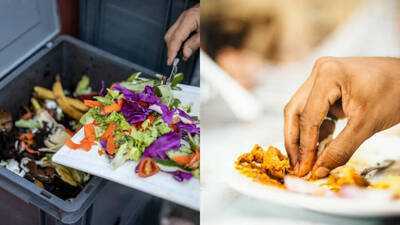
From north to south and east to west, garbage is a major problem on the streets, causing bad odors, unhygienic environments, and discomfort to people. But in a city within India, garbage is not a problem but a solution for hundreds of people, as it helps them run shops and, most importantly, feeds over 600 people daily. Wondering where and how? Scroll down to read the details.
In Hyderabad's Bowenpally market, garbage is not a problem but a resource for generating electricity and fuel. It is reported that this market turns waste into real impact, electricity, biogas, and fertilizer, powering shops and feeding 600 people daily. The Better India also reports that this market aids in plastic recycling and even solar cycling tracks.
According to reports, around 10 tons of fruit and vegetable waste are collected and sent to a biofuel plant. There, the waste is treated to produce almost 500 units of electricity, powering 170 shops, streetlights, water supply, and even cold storage. The residue from the biofuel production becomes fertilizer for local farmers.
The most interesting part of this waste-to-fuel conversion is that the unit produces 30 kg of biogas, which runs a canteen serving 10 varieties of breakfast to over 600 people, saving Rs 1.5 lakh every month.
What is a biofuel plant?
A biofuel plant is a facility where biological materials like crops, waste, or organic matter are processed to produce fuel that can replace petrol, diesel, or LPG. The plant used in Hyderabad was set up under the guidance of CSIR-IICT (Council of Scientific and Industrial Research–Indian Institute of Chemical Technology). Research at CSIR-IICT began in 2006 to find ways to produce biogas from vegetable, fruit, and food waste. By 2011, they had developed a patented technology that was tested on a small scale at various farms and kitchens across India. They later re-engineered the method to make it more efficient so it could handle a higher capacity of waste and produce more energy. The Department of Biotechnology picked up this project and provided a capital investment to set up the plant. The Department of Agriculture Marketing also supported the project and carried out the necessary civil work.
How does it work?
So, according to reports, everyday waste is first collected through hired teams on contract. This waste is then brought to a plant on the same premise and goes through a bio-methanation process. The waste is then shredded and soaked in a feed preparation tank, converting it into a slurry. This slurry undergoes an anaerobic bio-methanation process using a special culture (bacteria consortium). Finally, the biogas is collected in separate tanks and directed to the kitchen for cooking. The biofuel is supplied into a 100% biogas generator, which is used to power the water pumps, cold storage rooms, street, and shop lights.
Contact to : xlf550402@gmail.com
Copyright © boyuanhulian 2020 - 2023. All Right Reserved.