It’s always wise to make sure you’ll have everything you need when you go camping. While many view spending time in the great outdoors as an act of minimalism, no one likes heading home early because they failed to prepare. This is doubly true when it comes to backpacking, since you’ll be far away from any vehicles that might bring you back to civilization. You have to be even more precise about what you do and don’t bring in these situations, since everything you bring gets added to the weight of your pack. But what if you could make a bunch of the stuff you might want on your 3D printer?
It might seem odd to marry something as techy as 3D printing with something as decidedly non-techy as camping, but there are a lot of good reasons to consider making some of your camping supplies out of good ol’ filament. 3D printing can save you money, for one, which is nice because camping gear can be surprisingly expensive. It’s also very light. PLA, PETG, and ABS plastic are lightweight and easy to carry. Of course, you probably shouldn’t replace anything essential, or anything that needs to be able to take a beating with a 3D printed version, but there are a few great models that are free to download on sites like Thingiverse, Printables, and MakerWorld that could be useful for your next trek into the wilderness.
Tape Winder
You never expect to need duct tape when you’re backpacking, but it’s always good to have it on hand. You can use it to repair shoes and equipment, start a fire, or even to make a splint or dress a wound in a pinch. That said, a full roll of duct tape generally weighs about 1 to 2 pounds, which might be more than what you want to add to your pack.
Thingiverse user Zarquon made a simple little plastic Tape Winder specifically for backpacking that you can use to hold a more reasonable amount of tape, minimizing its weight while still offering a convenient means of adding the invaluable resource to your kit. “Typical hiker wisdom is to wrap [duct tape] around your water bottle, stove fuel, trekking pole, or similar item,” Zarquon said in his post. “After an experience last year where I wanted to just give my roll away to someone who was repairing stuff as I passed by, I decided to wind it around something I could hand off this year.” This makes it easy to carry multiple dedicated rolls while still keeping weight and space to a minimum.
Many of the comments on the post praised the simple utility of the device, while a handful of others were quick to suggest other potential applications for the winder. One claimed that they would add it to their everyday carry bag, while another suggested that the winder would also be useful for holding nylon rope. This is definitely the least complex addition to this list, but don’t let that fool you. Sometimes the simplest prints are the most reliable. This also makes it a perfect 3D printing project for beginners.
Grizzly Fishing Rod
Once your tent is set up and you’ve got everything you’ll need for your evening fire, you might want to do a little fishing. There are plenty of compact, telescoping fishing rods out there that you can buy, but wouldn’t it be fun to catch your dinner on a rod you 3D printed?
The Grizzly Fishing Rod by JH is currently available on MakerWorld. This is a redesign of his original Sharky Fishing Rod that has been recalibrated specifically to make it better suited to riverbed and lakeside fishing. The entire print is made to be completed without supports and assembled without the need for glue or screws. It does, however, use 6703 bearings in the wheel, which also have ratcheting teeth on one side for smoother reeling. There is also a loop on the rear where you can attach a carabiner (which you can also 3D print) to clip it onto a pack or belt loop. It has ISO-M10 standard threading for modular customization, a simplified line attachment mechanism, and an optimized axis design that places an inward groove along the cylinders to further smooth rotation.
This fishing rod has over 3,700 reported makes with over 400 comments on MakerWorld alone. “The reel spins very freely and reeled in this 26cm Bream like it was nothing!” one commenter said. “I might have to print a few more, so I have some pre-rigged options.” Dozens of the commenters also posted pictures of themselves with their catches, showcasing all kinds of different fish that they’ve caught on the little hand-held rod.
Backpacking Whistle
We always hope that our backpacking and camping trips will go well, but it pays to prepare for when things go wrong. One of the smallest, lightest, and most useful items you can add to your kit is a nice, loud whistle. These can scare away dangerous wildlife and serve as a signal that makes it easier for others to find you when you are lost or injured. Of course, there are an abundance of affordable whistles available in stores and online, but it’s important to get one that is both lightweight and loud enough that it can be heard from far away.
That’s why whistles are nearly always among the first prints to pop up when you search for camping and backpacking projects. The Mini Whistle by fifindr is a great choice if you want something so small as to be virtually weightless, offering 115 dB sound and weighing in at just 0.74 g. But those who want a bit more volume might want to try out the Extremely Loud Backpacking Whistle from FiveNights on Thingiverse. This whistle promises ~135 dB output with a randomized frequency. According to FiveNights, the whistle is so loud that ear protection is recommended when you use it.
A few commenters claimed that the whistle wasn’t as loud as they expected, but it’s worth noting that filament type, infill density, and print size can all affect the volume and frequency of the whistle. The vast majority found that it was extremely loud and were excited by its potential as an emergency tool. “I made two: one for my ice-spikes and one [for] my wilderness [backpack],” said one confirmed maker. “The whistle is extremely loud! This is great for emergency use or to scare off an animal.”
Automatic Paracord Rope Tensioner
Paracord has many uses when camping or backpacking. It can be used to make a ridgeline for a tent, a clothesline, a bag hoist to keep food out of the reach of bears, and a dozen other uses, many of which require you to be able to get the rope nice and tight. To do that, you’ll need a tensioner. These are available to buy, but it’s much more affordable for you to print your own.
The Automatic Paracord Rope Tensioner by firstgizmo is just such a tool. There are two different versions: The original, which requires you to use small bolts to attach the two halves with the roller in the middle, and a newer print-in-place version. “Attach the tensioner to something [rigid]feed the rope you want to be tensioned [through] the tensioner, and pull it to length. The friction will make the little roller turn and lock the rope in place.” The YouTuber 3D Printsmith did some stress testing for these tensioners and found that they could hold over 16 pounds of dead weight easily with no sign of slippage, though he did note that thinner rope might require you to print the tensioners at a smaller size. As a safety note, firstgizmo has stated that these are not intended for climbing or any other situation where a person would be in danger if the tensioner failed.
This print has over 300 makes and comments on Printables with a weighted rating that’s well over 4.5 stars. There are dozens of reports from users who claim to have used these tensioners successfully with several sizes of paracord.
Camping waste bin
One of the golden rules of camping is to leave no trace, meaning that any trash that goes into the wilderness with you needs to come back with you, too. It’s easy enough to just bring a trash bag, but that isn’t exactly the most structural solution. Then again, you don’t exactly want to be carting an entire waste bin into the woods either, do you? Sometimes the best 3D printing projects are the ones that solve everyday problems like this.
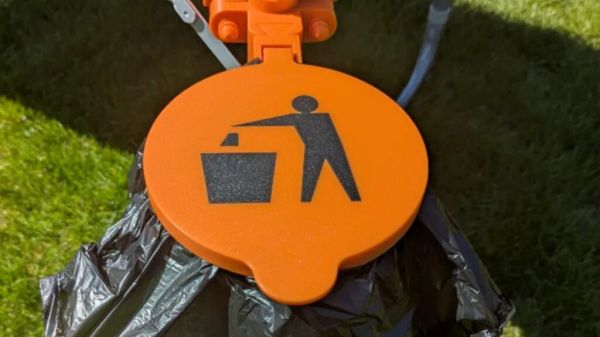
One creative solution is to print Dava’s Camping Waste Binwhich is designed to be attached to a folding table leg with a diameter that is between 22 and 28mm, using a set of twist-on clamps. This clamping mechanism supports a ring that holds a small trash bag and a lid that goes over the top, creating a small, portable waste disposal unit that provides structure, deters insects, and helps prevent the release of odors. There are several variations with different symbols on the lid, including the standard trash symbol, a recycling symbol, and one of a panda in a trash can.
This little project has 170 comments and likes on MakerWorld. “Game changer,” said one user. “Kept the bugs and dog from nosing around.” Some have noted that you’ll want to be sure to print it from a sturdy material with a high infill density, as it may end up supporting a fair amount of weight, but there are dozens of reports from users who used standard PLA and had great experiences as well. There are also multiple reports from makers who claimed to have successfully modified the print to accommodate larger and/or non-cylindrically shaped table legs.
Our methodology
In making this list, we wanted to find a selection of items that would be genuinely useful and of sufficient quality for backpacking. We started by searching Thingiverse, Printables, and MakerWorld for the most popular camping and backpacking projects. We filtered out results like tent stakes that were both cheap and readily available in sturdier materials, and focused on quality, lightweight items that add utility while boasting sufficient structural integrity for the tasks they’re intended for.
Once we had a few projects picked out, we examined their listings to make sure that they each had a reasonable number of successful prints and that makers were generally satisfied with the results. We shared details of the projects and user feedback, pointing out common complaints as well as potential modifications and alternate utilities in order to give readers a good idea of each print’s strengths and weaknesses.