The Delhi Economic Survey 2025-26, tabled in the Delhi Assembly on March 23, reveals a paradox at the heart of the city’s anti-pollution strategy.
Despite one of the largest vehicle removal campaigns ever attempted by an urban government, the number of motor vehicles on Delhi’s roads rose 7.93% to 8.76 million as of March 19, up from 8.12 million the year before.
The deregistrations stem from orders issued by India’s National Green Tribunal in 2014 and 2015, later upheld by the Supreme Court in 2018, banning diesel vehicles older than 10 years and petrol vehicles older than 15 years from operating in Delhi.
Vehicles that exceed these age limits automatically lose their registration and can no longer legally be driven on public roads. They must either be scrapped or transferred to states without age restrictions.
The policy has proven effective at removing older, dirtier engines. But it has done nothing to slow the flood of new purchases replacing them. For every vehicle deregistered and sent to a scrapyard, more than one new vehicle has been bought and registered.
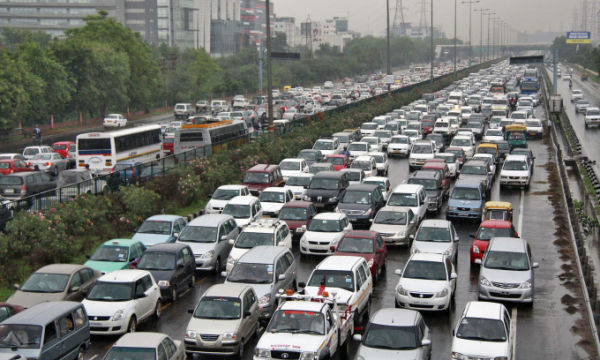
Heavy traffic moves along a busy road as it rains during a power-cut at the toll-gates at Gurgaon on the outskirts of New Delhi, India, July 31, 2012. Photo by Reuters |
Vehicle density has climbed to 522 motor vehicles per 1,000 residents, up from 484 a year earlier, the Economic Survey shows. Both figures are among the highest of any major city in India.
Two-wheelers drive the surge. Motorcycles and scooters account for 67.65% of all registered vehicles in Delhi, according to the survey, with 5.93 million on the road. They remain the cheapest and fastest way to navigate the city’s gridlocked streets. Cars and jeeps make up another 24%.
The reason so many residents keep buying private vehicles, the data suggests, is that public transport has failed to keep up. Buses and taxis showed limited growth compared to private vehicles, and the Delhi Transport Corporation’s average daily ridership actually fell from 2.56 million passengers in 2024-25 to 2.43 million in 2025-26, even as its fleet expanded to over 6,100 buses including thousands of new electric models.
The declining ridership, despite a larger and greener bus fleet, points to a deeper structural problem. Without public transport that is fast, frequent, and convenient enough to compete with a motorcycle, residents default to buying their own vehicles regardless of the policy environment.
The enforcement regime itself has been legally contested. In August 2025, the Supreme Court temporarily halted coercive action against overage vehicle owners after the Delhi government argued the blanket age-based ban was arbitrary and failed to account for actual emission levels or vehicle condition.
In December, the court partially reinstated enforcement but exempted vehicles meeting BS-IV or higher emission standards, effectively protecting newer-technology vehicles even if they exceed the age limits.
The mass deregistration campaign did briefly reduce Delhi’s total vehicle count once before. In 2021-22, the combined impact of the pandemic and aggressive enforcement brought the number down to around 7.92 million.
But the decline lasted barely a year. Vehicle numbers recovered steadily through 2023 and 2024 before hitting a new peak in early 2026.
Contact to : xlf550402@gmail.com
Copyright © boyuanhulian 2020 - 2023. All Right Reserved.