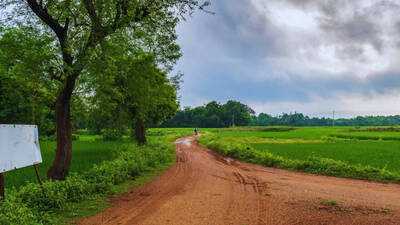
It doesn’t take long to realize that things are done differently here. For one, the place is clean, not because there is someone in charge of keeping it that way, but because people don’t make a mess. There is a sense of order, but it doesn’t feel forced. Not to mention, the facilities that you would associate with cities are here, but without the disorder that comes with them. If you stay here for a while, you will realize that this is not done to show development; this is just the way the place works.
In Adachiwadi, the village in Maharashtra’s Pune district, the scale is small enough that the concept of participation is applicable. With a population of 1,500 people, the systems are not anonymous; rather, they are shared. A good example of this is the cleanliness of the place. This is not maintained through periodic drives and pressure. People are involved in the maintenance of the place through regular participation. This has translated to the way of life, and this is what makes the difference.
The manner in which basic amenities are provided is another example of the same state of mind. There is a well-equipped gym available within the village, which can be availed for a monthly charge of INR 300. It is simply available for the residents to use. Similarly, the availability of clean drinking water has also been made convenient by the provision of a water ATM system. For a small charge, residents can access clean drinking water without depending on the vagaries of the water supply system. It is a small aspect, but it is a very relevant one.

The manner in which education is provided is another example of the same level of thinking. The classrooms are provided with tablets, which can be used by the students to avail of digital tools from a very early age. This is complemented by the provision of tuition classes, which can be used to ensure that the use of technology is actually made relevant to the students. This is also evident from the provision of WiFi services within the entire village, which can be used by the residents to go beyond the classroom.
The issue of safety is another area where planning and community awareness go hand in hand. There are CCTV cameras mounted at strategic points across the village, creating a network of surveillance that helps create a feeling of safety within the community. While the existence of the cameras might play a role, it is the awareness of the existence of the cameras that actually comes into play. It is not about the cameras, but about creating a space where people feel answerable to the surroundings.
Even the movement of people within the community is a testament to planning, as visitors are taken around the community in golf carts, making it easier to move about within the community without any hiccups. It is a small detail, but it points to a bigger fact—nothing is done haphazardly, everything is a part of a bigger picture.
But at the same time, Adachiwadi has not moved away from its rural background. Agriculture still plays a significant role in its economy. Similarly, daily life still revolves around familiar patterns. What has changed is not the foundation; what has changed is the manner in which the system has been developed around the foundation. Development here has not replaced what existed; it has only added to what existed.
What stands out, ultimately, is not any specific thing. It’s the consistency across different facets of life. Everything is clean, well-developed, and well-educated. But there’s no sense of excess, no sense of overstatement. Adachiwadi shows what happens when a community decides to get the fundamentals right and stays committed to this.
Contact to : xlf550402@gmail.com
Copyright © boyuanhulian 2020 - 2023. All Right Reserved.