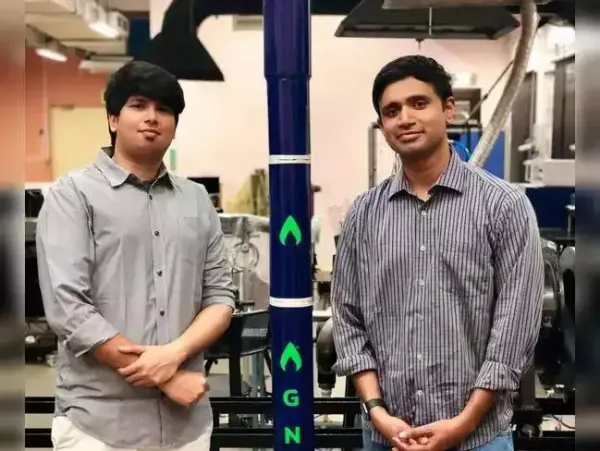
Spacetech startup Agnikul Cosmos has 3D printed and test-fired the largest single-piece rocket engine for the booster stage, as it moves closer to commercial launches.
The IIT Madras-incubated company said its engines can now be manufactured in just seven days, compared to six to seven months for traditional engines.
Cofounder and CEO Srinath Ravichandran said the engines are printed as a single piece without welding or assembly, significantly reducing complexity and timelines. “Traditional engines take months because you’re machining and assembling multiple parts. Ours prints in a few days,” he told ET, adding that the process cuts production timelines by as much as 90–97%.
Called Agnite, it is a one-metre-tall semi-cryogenic booster and the largest single-piece Inconel rocket engine built. It has been designed, manufactured, and test-fired at Agnikul's facility in Tamil Nadu. The company added that the approach improves repeatability and reduces failure points.
Agnikul is targeting a cadence of 25-30 launches a year, roughly one every 10 days, once operations stabilise. With the reuse of rocket stages, the startup expects to scale further.
On the demand side, the company said it is in talks with several satellite operators. “AI and space have gotten connected. Firms are investing hundreds of millions of dollars in building platforms in space,” Ravichandran said.
These include emerging areas such as space-based data centres, in-orbit manufacturing, and specialised R&D applications. Companies are exploring microgravity environments for pharmaceutical synthesis, advanced materials, and even space-based radiators for heat management. “These were earlier parts of satellites; now they are becoming independent industries,” he said.
Ravichandran said small launch vehicles are better positioned to serve this demand. “A small rocket is nimble; we can offer more customisation in pricing, waiting time, launch location, and orbital precision,” he said, adding that large rideshare missions are optimised for multiple payloads.
Agnikul Cosmos is backed by HDFC Bank, Chiratae Ventures, Speciale Invest, Mayfield India, Pi Ventures, and Celesta Capital. Recently, the Tamil Nadu Industrial Development Corporation (TIDCO) invested Rs 25 crore in the startup. In total, the startup has raised about $75.5 million in funding.
The company is currently preparing for its first orbital launch with Agnibaan, a small satellite launch vehicle, while also experimenting with a recoverable booster programme.
The IIT Madras-incubated company said its engines can now be manufactured in just seven days, compared to six to seven months for traditional engines.
Cofounder and CEO Srinath Ravichandran said the engines are printed as a single piece without welding or assembly, significantly reducing complexity and timelines. “Traditional engines take months because you’re machining and assembling multiple parts. Ours prints in a few days,” he told ET, adding that the process cuts production timelines by as much as 90–97%.
Called Agnite, it is a one-metre-tall semi-cryogenic booster and the largest single-piece Inconel rocket engine built. It has been designed, manufactured, and test-fired at Agnikul's facility in Tamil Nadu. The company added that the approach improves repeatability and reduces failure points.
Agnikul is targeting a cadence of 25-30 launches a year, roughly one every 10 days, once operations stabilise. With the reuse of rocket stages, the startup expects to scale further.
On the demand side, the company said it is in talks with several satellite operators. “AI and space have gotten connected. Firms are investing hundreds of millions of dollars in building platforms in space,” Ravichandran said.
These include emerging areas such as space-based data centres, in-orbit manufacturing, and specialised R&D applications. Companies are exploring microgravity environments for pharmaceutical synthesis, advanced materials, and even space-based radiators for heat management. “These were earlier parts of satellites; now they are becoming independent industries,” he said.
Ravichandran said small launch vehicles are better positioned to serve this demand. “A small rocket is nimble; we can offer more customisation in pricing, waiting time, launch location, and orbital precision,” he said, adding that large rideshare missions are optimised for multiple payloads.
Agnikul Cosmos is backed by HDFC Bank, Chiratae Ventures, Speciale Invest, Mayfield India, Pi Ventures, and Celesta Capital. Recently, the Tamil Nadu Industrial Development Corporation (TIDCO) invested Rs 25 crore in the startup. In total, the startup has raised about $75.5 million in funding.
The company is currently preparing for its first orbital launch with Agnibaan, a small satellite launch vehicle, while also experimenting with a recoverable booster programme.