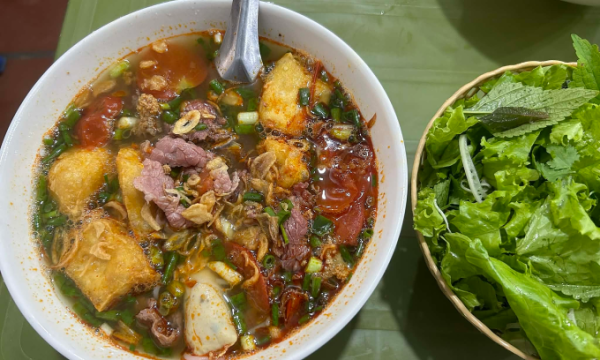
The issue was recently in the spotlight after a popular good luck (crab noodle soup) shop on Hang Luoc Street was forced to temporarily close down following complaints about its “filthy” conditions.
But some customers are unfazed.
Tuan Anh, a visitor from Ho Chi Minh City, said he would still return for the food’s taste even after learning about the eatery’s hygiene violations.
He is not alone.
Regular patrons often describe such eateries as “dirty but delicious,” reflecting a long-standing tolerance for poor sanitation, especially in Hanoi’s Old Quarter, where cramped spaces and heavy foot traffic make cleanliness hard to maintain.
Van Hung, a resident of Hanoi, said he stopped going to a favorite good luck eatery more than four years ago after finding cockroaches in his food.
Nevertheless he continues to eat at sidewalk stalls, where bowls and chopsticks are left out to dry, and considers such conditions “acceptable.”
However, attitudes are shifting among younger consumers.
Many now view hygiene as non-negotiable, rejecting restaurants with dirty kitchens, poor waste management or unsafe food handling practices.
Some say they rely on online reviews and avoid establishments flagged for sanitation issues.
Restaurant owners acknowledge the challenge.
Operators in the Old Quarter often struggle with limited space and high rents, making investments in modern hygiene systems unaffordable.
But some have begun upgrading facilities to meet the increasing expectations, particularly from younger customers and foreigners.
Bui Chi Thanh, the third-generation owner of Pho Thin Bo Ho, said the eatery’s former location on Dinh Tien Hoang Street appeared rundown due to its position in a narrow alley, and maintaining hygiene had been challenging.
He noted this is common across the Old Quarter, where many vendors operate in a traditional manner focused primarily on preserving flavors rather than sanitation.
After relocating to Hang Voi Street, he said he invested more than VND100 million (US$3,800) in hygiene upgrades, including an industrial dishwasher and a grease trap system to treat wastewater.
The new space of Pho Thin Bo Ho restaurant, November 2025. Photo by Read/Hoang Giang |
Thanh said younger customers now demand not only good food but also a clean dining environment, but acknowledged that such investments could be too expensive for many eateries.
Hoang Minh, who runs a small restaurant in Hoan Kiem Ward, said formal restaurants are better equipped to meet food safety standards than streetside vendors.
Minh said he rarely eats out after witnessing poor hygiene practices firsthand, recalling an incident in which a street vendor reused a discarded plastic cup for another customer.
Hung Kuma, who has more than two decades of experience in food and beverage industry, said the continued popularity of unhygienic eateries should not be seen as an indicator of good food but merely reflects habits entrenched for years among both sellers and customers.
“Customers are effectively condoning poor hygiene standards at restaurants. It is embarrassing that a foreign tourist complained about a well-known eatery on social media.”
Contact to : xlf550402@gmail.com
Copyright © boyuanhulian 2020 - 2023. All Right Reserved.