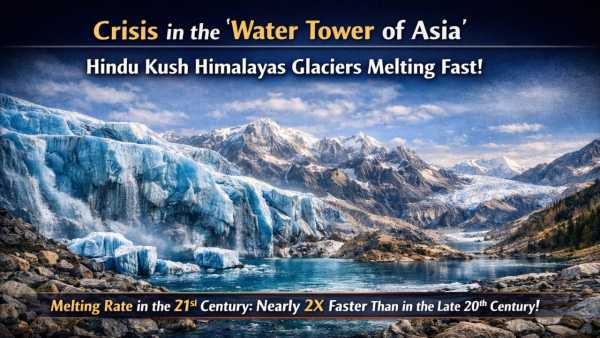
Dehradun: The glaciers of the Hindu Kush Himalayas (HKH), often called the “Water Tower of Asia,” are facing a serious crisis. A new study by the International Centre for Integrated Mountain Development (ICIMOD) has revealed alarming data about glacier shrinkage in the region.
The study analysed more than 63,000 glaciers across the HKH region. Between 1990 and 2020, the total glacier area decreased by around 12 percent, while ice reserves fell by nearly nine percent. Even more worrying, the rate of melting in the 21st century has nearly doubled compared to the late 20th century.
Rapid Decline After 2010
The report highlights that glacier shrinkage accelerated after 2010, especially in the eastern and central Himalayas. Smaller glaciers have been the worst affected, with many breaking into fragments or disappearing completely. This trend is dangerous because smaller glaciers are more vulnerable and melt faster.
Ice Thickness Reduced by 27 Meters
One of the most shocking findings is the reduction in ice thickness. Since 1975, glaciers have lost about 27 meters in thickness. This thinning of ice directly increases the rate of melting, making glaciers less stable and more prone to collapse.
Regional Variations
The study found differences across regions. The Karakoram range has remained relatively stable, but the Ganga and Brahmaputra basins have seen the greatest losses. Glacier area in the Ganga basin decreased by 21 percent, while the Brahmaputra basin lost 16 percent. These basins are crucial as they feed rivers that support millions of people.
Asia’s Water Tower in Danger
The Hindu Kush Himalayas are called Asia’s Water Tower because their rivers provide water to nearly two billion people. Glaciers act as natural reservoirs, releasing water during dry seasons. Their depletion threatens water availability, agriculture, and hydropower in the future.
Rising Hazards
The report warns that melting glaciers are increasing risks of disasters such as glacial lake outburst floods (GLOFs), landslides, and avalanches. Recent disasters in Sikkim and Uttarakhand are examples of how fragile the Himalayan ecosystem has become.
Causes of Rapid Melting
Experts point to rising temperatures and changing rainfall patterns as the main reasons. Glaciers below 5,500 meters are melting faster, while higher-altitude glaciers are relatively stable. Glaciers facing south and east are eroding more quickly due to stronger solar radiation.
Small Glaciers Most at Risk
Large glaciers are breaking into smaller fragments, which are more vulnerable to rapid melting. This fragmentation accelerates overall glacier loss and increases the risk of water shortages in the future.
Warning for the Future
If the current pace continues, experts warn of serious impacts on water supply, agriculture, and energy production. Millions of people across Asia could face water crises. The report stresses the need for strong policies, better monitoring, and regional cooperation to tackle this challenge.
Contact to : xlf550402@gmail.com
Copyright © boyuanhulian 2020 - 2023. All Right Reserved.