
Large deals are gaining momentum at mid-tier IT service providers in 2026, amid concerns over artificial intelligence (AI) tools disrupting traditional outsourcing models, as enterprises cast a wider net for large transformation projects.
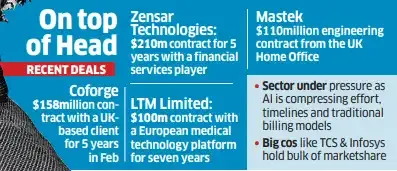
Coforge last month announced a $158 million contract with a UK-based client for five years, while Zensar Technologies landed a $210 million contract for five years with a financial services player.
Mastek secured a $110 million engineering contract from the UK Home Office. LTM Limited, too, signed a seven-year $100 million contract with a European medical technology platform focused on hearing solutions in February.
While these recent deal announcements are also a sign of market strength despite AI disruptions, industry experts said mid-caps are gaining better visibility because they are often faster, more verticalised and better positioned for the new AI-led, outcome-centric buying cycle.
“The sector is under pressure because AI is compressing effort, timelines and traditional billing models,” said Phil Fersht, chief executive of US-based IT advisory firm HfS Research. “At the same time, enterprises are still spending, but far more selectively, and they are directing that spend toward vendors that can move quickly, bring sharper domain context and package AI around measurable business outcomes.”
For instance, Coforge reported on its earnings call in January that it had clinched 16 large deals in the first three quarters of 2025-26. The company posted $593 million in order bookings for the third quarter, inking six large deals.
Persistent Systems reported total contract value (TCV) of $674.5 million for the third quarter of the fiscal, adding five large clients during the three months to December 2025, while Mphasis reported a TCV of $428 million, with four large deals.
Large incumbents such as Tata Consultancy Services and Infosys still capture much of the market share, especially among big transformation projects. For the third quarter, TCS reported an overall TCV of $9.3 billion and annualised AI services revenue of $1.8 billion, Infosys reported $4.8 billion in large deal TCV, while HCLTech reported $3.0 billion in new bookings.
However, analysts said smaller companies focus on the untapped mid-market segment, along with better agility to weather deflation risks from the launch of AI tools such as Anthropic’s Claude Cowork, ensuring they are better placed to grab such deals.
“The mid-caps are seen as more aligned with AI and hence are being favoured. Also, they are more focused on the mid-market, which has not had the same AI impact as the larger firms where the tier 1 service providers focus,” said Peter Bendor-Samuel, executive chairman of the US-based consultancy firm Everest Group.
Additionally, industry watchers pointed to a ‘flywheel’ effect, where winning a few such deals initially has drawn executives’ focus on grabbing more large-sized deals than before.
“Mid-sized companies have started getting invited to the bigger table now. They are winning a lot of the deals, which aren’t very strategic to the tier 1s, and go beyond classic transformation projects to projects like AI-wrappers, etc, which everyone wants to implement now,” said Praveen Bhadada, chief executive of consulting firm Neovay Global.
Analysts at ICICI Securities, in a note on March 16, upgraded the stock ratings of Coforge, Mphasis and LTM, citing their ability to quickly remodel their business and compete with incumbents in large multi-service line deals leveraging AI.
While the brokerage noted that there is minimal earnings downgrade risk, as AI-driven productivity gains are currently offset by new work volumes, in the case of a deflationary risk, where revenue growth for the industry would be around 1-2% in 2026-27 and 2027-28, they would prefer mid-cap companies.
“We note that AI-led productivity gains also provide opportunities for mid-sized and smaller peers to compete with larger incumbents in large managed services or multi-service line deals, leveraging a combination of human and agentic AI solutions. This would be cannibalisation of revenue for larger peers, but a net new opportunity for mid-sized and smaller peers,” the analysts said.
Coforge last month announced a $158 million contract with a UK-based client for five years, while Zensar Technologies landed a $210 million contract for five years with a financial services player.
Mastek secured a $110 million engineering contract from the UK Home Office. LTM Limited, too, signed a seven-year $100 million contract with a European medical technology platform focused on hearing solutions in February.
While these recent deal announcements are also a sign of market strength despite AI disruptions, industry experts said mid-caps are gaining better visibility because they are often faster, more verticalised and better positioned for the new AI-led, outcome-centric buying cycle.
“The sector is under pressure because AI is compressing effort, timelines and traditional billing models,” said Phil Fersht, chief executive of US-based IT advisory firm HfS Research. “At the same time, enterprises are still spending, but far more selectively, and they are directing that spend toward vendors that can move quickly, bring sharper domain context and package AI around measurable business outcomes.”
For instance, Coforge reported on its earnings call in January that it had clinched 16 large deals in the first three quarters of 2025-26. The company posted $593 million in order bookings for the third quarter, inking six large deals.
Persistent Systems reported total contract value (TCV) of $674.5 million for the third quarter of the fiscal, adding five large clients during the three months to December 2025, while Mphasis reported a TCV of $428 million, with four large deals.
Large incumbents such as Tata Consultancy Services and Infosys still capture much of the market share, especially among big transformation projects. For the third quarter, TCS reported an overall TCV of $9.3 billion and annualised AI services revenue of $1.8 billion, Infosys reported $4.8 billion in large deal TCV, while HCLTech reported $3.0 billion in new bookings.
However, analysts said smaller companies focus on the untapped mid-market segment, along with better agility to weather deflation risks from the launch of AI tools such as Anthropic’s Claude Cowork, ensuring they are better placed to grab such deals.
“The mid-caps are seen as more aligned with AI and hence are being favoured. Also, they are more focused on the mid-market, which has not had the same AI impact as the larger firms where the tier 1 service providers focus,” said Peter Bendor-Samuel, executive chairman of the US-based consultancy firm Everest Group.
Additionally, industry watchers pointed to a ‘flywheel’ effect, where winning a few such deals initially has drawn executives’ focus on grabbing more large-sized deals than before.
“Mid-sized companies have started getting invited to the bigger table now. They are winning a lot of the deals, which aren’t very strategic to the tier 1s, and go beyond classic transformation projects to projects like AI-wrappers, etc, which everyone wants to implement now,” said Praveen Bhadada, chief executive of consulting firm Neovay Global.
Analysts at ICICI Securities, in a note on March 16, upgraded the stock ratings of Coforge, Mphasis and LTM, citing their ability to quickly remodel their business and compete with incumbents in large multi-service line deals leveraging AI.
While the brokerage noted that there is minimal earnings downgrade risk, as AI-driven productivity gains are currently offset by new work volumes, in the case of a deflationary risk, where revenue growth for the industry would be around 1-2% in 2026-27 and 2027-28, they would prefer mid-cap companies.
“We note that AI-led productivity gains also provide opportunities for mid-sized and smaller peers to compete with larger incumbents in large managed services or multi-service line deals, leveraging a combination of human and agentic AI solutions. This would be cannibalisation of revenue for larger peers, but a net new opportunity for mid-sized and smaller peers,” the analysts said.