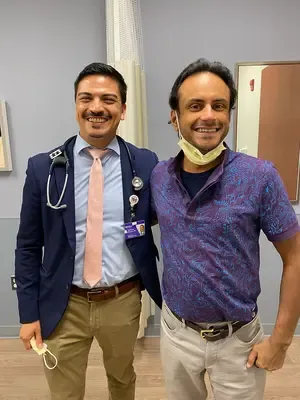
In 2023, as the city of Madison in Wisconsin, US, geared up to celebrate St. Patrick’s Day, Mahanth Joishy waited for news that could potentially upend his life. His lymph nodes had been swollen and painful for more than a week, and he was awaiting the results of a blood test and CT scan. He was 43, and brimming with plans: as the Superintendent of the City of Madison Fleet Service, he was laser focussed on making the city’s government fleet the best in North America and had won prestigious awards for his efforts. On the personal front, he had entered the dating world after a divorce and hoped to remarry one day.
Instead, a voicemail from his primary care doctor at UW Health University Hospital confirmed his worst fears: he had Stage IV lymphoma. Later, skin and lymph node biopsies pinpointed Sézary Syndrome, which is often described in medical circles as a “rare and aggressive form of cutaneous T-cell lymphoma”. “It operates on three levels,” he tells Wknd. during his recent visit to Dubai. “It’s in the blood, lymph glands and, most prominently, in the skin—that’s where most of the suffering comes in for patients.”
The first person he called after receiving the diagnosis was his father—a retired haematologist/oncologist, who was specialised in palliative medicine. Joishy realised the gravity of the situation when his parents decided to uproot their lives in California to shift to Wisconsin. “My father told me to not worry and that we were going to tackle this together.”
But how does someone—even if that person is backed by a family that’s largely composed of highly skilled doctors—beat a cancer that’s so uncommon that Cleveland Clinic’s website describes it as affecting only about 1 in 1 million people in the US annually? Joishy said his father, who’s worked for 50 years across the world—US, UAE, Saudi Arabia, UK, New Zealand—had never encountered a case of Sézary Syndrome first-hand. He did write a research paper on it in 1978 and that knowledge acted as ammunition in his battle with cancer.
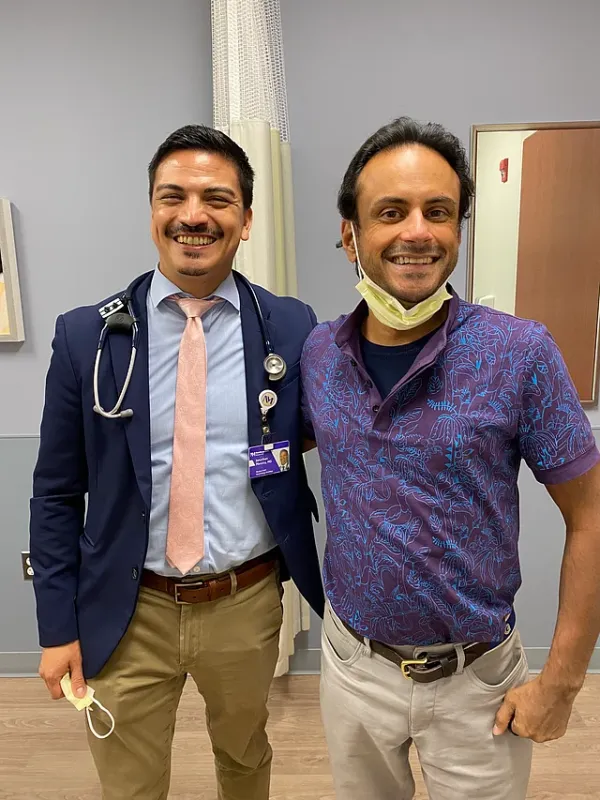
Joishy with Dr Jonathan Moreira (left), who oversaw his transplant and post-recovery at Northwestern University in Chicago
A medical mystery
“I’ve had rashes and skin problems for as long as I can remember,” Joishy recalls. “It would typically be in patches—either on my face, scalp, arms or legs—that would come and go, and usually improved with some treatments.” Sézary Syndrome is known to be particularly deceptive, as its symptoms may resemble common skin conditions like eczema. In Joishy’s case too, multiple dermatologists diagnosed it as eczema which is typically managed with medication, ointments and creams.
But as he grew older, the skin irritations got worse and by 2019, it had affected a large area of his body. “The itching was getting worse as well. But we still thought it was eczema and treated it as such,” he says. For the next couple of years, he tried Dupixent, a medication commonly prescribed for eczema. It was only when he noticed his swollen lymph nodes that he opted for further tests. Even today, Joishy is uncertain whether he ever had eczema. “Even my father, who has researched Sézary Syndrome as much as anyone in the world now in his retirement, is not sure. Is eczema a precursor to lymphoma, or did I ever even have eczema? Or, did I have both?” he wonders.
The healing journeyThe treatment plan was a gruelling cycle of trials, errors, complex tongue-twisting medications and therapies.
Joishy consulted a haematologist and began an aggressive form of chemotherapy almost immediately. He was also on the prescription medication Romidepsin which was effective in scorching the cancer cells but had side-effects like nausea, vomiting, diarrhoea, headaches, constipation, extreme fatigue, and a loss of the sense of taste. “I’ll never forget suddenly throwing up all over my desk in my office—I could not hold it in long enough to walk the 30 feet to the men’s room,” he recalls. “I had also thrown up all over the Wisconsin Capitol lawn while sightseeing with my friends visiting from Miami.”
It often felt like playing a morbid game of snakes and ladders—one hopeful step forward, two devastating steps back. He tried the oral medication Vorinostat for several months, but it was ineffective and even undid some of the progress. Extracorporeal photopheresis or ECP came next but after 22 sessions of the intensive treatment, they realised it wasn’t working either.
The tide finally turned with Mogamulizimab which, when especially combined with ECP, turned out to be the most effective treatment for Joishy. In 2024, he felt well enough to start thinking of undergoing a risky allogeneic bone marrow stem cell transplant although several doctors advised against it as his current treatment plan was working well. “But the problem with Mogamulizimab is that it might work for six months or even four or five years but the longer you do it, chances are less that a stem-cell transplant would be successful,” he says. Joishy didn’t want to spend the rest of his life looking over his shoulder.
After finding matching donors, he finally underwent the transplant in November 2024. Joishy was confined to the ICU, before and after the transplant, for therapies and treatments like chemotherapy, radiation, blood transfusions and platelet transfusions. He was also re-admitted twice later for kidney issues. “Graft-versus-host disease (where the donor cells attack the host’s cells) showed up a month after transplant and while it was very difficult, it was manageable,” he says. He had intense skin rashes and dry desquamation where, he says, his skin shed like a snake’s. “It was truly weird and disgusting but the new skin that came up underneath was perfect skin, which I still have 15 months later.”
Staying grateful
Joishy has been in remission for the past fifteen months. He says his battle with cancer was as much a test of his mental strength as it was of his physical strength. “I struggled a bit mentally to accept that this had happened to me at this age. But by October 2023, I had made peace with what was happening … Having an optimistic attitude became a matter of survival for me.”
He tackled those challenging months at the hospital by head-banging to heavy metal every day in the ward and walking inside, with his IV pole for company. “I was on the phone a lot with well-wishers, friends and relatives. I was watching movies. In fact, I watched one of the best movies I’ve ever seen in that period, Transformers One,” he grins, “It sounds cheesy, but it was somewhat inspiring to me.” He also wrote a lot, on his blog and social media, to document his healing journey. “You can’t control the numbers on your blood tests, or the side-effects you’re suffering,” he says. “But you can control your positivity and mindset.”
Throughout it all, he remained grateful for his circle of supportive friends, family, and colleagues, his formidable team of doctors from the University of Wisconsin–Madison and Northwestern University in Chicago as well as the strong health insurance and financial security that allowed him to take time off work.
He established the Sézary Syndrome Society in January 2025, with a volunteer board of 11 members, including doctors. The NGO has two major aims—to conduct medical research on this rare cancer and provide patient support. “One is to find a cure for this disease and come up with medication and treatments that are better,” he says. “We’ll need to do a lot of research, gather data, learn about the patients who have it and see whether there are any risk factors. Number two is, we’re raising funds to help patients around the world and provide support…”
Why Dubai expat who got cancer diagnosis on wedding anniversary chose robotic surgery One-year-old beats rare blood cancer after father’s bone marrow donationContact to : xlf550402@gmail.com
Copyright © boyuanhulian 2020 - 2023. All Right Reserved.