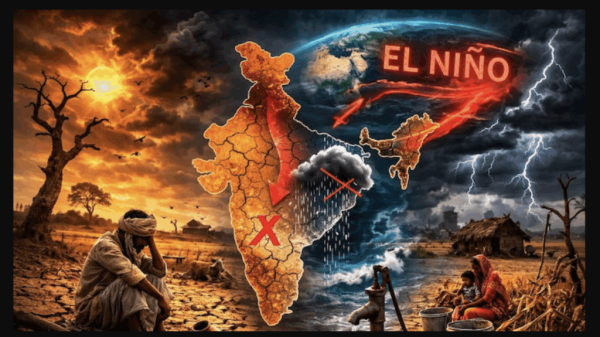
Climate scientists are sounding alarms that the planet may soon enter a powerful El Nino phase, one that could be among the strongest in recent decades. Fresh climate forecasts indicate that this event may develop later this year, carrying the potential to dramatically alter global weather patterns. For India, the implications are especially concerning, as the country may face intense heat and irregular monsoon behaviour.
New observations from the European Centre for Medium-Range Weather Forecasts suggest the likelihood of a strong or even “super” El Nino, with forecast models revealing ocean and atmospheric indicators beginning to align by June, a critical marker of the phenomenon’s emergence.
El Nino’s Intensifying Global Impact and India’s Rising Heat and Monsoon Risks
At the core of this event lies El Nino, a natural climate cycle driven by unusual warming of sea surface temperatures in the central and eastern Pacific Ocean. Normally, strong trade winds push warm surface waters toward Southeast Asia and Australia, while cooler waters rise near South America.
During El Nino, however, these winds weaken significantly, allowing warm water to spread eastward across the Pacific. This triggers major changes in global atmospheric circulation, with warm waters generating rising air and heavy rainfall over the central and eastern Pacific. Meanwhile, regions such as the Indian Ocean and parts of Africa experience sinking air that suppresses rainfall and increases temperatures.
Scientists note that the latest climate models display an “extremely classic” El Nino response, with strong rising air over the Pacific and descending air across the Indian Ocean region. Historically, these conditions have been linked to hotter temperatures and weaker monsoon rainfall in India. Because India’s summer monsoon depends heavily on land–ocean temperature differences, the altered atmospheric circulation during El Nino can weaken monsoon winds responsible for transporting moisture from the Arabian Sea and Bay of Bengal. If the projected strong El Nino forms, the risks of widespread heatwaves across northern and central India may rise sharply, along with concerns over a potential monsoon rainfall deficit. Past major El Nino events, such as those in 1997–98 and 2015–16, contributed to extreme global weather and temporary spikes in global temperatures. The new ECMWF forecast indicates that by June, ocean and atmospheric conditions may fully couple, reinforcing the phenomenon. Globally, the developing pattern may suppress Atlantic hurricanes and increase typhoon activity in the western Pacific. Although uncertainties remain, scientists agree that a strong El Nino is increasingly likely, with far-reaching effects in the months ahead.
Summary:
A potentially powerful El Nino may develop this year, with forecasts showing warming Pacific waters and shifting atmospheric patterns. India could face intense heat, weakened monsoon winds, and rainfall deficits. Past strong events caused global climate extremes, and current models indicate similar widespread impacts, including altered hurricane and typhoon activity worldwide.
Contact to : xlf550402@gmail.com
Copyright © boyuanhulian 2020 - 2023. All Right Reserved.