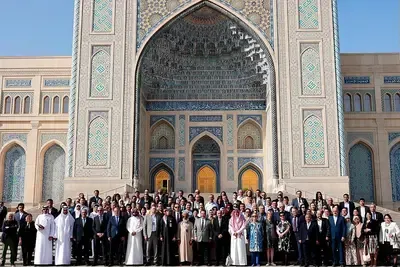
A new chapter in the celebration of Central Asia’s intellectual legacy begins in Tashkent, highlighting the region’s pivotal role in the advancement of global knowledge.
For centuries, the Silk Road was more than a trade route; it was a pathway for the exchange of ideas, culture, and scientific discoveries, many of which originated from the cities of modern-day Uzbekistan. Today, this tradition continues with the opening of the Islamic Civilization Center - a 10-hectare complex that honors the region’s rich Islamic culture, architectural wonders, and scholarly achievements.
Reviving a glorious heritage
At the heart of the Center’s exhibition hall lies one of the most revered treasures of the Islamic world: the Uthman Quran, a 7th-century manuscript that is one of the oldest surviving copies of the Quran, now preserved in UNESCO's Memory of the World Register. Alongside it is a fragment of the Kiswah, the silk cloth draped over the Kaaba in Mecca, Islam’s most sacred site. These priceless artifacts are displayed alongside over 2,000 manuscripts and relics returned to Uzbekistan as part of a special Presidential initiative for artifact repatriation. Sotheby’s, Christie's, museums, galleries, and private collectors all played key roles in uniting these items.
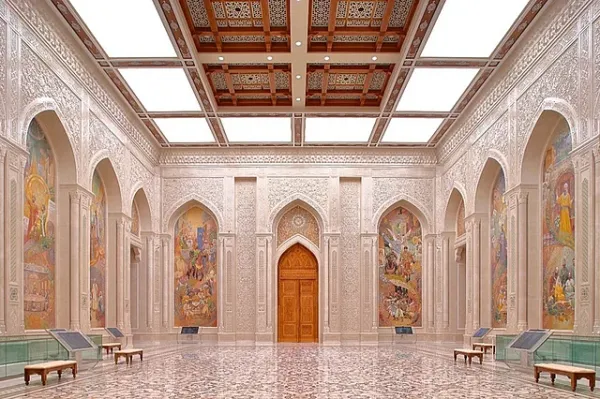
The exhibitions are organised under the theme "Civilizations – Personalities – Discoveries," spanning from the pre-Islamic era, through the First and Second Renaissances of Central Asia, and concluding with a section titled "New Uzbekistan - the Foundation of the Third Renaissance." One of the focal points is the Hall of Glory, where micro-mosaic compositions honor the scholars whose work shaped civilization beyond the region, including Al-Khwarizmi, the founder of algebra, Ibn Sina, whose medical encyclopedia guided generations of physicians, and Mirzo Ulugh Beg, whose star charts remained unsurpassed for over a century.
A bridge for dialogue and discovery
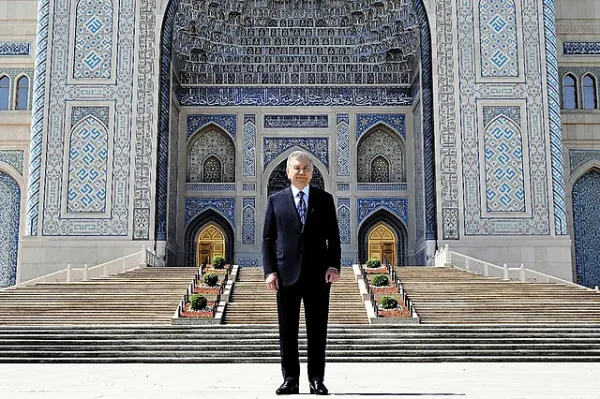
Designed in the timeless style of Timurid architecture, the Center is deeply connected to its cultural heritage. The four monumental portals represent the regions of Uzbekistan, while the facades are adorned with intricate tilework and calligraphy, showcasing centuries of craftsmanship.
Inside, the experience is modern, with immersive multimedia environments, AI-powered interactive installations, and three-dimensional reconstructions allowing visitors to journey through time. The complex also houses research facilities, restoration and digitisation laboratories, archival storage, and a library, positioning the Center as both a scholarly institution and a public museum.
More than 1,500 specialists from 40 countries contributed to the creation of this remarkable project. Much like the Mamun Academy in Khorezm or the Ulugh Beg Madrasah in Samarkand - institutions that once made Central Asia a beacon of intellectual achievement - the Islamic Civilization Center is poised to restore and pass on this intellectual heritage to the next generation.
Global recognition
The Islamic Civilization Center in Tashkent has already earned international acclaim. It has been featured in prestigious rankings by "Smithsonian Magazine," "BBC Travel," and "BBC History," further solidifying its position in the global museum landscape. This recognition, coupled with its inclusion in the list of "The Most Beautiful Museums in the World 2026" by the International Committee of the "Prix Versailles" award, underscores its significance on the world stage.
Firdavs Abdukhalikov, director of the Islamic Civilization Center, remarked: "For many years, our esteemed President envisioned the creation of a true center of enlightenment - a space that would remind the world of our people's tremendous contribution to global civilization. We are confident that this project will serve as a platform for cultural dialogue, bringing together scholars, researchers, and people of goodwill from all over the world."
A living symbol of revival
The opening of the Center coincides with the sacred month of Ramadan. In 2018, during this blessed month, the first stone was laid for this grand project. Now, after 8 years, the Islamic Civilization Center is set to open its doors, becoming a powerful symbol of the revival and preservation of Islamic cultural heritage for future generations.
Disclaimer: Any legal consequences arising from this activity will be sole responsibility of Linkopify. Khaleej Times shall not be held liable for any legal issues.
Contact to : xlf550402@gmail.com
Copyright © boyuanhulian 2020 - 2023. All Right Reserved.