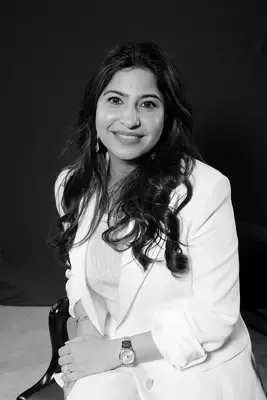
There are artists who create for expression, and others who create for purpose. Medha Nanda firmly belongs to the latter category, though her journey began, like many, with an instinctive love of creativity.
Formally trained in design, Nanda’s academic path took her from Pearl Academy in Delhi to the Royal Melbourne Institute of Technology (RMIT) in Australia, where discipline, structure, and technical mastery sharpened her creative voice. Yet, she is quick to note that her most meaningful education unfolded beyond the classroom: through travel, human connections, cultural exposure, and the quiet lessons learned in both success and failure. These lived experiences, more than any grade or qualification, continue to guide her approach to art, philanthropy, and purpose.
From fashion to fine art
Nanda’s professional career first flourished in the fashion industry. She launched her own private label, dressing film stars and leaders from business and political circles. But when she relocated to Dubai with her husband in 2013, something shifted. The city’s sense of safety, openness, and possibility offered her the freedom to think long-term — to slow down, reflect, and realign. Fashion gradually gave way to painting. And painting, in turn, became the conduit for something far larger than personal expression.
Medha Nanda
Nanda’s worldview was shaped early by everyday influences, including travel, friendships, and exposure to different perspectives. But one defining figure stands out: her grandmother. In a moment etched deeply into her memory, Nanda recalls her grandmother hospitalised, in severe pain after being attacked by a swarm of bees, choosing not to pray for herself but for the person in the next bed whose suffering was far less. That single act of selflessness reframed everything.
“It taught me that life is not about what we do for ourselves,” Nanda reflects, “but what we do beyond ourselves.”
Another quiet-yet-profound influence came not from a famous artwork, but from an art teacher, someone immensely talented who chose mentorship over recognition. Through him, Nanda learned that art’s true value lies not in applause, but in impact, generosity, and the ability to help others realise their dreams.
Art as a vehicle
That philosophy crystallised with the founding of ‘Art Be a Part’. What began with one simple intention of giving back soon evolved into a powerful movement bridging art and philanthropy.
The spark came from meeting an artist who relied on selling her work to survive, yet still chose to support a charitable cause. That act of generosity, despite limited means, revealed a gap Nanda couldn’t ignore: art and philanthropy often existed in parallel, rarely intersecting in a sustainable way. Art Be a Part was created to bridge that divide by supporting artists while transforming their work into a force for social good.
The platform builds a community rather than a traditional charity model. Artists, collectors, philanthropists, and supporters come together in a shared ecosystem of giving which is inclusive, human, and purpose-driven. As Nanda often says, “Alone, you may stand tall, but together, you stand strong.”
The spark
At the heart of Art Be a Part lies its flagship initiative, SpArK (Special Art for Kids), which supports equitable education for children with special needs in India through Dubai Cares, in partnership with UNICEF India.
For Nanda, this cause is deeply personal. Beyond access to education, SpArK addresses awareness and acceptance, particularly in rural communities where limited understanding of special needs can lead to fear, stigma, or exclusion. She recalls witnessing a child with special needs being physically restrained because the community did not know how to support them. The experience underscored a painful truth: education alone is not enough; empathy and understanding must follow.
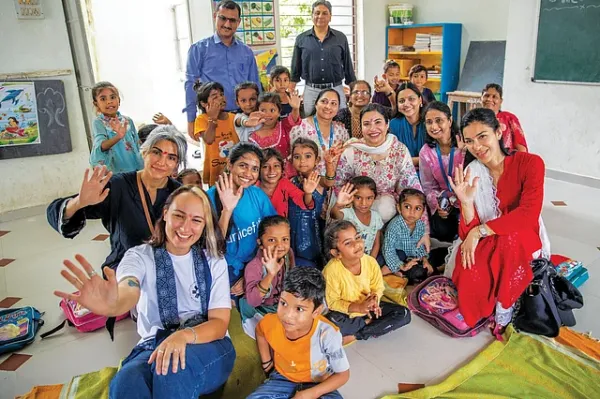
Art Be a Part founder & UNICEF India Champion for Children Medha Nanda, along with Advisory Board Member of Art be a part Namrata Shroff, and founder of Looking Glass FZE Rinku Awtani, pose for a group portrait with children & special educators
Art, Nanda believes, plays a vital role in reshaping this narrative. It creates lasting awareness, encourages compassion, and invites societies to move from exclusion toward inclusion.
That philosophy echoed powerfully in TAG25’s theme, ‘Beyond the Frame: Art and the Future of Inclusion’. For Nanda, inclusion is not a concept; it is a reality. “We are not different,” she says. “We are born the same way, our bodies function the same way, and we leave the world the same way.”
She likens humanity to the body itself: hands and feet may look different, but each is essential. The “frame,” in her view, represents the boxes society imposes. Inclusion begins when we step beyond them. Much like art, inclusion is subjective. The artwork does not change, but our experience of it does.
A night of impact
The Art Be a Part Gala 2025 marked a defining milestone, raising an extraordinary Dh2.5 million at the iconic Museum of the Future. Among the most unforgettable moments was the Dh1 million pledge by Mahmood Mazhar for a single artwork, an act that symbolised deep trust in the platform’s mission. While he received a piece of art, the true value lay in the lives that the contribution would touch.
From collaborating with artists, such as eL Seed and Lorenzo Quinn, to welcoming emerging voices, Nanda curates not by fame but by intention. What matters most is generosity and the shared belief that art can serve something beyond the self.
For Nanda, the gala is only the beginning. When the lights fade, the real work begins. By partnering closely with organisations that engage directly with government systems, Art Be a Part focuses on long-term, systemic change, ensuring inclusion is not a moment, but a future.
Dubai, she believes, has been instrumental in enabling this vision. With its efficiency, safety, and forward-thinking ecosystem, the city has created space for outward giving. Through Art Be a Part, she sees Dubai emerging as a global hub for purpose-driven art and philanthropy.
Redefining success
Leading a platform of this scale comes with pressure, but Nanda remains grounded in faith. “We are instruments,” she says. “Not the purpose itself.” Trusting in something larger allows her to release control and remain focused on service.
Her definition of success has evolved. It is no longer personal, but rather measured in impact. One moment stands out: during a field visit with UNICEF, a mother shared that she had never realised her child with special needs was capable of socialising until she witnessed true inclusion. For Nanda, changing even one life is success.
As Art Be a Part continues to grow, the future points toward thoughtful expansion — new geographies, including London, Delhi, and Mumbai; deeper community engagement; and broader causes, including support for children with special needs in emergency situations globally. Growth, she insists, must always be responsible and rooted in community.
For those who wish to give back but don’t know where to begin, Nanda offers simple advice: look within. “When people tell you how to do it, you follow instructions. When you look within, you follow your calling.”
And perhaps that is the essence of her work: a quiet but powerful belief that art has the power to transform lives, mindsets, behaviour, and ultimately, the world.
Motivational drumming in UAE: How music is driving emotional and workplace transformation UAE: Meet Syrian software engineer using digital art to promote inclusive designContact to : xlf550402@gmail.com
Copyright © boyuanhulian 2020 - 2023. All Right Reserved.