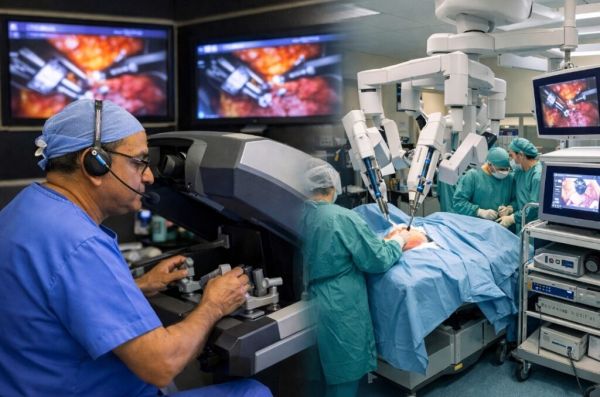
In a medical achievement that highlights how technology is reshaping modern healthcare, a surgeon in London has successfully carried out a complex cancer operation on a patient located roughly 1,500 miles away in Gibraltar. The procedure represents a significant development in the field of telesurgery and marks the first time a hospital in the United Kingdom has successfully performed a remote robot-assisted surgical operation on a patient in another location.
The procedure was conducted by Prokar Dasgupta, a specialist in robotic urological surgery based at The London Clinic. Operating from the clinic’s robotic surgery center in Harley Street, Dasgupta guided a robotic system to remove the cancerous prostate of a 62-year-old patient located at St Bernard’s Hospital.
The patient, Paul Buxton, underwent the operation without the surgeon being physically present in the operating room. Despite the large geographical distance between surgeon and patient, the procedure was completed successfully, demonstrating how robotic systems and high-speed communications can enable advanced surgical care across borders.
Advanced Robotic Technology Enabled the Operation
The surgery relied on the Toumai robotic surgical system, a sophisticated robotic platform designed to allow surgeons to perform operations with high levels of precision. The system includes multiple robotic arms that hold surgical instruments and a high-definition 3D camera that provides the surgeon with a detailed view of the surgical area.
From his console in London, Dasgupta controlled four robotic arms positioned over the patient in Gibraltar. The movements of his hands were translated into precise robotic actions, allowing him to perform the delicate steps required during a prostatectomy.
One of the most important technical aspects of the operation was the extremely low communication delay between the surgeon’s commands and the robotic system’s response. The latency between London and Gibraltar was reported to be around 60 milliseconds.
This minimal delay meant the robotic system reacted almost instantly to the surgeon’s movements. Such responsiveness is crucial during delicate surgical procedures, particularly cancer surgeries that require accurate and controlled movements.
With the technology functioning smoothly, the surgeon was able to perform the operation in a way that closely resembled traditional robotic surgery performed in the same room as the patient.
Local Medical Team Remained on Standby
Even though the procedure was carried out remotely, a medical team remained present in the operating theatre at St Bernard’s Hospital to ensure the patient’s safety.
Their role was to monitor the procedure, assist with preparation and equipment, and step in if any complications occurred. This included the possibility of technical disruptions such as connectivity issues between the two locations.
Remote surgery depends heavily on reliable communication networks. High-speed fiber-optic connections and backup systems such as 5G networks are often used to maintain a stable link between the surgeon and the robotic platform.
During this operation, the connection remained stable and the surgery proceeded without technical problems. The prostatectomy was completed successfully, demonstrating that the system could support complex surgical procedures across long distances.
Patient Avoids Long-Distance Travel for Treatment
For the patient, the availability of remote surgery offered a practical benefit. Buxton has lived in Gibraltar for about 40 years, and receiving specialized cancer treatment would normally require traveling abroad.
Patients in smaller territories or remote regions frequently need to travel to larger medical centers in cities such as London or Madrid when advanced procedures are required. This often involves significant travel expenses, logistical challenges, and extended periods away from home.
In this case, the new technology allowed the patient to undergo the surgery locally while still benefiting from the expertise of a highly experienced surgeon based in the United Kingdom.
By eliminating the need for long-distance travel, remote surgery has the potential to make specialized medical care more accessible to patients who live far from major healthcare hubs.
Telesurgery Has Been Explored for Decades
While the procedure represents a first for the United Kingdom, remote robotic surgery has been explored internationally for several years.
One of the earliest landmark demonstrations occurred in 2001 during an operation widely known as the Lindbergh Operation. During that procedure, surgeons located in New York used robotic technology to remove a patient’s gallbladder in Strasbourg, France.
The success of that operation showed that surgery across long distances was technically possible. However, limitations in network speeds and reliability meant that the technology remained largely experimental for many years.
Recent improvements in robotics, imaging systems, and telecommunications infrastructure have made telesurgery increasingly practical. In 2024, for example, surgeons successfully conducted a robotic prostate operation between Rome and Beijing, highlighting how modern networks can support long-distance surgical procedures.
Similar operations using the Toumai robotic system have also been carried out in parts of Africa, demonstrating the growing international interest in remote surgical care.
Expanding Access to Specialized Surgeons
Medical experts believe that telesurgery could eventually play a significant role in improving access to healthcare. In many parts of the world, specialized surgeons are concentrated in large urban hospitals, leaving smaller communities with limited access to advanced procedures.
Remote robotic surgery could help bridge this gap by allowing surgeons to perform operations from centralized facilities while patients remain in local hospitals.
Such an approach could reduce travel burdens for patients and make it easier for hospitals in remote regions to provide advanced treatments. In theory, a single specialist could assist multiple hospitals located in different regions or even different countries.
This could be particularly valuable in areas where access to highly trained surgical specialists is limited.
Contact to : xlf550402@gmail.com
Copyright © boyuanhulian 2020 - 2023. All Right Reserved.