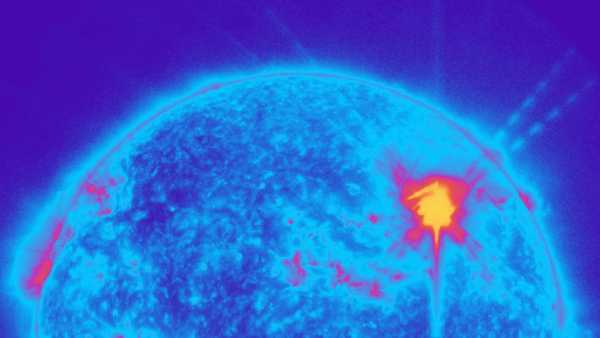
New Delhi: In May 2024, the Earth was hit by the most severe solar storm in over 20 years, resulting in spectacular polar lights. This storm also struck Mars, where two orbiters of the European Space Agency, Mars Express and the ExoMars Trace Gas Orbiter (TGO) were suitably positioned to track the impact of the solar storm on the Red Planet. The radiation monitor on the TGO picked up a dose equivalent of 200 normal days over a period of just 64 hours. A paper describing the response of the tenuous atmosphere of the Red Planet to the solar storm has been published in Nature Communications.
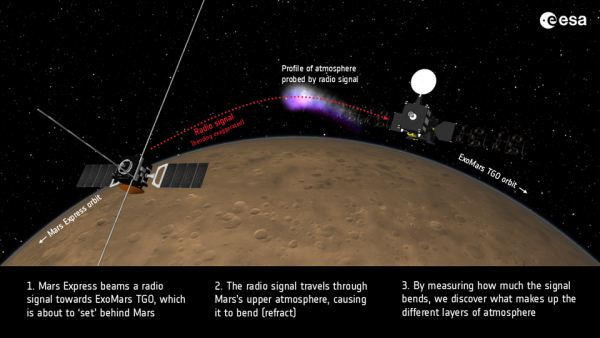
To assess the impact of the solar storm on Mars, the researchers used a new technique called radio occultation. Mars Express beamed a radio signal to TGO just as it vanished beyond the horizon. This radio signal was refracted by the various layers of the atmosphere before being picked up by TGO, allowing the orbiter to better understand each layer. Observations by NASA’s Maven mission was used to confirm the measured electron densities. The changes to the atmosphere influenced how radio signals travel through space, and a saturation of electrons in the upper atmosphere can block signals to the surface, which needs to be factored in while planning future missions to the Red Planet.
Remarkable Impact
Lead author of the study, Jacob Parrott explains, “The impact was remarkable: Mars’s upper atmosphere was flooded by electrons. It was the biggest response to a solar storm we’ve ever seen at Mars. The storm also caused computer errors for both orbiters – a typical peril of space weather, as the particles involved are so energetic and hard to predict. Luckily, the spacecraft were designed with this in mind, and built with radiation-resistant components and specific systems for detecting and fixing these errors. They recovered fast.” The orbiters recorded the most electrons in distinct layers of the Martian Atmosphere.
Contact to : xlf550402@gmail.com
Copyright © boyuanhulian 2020 - 2023. All Right Reserved.