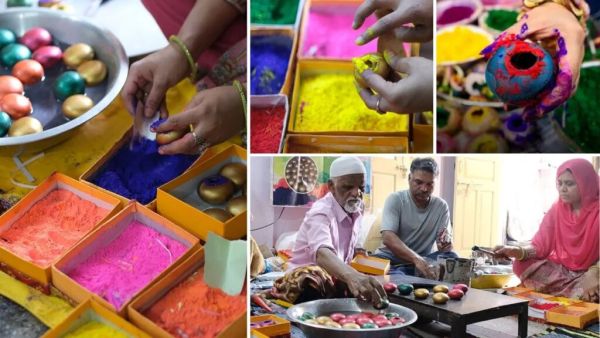
New Delhi: In Jaipur, Holi comes alive not just with colours, but through centuries-old craftsmanship that reflects royal heritage with festive joy. The city’s famed gulal gota, which is delicate lac balls filled with vibrant gulal powder, originated in royal courts nearly 300 years ago and remains a symbol of Rajasthan’s refined celebration. Crafted painstakingly by skilled Manihar artisans, each gota is shaped from molten lac, filled by hand, and sealed to burst safely, reflecting generations of knowledge and care.
Unlike modern synthetic props, these fragile spheres connect players to a history of patience, artistry, and devotion. As Jaipur’s markets bustle with preparation, workshops echo with the quiet rhythm of shaping, filling, and perfecting each gota. The tradition is more than festive play. It sustains artisan communities, preserves regional craft, and carries the city’s royal legacy into contemporary celebrations, offering a Holi experience steeped in heritage, colour, and craftsmanship.
Gulal gota history and other aspects
Gulal gota: Traditional Holi accessory
Gulal gota is a traditional Holi accessory unique to Jaipur. These small, hollow balls are made from lac and filled with dry gulal powder. Instead of splashing water or using plastic balloons, revellers gently throw these shells, which burst on contact and release a soft cloud of colour.
The craft resembles the making of lac bangles but requires greater precision. Artisans handle heated lac, shaping it into thin, fragile spheres. The process is physically demanding, often leaving hands bruised from working with molten material. Each piece is handmade and produced in limited numbers, especially in the weeks leading up to Holi.
Making of gulal gota
The making of gulal gota follows a careful, step-by-step method:
- Lac is heated until it becomes soft and pliable.
- While still warm, it is shaped into hollow shells using a blowing pipe.
- The shells are cooled in water to harden.
- Each sphere is filled by hand with dry gulal powder, measured to burst safely.
- The opening is sealed with coloured paper.
Production begins nearly a month before Holi, with Manihar households and workshops focusing on preparation. The craft is neither mechanised nor rushed, relying entirely on manual skill.
History of gulal gotas
The origins of gulal gotas trace back 300 to 400 years to the Jaipur royal family, who favoured this refined way of celebrating Holi. The Manihar community, Muslim artisans of the city, have preserved the practice across generations. Today, government-issued artisan cards provide access to welfare schemes, and efforts are underway to secure a Geographical Indication tag to safeguard the craft’s regional identity.
Celebration of gulal gotas today
As Holi approaches, Jaipur’s markets display ‘Rajwadi gulal gota’, once associated with royalty but now accessible to all. Demand rises weeks in advance, with orders arriving from across India and overseas. Over the past decade, wider visibility through social media platforms has introduced new audiences to this heritage craft, renewing interest in Jaipur’s enduring artistry.
In every fragile lac shell lies a story of shared tradition, skilled labour and a celebration that goes beyond colour, connecting present-day festivities with centuries of craftsmanship.
Contact to : xlf550402@gmail.com
Copyright © boyuanhulian 2020 - 2023. All Right Reserved.