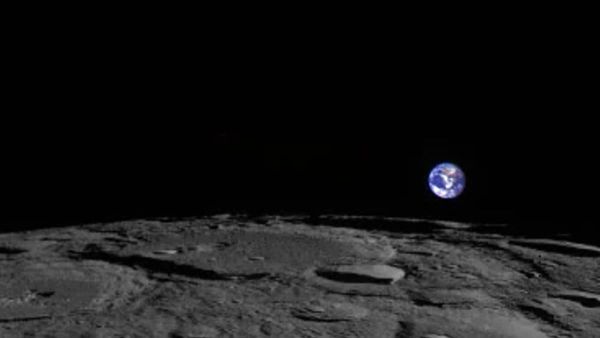
Lunar Orbit: While sky watchers on Earth recently watched the Moon turn a deep red colour during a total lunar eclipse, NASA’s Lunar Reconnaissance Orbiter (LRO) captured the event from a much different perspective.
In a stunning new data visualisation, NASA has revealed what a lunar eclipse looks like from the lunar surface: a four-hour "solar blackout" where Earth replaces the Sun in the sky.
From the Moon, a lunar eclipse looks like a total solar eclipse, but it lasts a LOT longer. For NASA's Lunar Reconnaissance Orbiter, that means the team has to plan carefully for the 4 hours that the spacecraft — and its solar panels — will be in the dark and the cold.
— NASA Solar System (@NASASolarSystem) March 2, 2026
??
1/3 pic.twitter.com/equoMRL6Gm
A Solar Eclipse in Reverse
To an observer on the Moon, a lunar eclipse is actually a solar eclipse.
As the Earth passes directly between the Sun and the Moon, it appears as a dark disk rimmed by a brilliant, fiery red ring.
This ring is caused by the Earth’s atmosphere bending and filtering sunlight, essentially projecting every sunrise and sunset on the planet simultaneously onto the lunar landscape.
Science in the Dark
The event is more than just a visual spectacle; it is a critical window for lunar science.
During the blackout, the Moon’s surface temperature plummets with terrifying speed, dropping nearly 280° Fahrenheit (138° C) in a matter of minutes.
NASA uses the Diviner Lunar Radiometer aboard the LRO to monitor this rapid cooling.
Because different materials, such as fine dust versus large boulders, cool at different rates, this thermal shock allows scientists to map the composition of the lunar soil (regolith) in ways that are impossible under normal lighting.
"The rapid cooling gives us a view of how the top few centimetres of the surface respond differently than during a normal 14-day lunar night," explained Dr Noah Petro, LRO Project Scientist.
Surviving the Blackout
For the LRO itself, the eclipse is a test of endurance. The spacecraft is solar-powered, meaning a four-hour blackout forces it to rely entirely on its internal batteries.
To conserve energy, the flight operations team at NASA’s Goddard Space Flight Centre typically shuts down most instruments, leaving only the Diviner and essential heaters running.
This latest LRO data previews the challenges future lunar colonists will face.
Understanding how the Moon’s environment undergoes sudden, extreme temperature changes is vital for designing habitats and technology that can survive the long, cold lunar night and the occasional Earth's shadow.
Contact to : xlf550402@gmail.com
Copyright © boyuanhulian 2020 - 2023. All Right Reserved.