SUMMARY
On a yearly basis, Ola Electric’s sales declined over 84% in February to 3,968 units
Bajaj Auto is slowly trying to close the gap with TVS Motor, as its registrations saw only a marginal 1.5% MoM decline in February
The third largest E2W manufacturer, Ather Energy, also saw a 7% MoM decline in sales to 20,584 E2W units
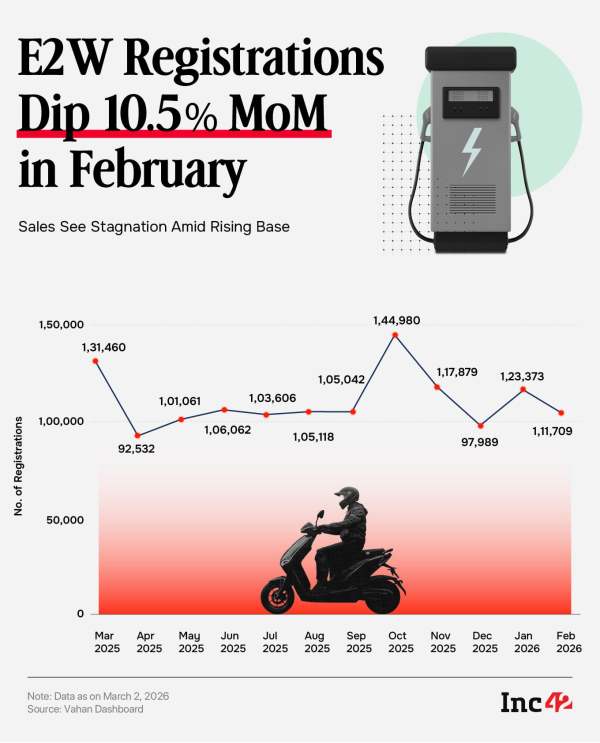
Ola Electric slipped further to the sixth spot in terms of market share in the electric two-wheeler (E2W) market in February after its registrations slumped 47% to 3,968 units from 7,531 units in January. This came amid a broader decline in E2W registrations in February, which slipped 9% to 1.12 Lakh units from 1.23 Lakh units in Januaryaccording to vehicle data.
On a yearly basis, Ola Electric’s sales declined over 84%, as consumer trust in the brand continues to erode on the back of lacklustre after-sales services. Notably, the company launched ‘Ola Insiders’ programme last week to provide structured benefits for vehicle upgrades, additional purchases and referrals.
Nevertheless, Ola Electric now ranks below Greaves Electric Vehicles, which sells the Ampere brand of escooters. In February, Greaves sold 4,724 units, down 11.5% from 5,341 units registered in January. During the month, Greaves expanded its presence to Nepal by launching its flagship Ampere Nexus scooter in the country.
Other players retained their previous positions in terms of E2W sales, with automotive giant TVS Motor taking the top spot yet again. However, its registrations fell 9% to 31,614 units in February from 34,742 units in January.
Meanwhile, legacy automaker Bajaj Auto is slowly trying to close the gap with TVS Motor, as its registrations saw only a marginal 1.5% MoM decline in February. During the month, Bajaj Auto saw registrations of 25,328 units as against 25,721 units in January.
The third largest E2W manufacturer, Ather Energy, also saw a 7% MoM decline in registrations in February to 20,584 units as against 22,131 units in January.
EV Makers Feel Pressure
After a roaring few years for India’s EV ecosystem, buoyed by subsidies and interest in the new vehicle format, registration numbers have started to show pressure in recent months.
Multiple reasons can be attributed to this, including the rising base of EV users. The accelerated adoption seen in the last few years has comparatively slowed in recent months as initial euphoria fades. This has been combined with decrease in subsidies, which was a key factor behind early adoption.
The second iteration of the government’s flagship faster adoption and manufacturing of electric vehicles (FAME) scheme ended in 2024 under which ₹11,500 Cr were allocated for manufacturers and consumers. At the same time, schemes of state governments to promote EV adoption have also come under scrutiny.
Recently, Bajaj Auto’s managing director Rajiv Bajaj criticised Maharashtra’s EV policy, claiming that the company has received only a tiny fraction of its promised dues, and it is unclear whether the remaining amount would be disbursed. The decline in subsidies and sales momentum has also led to many smaller EV retailers dropping off the charts.
Contact to : xlf550402@gmail.com
Copyright © boyuanhulian 2020 - 2023. All Right Reserved.