
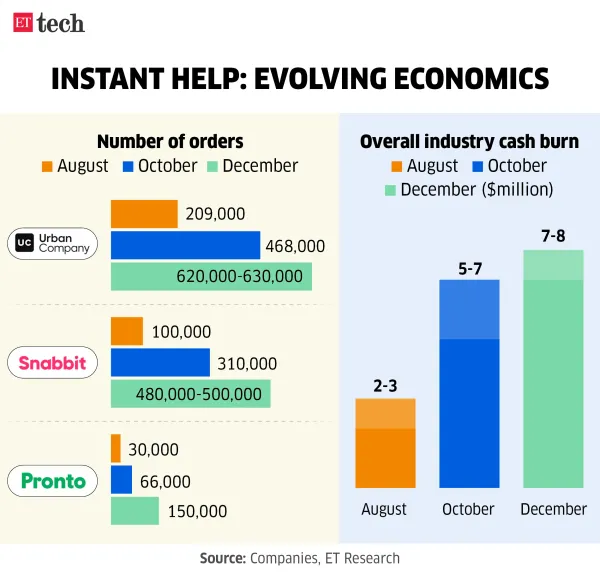
Instant house help startup Snabbit has clocked 830,000 orders in February, up from about 500,000 in December, its founder and CEO Aayush Agarwal told ET. He said that in February, new users comprised about 20-25% of the firm’s monthly transacting users (MTUs) as the company went deeper into its existing markets of Delhi-NCR, Pune, Bengaluru, and Mumbai.
MTUs represent the number of unique users who complete at least one paid transaction on a platform in a month.
“What’s important is that this growth hasn’t come from aggressively expanding into new micro-markets. We’re still operating in a relatively small footprint. In fact, some of our core markets are now touching around 1,500 jobs on peak days,” Agarwal said.
He added that compared to 87 micro markets in December, Lightspeed and Nexus Venture Partners-backed Snabbit is now present in around 108 such hyperlocal markets.
On February 23, Snabbit's rival Urban Company crossed the 50,000-daily bookings mark while Pronto crossed the 15,000-orders mark. For both, these were peak day metrics and not average daily numbers.
The instant help segment is a part of the overall home services industry, which was valued at $60 billion in FY25 and is expected to reach $100 billion by FY30, a recent report by brokerage firm Jefferies noted. The industry spans categories such as beauty and wellness, home repairs, cleaning, and renovations.
“We’re seeing a clear shift in consumer behaviour. Certain cohorts, especially bachelors and young couples, are choosing the convenience of on-demand home services over the effort and uncertainty of finding and hiring full-time help themselves. This is leading to (order) frequency on the platform increasing for repeat customers, where we don't have to spend a lot to retain them.,” Agarwal said.
“A large share of the growth is coming from existing markets, which continue to deepen and grow steadily. That’s encouraging not just from a scale perspective, but also from a profitability standpoint, as supply utilisation increases as a result of micromarket densification. Our mature micromarkets are now operating at 55-60% utilisation consistently with weekends touching higher numbers,” he added.
Competition in the space has been intensifying among the top three players with companies increasingly burning cash to acquire new customers as they enter new markets. ET had reported earlier that between August and December 2025, the industry’s cash burn had more than doubled from $2-3 million to $7-8 million a month.
In January, as the sector heated up, Accel-backed startup Pync, which was building a house help service in Bengaluru, shut down. Its founders joined Snabbit in senior roles across operations and business functions.
MTUs represent the number of unique users who complete at least one paid transaction on a platform in a month.
“What’s important is that this growth hasn’t come from aggressively expanding into new micro-markets. We’re still operating in a relatively small footprint. In fact, some of our core markets are now touching around 1,500 jobs on peak days,” Agarwal said.
He added that compared to 87 micro markets in December, Lightspeed and Nexus Venture Partners-backed Snabbit is now present in around 108 such hyperlocal markets.
On February 23, Snabbit's rival Urban Company crossed the 50,000-daily bookings mark while Pronto crossed the 15,000-orders mark. For both, these were peak day metrics and not average daily numbers.
The instant help segment is a part of the overall home services industry, which was valued at $60 billion in FY25 and is expected to reach $100 billion by FY30, a recent report by brokerage firm Jefferies noted. The industry spans categories such as beauty and wellness, home repairs, cleaning, and renovations.
“We’re seeing a clear shift in consumer behaviour. Certain cohorts, especially bachelors and young couples, are choosing the convenience of on-demand home services over the effort and uncertainty of finding and hiring full-time help themselves. This is leading to (order) frequency on the platform increasing for repeat customers, where we don't have to spend a lot to retain them.,” Agarwal said.
“A large share of the growth is coming from existing markets, which continue to deepen and grow steadily. That’s encouraging not just from a scale perspective, but also from a profitability standpoint, as supply utilisation increases as a result of micromarket densification. Our mature micromarkets are now operating at 55-60% utilisation consistently with weekends touching higher numbers,” he added.
Competition in the space has been intensifying among the top three players with companies increasingly burning cash to acquire new customers as they enter new markets. ET had reported earlier that between August and December 2025, the industry’s cash burn had more than doubled from $2-3 million to $7-8 million a month.
In January, as the sector heated up, Accel-backed startup Pync, which was building a house help service in Bengaluru, shut down. Its founders joined Snabbit in senior roles across operations and business functions.