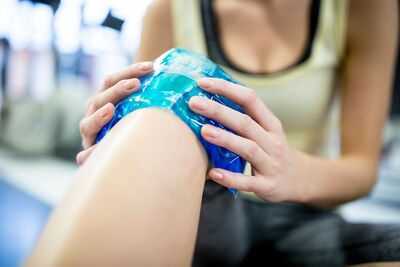
If you've suffered painful injuries in the past, no doubt your loved ones will have told you to either put something cold or hot on it. Indeed a cold compress or heat pack both sound like viable remedies.
But is one of these methods more beneficial than the other? Dr Nightaf Arif has attempted to clear it up. "It's the most common question I get asked by my family," the NHS and private medic revealed in a TikTok video. For Dr Arif, as detailed in her own book, the answer lies in the type of ailment you have.
She illustrated in her clip that arthritic pain, chronic back pain and joint aches should all be treated with heat.
- Asda selling 'best outfit of 2026' as shoppers race for 'sensational' £42 set
- 'I'm a GP and I've removed one item from my kitchen to slash cancer risk'
Conversely, for a sudden swelling or pulled muscle, you should opt for something cold.
"My book took me about two years to write," Dr Arif explained in a follow-up clip, proudly holding aloft a copy of The Complete Family Health Guide.
She added of the fully-illustrated book: "The book has underpinned all my incredible knowledge as a general physician and family health doctor. It has been a labour of love to bring you no-nonsense medical advice to empower you and your family about their health."
Meanwhile, the NHS elaborates another numbers to use ice and when to avoid online...
Why use ice?With any sprain, strain or bruise there is some bleeding into the underlying tissue which causes pain and swelling. Using ice immediately after the injury will help to limit the body's response to injury, the ice will:
- Reduce bleeding into the tissues
- Prevent or reduce swelling (inflammation)
- Reduce muscle pain and spasm
Using ice treatment every 2 hours (when awake) for the first 24 to 48 hours after an injury will give the best results.
Ice may also be used to ease the pain in the lower back and long-term problems such as arthritis.
When to use heat treatment?When an injury is over 2 days old, heat can be applied in the form of a wheat bag, heat pad, deep heat cream, hot water bottle or a bath. Heat causes the blood vessels to open wide (dilate) which delivers more blood into the area to help the healing of damaged tissues.
Heat also soothes or relieves pain and spasm leading to less stiffness. If heat is applied to the skin, it should not be hot; gentle warmth will be enough. A towel can be placed between the heat source and the skin for protection. The skin must be checked at regular intervals.
The NHS also warns: "Do not use heat on a new injury because it may make the problem worse. The exception to this is when you have a new lower back strain. A lot of the pain in this case is caused by muscle spasm rather than tissue damage, so heat is often more helpful than ice.
"Ice gives a longer-lasting effect on the circulation and the pain-relieving properties are deeper than heat. Both heat and ice can be re-applied after an hour if needed."
Ensure our latest headlines always appear at the top of your Google Search by making us a Preferred Source. Click here to activate or add us as your Preferred Source in your Google search settings.
Contact to : xlf550402@gmail.com
Copyright © boyuanhulian 2020 - 2023. All Right Reserved.