
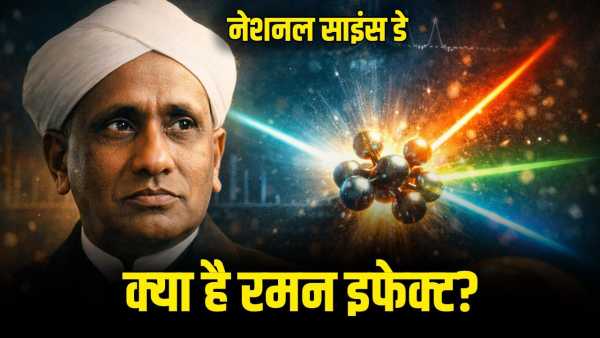
February 28, 1928, is a historical date which is recorded in golden letters in the history of India. On this day, the country's great scientist CV Raman discovered the Raman effect. It was this achievement that won India its first Nobel Prize in Science in 1930. This is the reason why National Science Day is celebrated in the country every year on 28 February.
CV Raman, who discovered this effect, was born on 7 November 1888 in Madras Presidency. Passed graduation examination in 1904, securing first position and gold medal in Physics. He completed post graduation in 1907. In 1907, he got the job of Assistant Accountant General but due to his interest in science, he left the government job and became Professor of Physics in Calcutta University. From here the path to discovery of Raman effect was paved.
What is Raman effect?
CV Raman has proved through his experiment that when light passes through a transparent object, some part of it gets scattered. This effect is known by its name i.e. Raman effect. Presently it is being used in many places.
- Medical Sector: It is used in checking the purity of medicines, in identifying cancer cells and in chemical analysis of blood or tissue. Raman spectroscopy has the ability to investigate without damaging the sample.
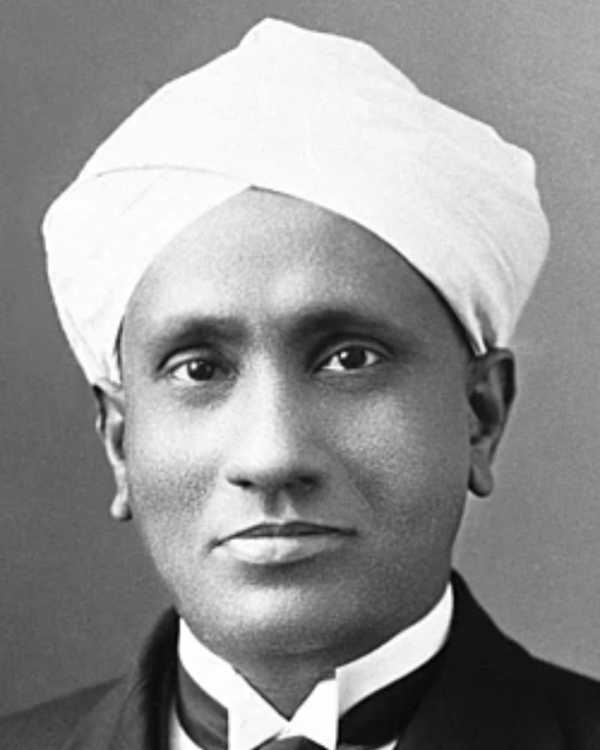
C V Raman.
- Chemical Analysis: The concept of Raman effect is used to identify any unknown substance and to understand the chemical bonds of any chemical.
- Industrial Use: It is used in testing substances in petroleum and gas industry, quality testing of plastics, polymers and chemicals and detecting adulteration in food industry.
- Space Research: It is used to identify minerals present on the surface of planets and to examine soil with the Raman spectrometer installed on the rover in the Mars mission. For example, instruments based on Raman effect are installed on the Preservation Rover.
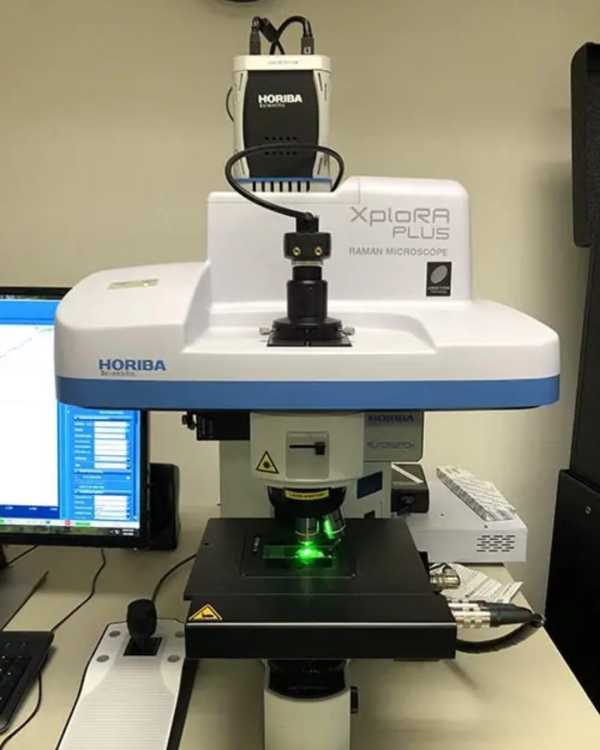
Raman spectroscopy.
- Forensic Science: Used to identify powder, drugs or explosives found at a crime scene. Apart from this, this concept is also used in checking fake and genuine notes.
How is it helpful in treating cancer?
Raman spectroscopy reveals the chemical composition of cells. Cancer cells are different from normal cells, Raman spectroscopy can easily identify them. Due to which identification is possible in the early stages. This technique clarifies the difference between healthy and cancerous tissue. Not only this, it is helpful in studying the effects of new cancer drugs.
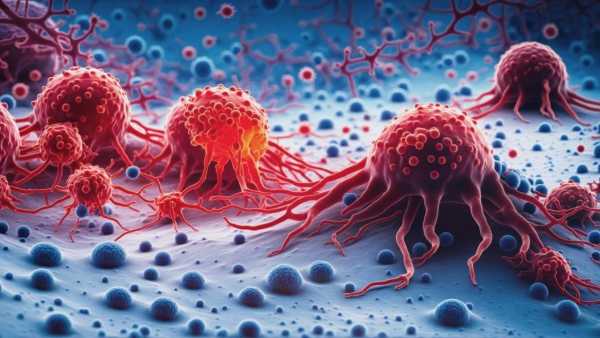
cancer.
This is the reason why Raman's achievement and use of CV was not limited to India only. It is used in many countries and at many levels it is working to make complex tasks easier. The country got its first Nobel Prize in the field of science because of this achievement of CV Raman. His achievement brought glory to India at the global level and the country registered its achievement at the world level in the field of science.
Contact to : xlf550402@gmail.com
Copyright © boyuanhulian 2020 - 2023. All Right Reserved.