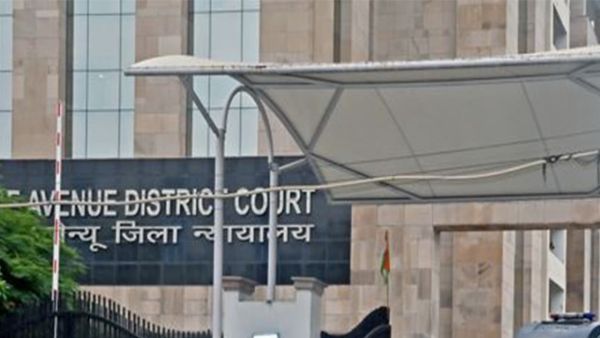
A Delhi court discharged Arvind Kejriwal, Manish Sisodia and others, stating the CBI's case is 'unable to survive judicial scrutiny' and 'stands discredited'. The court found no evidence of conspiracy, calling the allegations mere 'speculation'.
The Rouse Avenue court on Friday not only discharged Arvind Kejriwal, Manish Sisodia and 21 accused persons, but it also highlighted lapses in the investigation by saying that "CBI's case unable to survive judicial scrutiny, and stands discredited in its entirety."

Special CBI Judge Jitendra Singh passed a discharge order running in around 600 pages and made some serious observations about the manner in which the investigation was conducted.
Court Finds No 'Prima Facie Suspicion'
The Judge said, "This Court is left in no manner of doubt that the prosecution's case does not disclose even the threshold of a prima facie suspicion, far less the 'grave suspicion' mandated by settled principles of criminal jurisprudence for proceeding further."
The court pointed out the contradiction in statement of witnesses that the CBI relied upon.
The court held that the excise policy case, as sought to be projected by the CBI, is wholly unable to survive judicial scrutiny and stands discredited in its entirety.
The court also reprimanded the CBI over the contradiction in the statement of witnesses and said, "While it is to the credit of the investigating agency that it has placed reliance upon the statement of its own witnesses even when such evidence runs contrary to the prosecution's foundational allegations, the cumulative effect of that very evidence demolishes, rather than supports, the case sought to be built."
The court said that there is no legally admissible evidence to prosecute the accused persons, adding that " To compel the accused to face the rigours of a full-fledged criminal trial in the stark absence of any legally admissible material connecting them to the alleged offences would not serve the ends of justice."
"It would instead constitute a manifest miscarriage of justice and an abuse of the criminal process, offending the most basic tenets of fairness and the rule of law," the special judge remarked.
Conspiracy Allegations a 'Speculative Construct'
The court also said that the allegations are speculation and there is no evidence. "The alleged conspiracy, from its very inception, has progressively unravelled and, upon close scrutiny, is revealed to be nothing more than a speculative construct resting on conjecture and surmise, devoid of any admissible evidence," the court said in the discharge order.
The court also pointed out that the investigation, when tested against the material collected by the agency itself, reflects a fundamental failure to properly appreciate, evaluate, or draw lawful inferences from the evidence and documents on record.
"As a result, the prosecution's case is rendered legally infirm, unsustainable, and unfit to proceed any further in law. Stated differently, this Court records that the theory of an overarching conspiracy, so emphatically projected, stands completely dismantled when tested against the evidentiary record," the court held.
Excise Policy Formulation Deemed Lawful
The court said that the CBI has failed to show any manipulation to give any benefit to the South Group. "Upon consideration of the entire material placed on record, this Court is of the considered view that the prosecution has failed to place any material which, even prima facie, suggests that the Delhi Excise policy (DEP-2021-22) was manipulated, altered, or engineered to confer any undue or unlawful benefit upon any private individual or the so-called "South Group"," the court observed.
The court said that, on the contrary, the contemporaneous record clearly establishes that the policy was the outcome of a consultative and deliberative exercise, undertaken after engagement with relevant stakeholders and in adherence to the procedure prescribed under law.
The court also noted that suggestions were obtained from LG and incorporated in the policy and said that Though there was no statutory or constitutional requirement mandating the obtaining of suggestions from the Lieutenant Governor, the file notings unmistakably reflect that such suggestions were nevertheless sought, examined, and incorporated. The procedural integrity of the policy-making process thus stands affirmed from the documentary record itself.
The court held, " Once the formulation of the policy is shown to be the product of deliberation, institutional scrutiny, and procedural compliance, any subsequent attempt to attribute criminality to its implementation becomes wholly untenable."
Bribery and Kickback Allegations Rejected
The court said that the very foundation on which the prosecution seeks to construct the narrative of conspiracy, centred around alleged payment of "upfront money" and its purported recoupment, stands fundamentally eroded.
The court also said, "In the absence of a tainted policy or demonstrably unlawful implementation, the prosecution theory is reduced to conjecture."
It further said that the private persons who sought to derive commercial advantage from a policy validly framed and lawfully implemented, without any established violation of policy conditions or statutory prohibitions, cannot be compelled to face the rigours of criminal prosecution.
"This court finds no apparent breach of restrictions relating to 'related entities' or any other policy condition which could, by itself, attract criminal liability," the court held.
The court also rejected the allegations of payment of any bribe.
"The allegations concerning payment of upfront money and its alleged recoupment are equally devoid of legal substratum. De hors (Without) any material indicating manipulation in policy formulation or corruption in implementation, such allegations fail to sustain. The court found that the entire alleged chain of payments rests predominantly on so-called pavti entries of Angadia firms, documents which are inadmissible in law, and on an approver-like statement which remains uncorroborated on material particulars. These infirmities are not peripheral; they strike at the very root of the prosecution's case and render it unsustainable even at the threshold stage, the court said.
(Except for the headline, this story has not been edited by Asianet Newsable English staff and is published from a syndicated feed.)Contact to : xlf550402@gmail.com
Copyright © boyuanhulian 2020 - 2023. All Right Reserved.