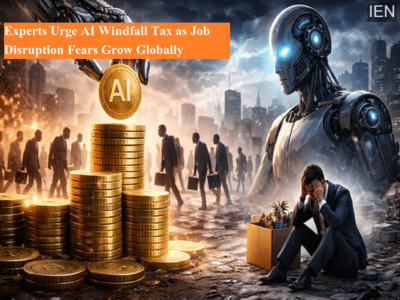
Governments worldwide should consider imposing a windfall tax on extraordinary profits generated through artificial intelligence, according to market strategist Alap Shah. His recommendation comes amid rising concern that rapid AI adoption could trigger widespread job displacement and reshape global labor markets faster than policymakers can respond.
Shah, co-author of a widely circulated research report by Citrini Research, warned that automation powered by advanced AI systems may significantly reduce employment across multiple sectors. He argues that proactive policy planning is essential to cushion potential economic shocks and prevent a decline in consumer demand caused by job losses.
Why the Tax Debate Is Gaining MomentumIn a recent interview with Bloomberg TV, Shah—who serves as chief investment officer at Lotus Technology Management—said the accelerating pace of AI innovation could destabilize consumer-driven economies such as the United States. According to him, the smarter AI becomes, the more tasks it can replace, potentially displacing workers across industries ranging from finance and software to logistics and customer service.
His remarks followed a research note that sparked volatility in equity markets, particularly in delivery platforms, payment firms, and certain software companies, as investors reassessed long-term employment trends and corporate profitability.
IMF Warns of “Tsunami-Like” Labor ImpactConcerns about AI’s employment impact are not limited to private analysts. The International Monetary Fund has also sounded alarms. Managing Director Kristalina Georgieva recently cautioned that artificial intelligence could affect nearly 40% of jobs worldwide—and up to 60% in advanced economies. She described the technology’s influence on labor markets as comparable to a “tsunami,” highlighting the scale and speed of potential disruption.
According to IMF projections, AI will not simply eliminate jobs; it will transform many roles and create new ones. However, these new positions may often offer lower wages or require entirely different skill sets, placing pressure on middle-income workers and reducing opportunities for entry-level candidates.
What an AI Windfall Tax Would DoShah clarified that the proposed tax would not target AI technology itself. Instead, it would apply to unusually large corporate profits generated through automation-driven cost savings. His argument is that if companies replace employees with AI to reduce expenses, they may boost profits but simultaneously shrink household incomes, which could weaken consumer spending—the backbone of many economies.
A windfall tax is typically imposed when a sector earns unexpectedly high profits due to external factors rather than operational improvements. Shah believes such a levy could help governments redirect part of those gains toward social safety nets, reskilling programs, and income support for displaced workers.
Short-Term Job Risks Already EmergingThe Citrini analysis outlines a scenario in which AI dramatically boosts productivity but leads to significant layoffs among white-collar professionals. Shah estimates that roughly 5% of such roles could disappear within the next 18 months if adoption accelerates as expected.
He also warned of a feedback loop: companies may initially cut staff to reduce costs, then reinvest those savings into more automation, leading to further job reductions and potentially weaker overall demand in the economy. Sectors like finance, insurance, and consumer platforms could face the greatest disruption, while semiconductor manufacturers, data-center operators, and AI model developers may benefit.
India’s Unique ChallengeSpeaking at a recent industry forum, Vineet Nayar, former CEO of HCL Technologies, echoed similar concerns. He argued that it would be risky to assume AI will automatically generate enough new jobs to offset losses—especially in India’s IT services sector, where companies tend to prioritize efficiency and profit margins.
Nayar added that large-scale employment growth may instead come from startups and entrepreneurship rather than traditional corporate hiring. He also warned that reliance on foreign AI platforms using domestic data could create long-term strategic vulnerabilities.
A Policy Question Governments Can’t IgnoreThe central dilemma facing policymakers is clear: if AI significantly increases productivity but reduces employment, tax systems and social protections may need to be redesigned. Advocates of an AI windfall tax say it could redistribute a portion of automation-driven gains back into society, helping stabilize demand and fund worker transition programs.
While no major economy has yet implemented such a tax specifically for AI profits, the growing debate suggests governments are beginning to explore fiscal tools to manage the economic consequences of rapid technological transformation.
Contact to : xlf550402@gmail.com
Copyright © boyuanhulian 2020 - 2023. All Right Reserved.