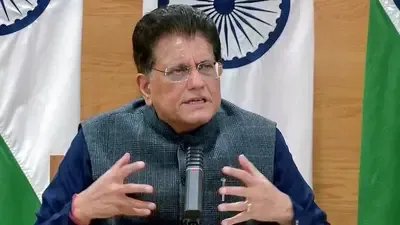
Union Commerce Minister Piyush Goyal has assured that India will receive zero-duty access for textile exports to the United States, similar to the benefits recently extended to Bangladesh, amid concerns about potential trade disadvantages. Speaking to address apprehensions within the Indian textile sector, Goyal clarified that the Indian framework agreement with the US is under finalization, which will secure reciprocal tariff exemptions for Indian textile and apparel products, particularly those made with American cotton or man-made fibers. The Minister’s statement comes at a crucial time when India’s textiles industry is preparing for enhanced exports to major international markets, seeking clarity on trade arrangements that impact both competitiveness and revenue. Goyal emphasized that once the interim agreement is formalized, Indian exporters will benefit from the same opportunities granted to Bangladesh, dispelling rumors regarding trade inequalities.
Framework Agreement and Zero Duty Access for Indian Textile Exports
India’s textile industry has been attentive to developments in international trade agreements following Bangladesh’s signing of a deal with the United States on February 9. Under this agreement, the US reduced reciprocal tariffs imposed on Dhaka to 19 percent from an earlier announcement of 20 percent, while providing zero-tariff access for specific textile and apparel products manufactured from US-origin cotton and man-made fibers. The move triggered concerns among Indian manufacturers and industry stakeholders about potential competitive disadvantages, fearing that Indian exports could be relatively more expensive in US markets if similar benefits were not granted.
Addressing these concerns, Minister Goyal clarified that India is not being left behind and will receive equivalent benefits. “India also has the same facility, and India will also get it. Right now, our framework agreement is being made. When the interim agreement is finalised, then you will get to see this in the fine print,” he said. The Minister further elaborated that the agreement would enable Indian exporters to leverage raw materials sourced from the US, process them domestically, and export finished products with zero reciprocal tariffs. This arrangement will effectively place Indian manufacturers on equal footing with their Bangladeshi counterparts in the US market, ensuring competitiveness and market stability.
Goyal also highlighted the strategic importance of such trade agreements in enhancing India’s global export profile. By securing zero-duty access, India is poised to increase its textile and apparel exports significantly. Current estimates suggest that India exports goods worth Rs 5 lakh crore, and with the full implementation of the framework agreement, this figure could potentially double to Rs 10 lakh crore. The minister’s remarks underscored the transformative potential of the agreement not just for manufacturers, but also for farmers, small-scale industry workers, and artisans involved in textile production across India.
Rebuttal to Opposition and Assurance for Farmers, MSME Workers, and Artisans
In his address, Piyush Goyal also criticized the claims made by Rahul Gandhi in Parliament, who suggested that Bangladesh received greater trade benefits than India. Goyal labeled this assertion as false and emphasized that India’s textile exporters would enjoy similar advantages, particularly with raw materials purchased from the US. He urged that such misinformation must not undermine confidence in India’s export potential or create unnecessary panic within the domestic textile sector. “He spread another lie in the Parliament that Bangladesh has got more benefits from the trade than India. Just as Bangladesh has a facility that if raw material is purchased from America, then if you process it and make cloth and export it, then it will be available at zero reciprocal tariff,” Goyal said, clarifying the specifics of the agreement.
Further, the Minister addressed the wider implications of the trade benefits for farmers, MSME workers, fishermen, and artisans such as Vishwakarmas, emphasizing that the expanded access to international markets will create increased demand for raw materials and finished products alike. By doubling export potential, the framework agreement is expected to generate substantial economic activity, provide job security, and boost rural and urban livelihoods dependent on textile production. Goyal highlighted that Indian farmers will gain from increased cotton exports, while skilled workers and artisans in small-scale industries will benefit from greater orders for finished garments and fabrics.
The Minister’s remarks highlighted India’s proactive approach to trade negotiations, ensuring that agreements are structured to promote domestic industry competitiveness while adhering to international trade norms. By securing zero-duty access, Indian manufacturers can mitigate the effects of differential tariffs and remain competitive in global markets, especially as the US represents one of the largest import destinations for textiles and apparel. The commitment to a finalized framework agreement assures stakeholders that India is prepared to match or exceed benefits granted to regional competitors like Bangladesh, strengthening India’s position in international trade diplomacy.
Goyal’s response also emphasized the importance of clear communication and transparency in trade policymaking. Misinterpretations or misrepresentations of trade agreements, particularly those that could influence investor sentiment or industry confidence, have the potential to disrupt supply chains and delay strategic planning. By directly addressing rumors and highlighting the ongoing finalization of the framework, the Minister reassured exporters and related industry participants that India’s trade policies are aligned with the goal of maximizing benefits for domestic producers while maintaining compliance with international obligations.
Additionally, the Minister underscored that the framework agreement is part of a broader effort to expand India’s export footprint to multiple international markets, including the European Union, the UK, Switzerland, Norway, and Australia. The arrangement is expected to create a cascading effect, where increased access to one major market, such as the US, stimulates demand across other regions. Goyal highlighted that Indian industries have historically demonstrated resilience and adaptability, and the zero-duty access framework will provide further impetus to scale production, innovate, and compete globally.
The Minister also urged political accountability, particularly asking Rahul Gandhi to apologize to farmers, fishermen, MSME workers, and artisans, who stand to benefit directly from expanded trade opportunities. Goyal argued that misinformation regarding India’s trade advantages could harm the morale of workers and undermine confidence in government trade policies. By emphasizing the tangible benefits for ordinary citizens and industry stakeholders, Goyal positioned the framework agreement as a strategic win for India’s textile sector, combining diplomatic engagement with economic empowerment.
Goyal’s clarification is expected to stabilize market perceptions and reinforce confidence among stakeholders in the Indian textile industry. Analysts note that equal access to zero-duty facilities ensures that India can compete effectively with regional players like Bangladesh, particularly in products manufactured using US-sourced raw materials. The framework agreement is also seen as a significant step in India’s larger goal of expanding its share of global textile exports, enhancing competitiveness, and achieving long-term economic growth.
The Union Minister’s emphasis on doubling exports from Rs 5 lakh crore to Rs 10 lakh crore reflects the government’s ambitious vision for the sector. By facilitating zero-tariff access, encouraging production, and ensuring equitable benefits across international trade deals, India is positioned to strengthen its industrial base, create employment opportunities, and provide economic stability to millions associated with the textile supply chain. Goyal’s statements make it clear that India’s policies aim to support farmers cultivating cotton, fishermen involved in raw material transport, MSME workers engaged in processing and garment manufacturing, and artisans who contribute traditional skills to contemporary textile production.
Through these measures, the government seeks to align domestic industrial growth with international trade benefits, ensuring that Indian exporters can operate on par with global competitors while maintaining profitability and sustainability. The assurance of zero-duty access also encourages long-term investment in the textile sector, facilitates modernization of production processes, and promotes skill development initiatives across both rural and urban settings.
The equivalence of benefits extended to India and Bangladesh, Piyush Goyal reaffirmed India’s commitment to safeguarding the interests of domestic producers while simultaneously engaging in constructive trade diplomacy. The framework agreement under finalization represents a strategic instrument to bolster India’s position in global textile markets, encourage higher exports, and provide economic security to a wide spectrum of stakeholders. Goyal’s message reinforces the government’s proactive stance in ensuring that India remains competitive while leveraging international trade agreements to benefit its citizens directly.
The post India to secure zero-duty textile access to US, Piyush Goyal assures parity with Bangladesh under upcoming framework agreement | Cliq Latest appeared first on CliQ INDIA.
Contact to : xlf550402@gmail.com
Copyright © boyuanhulian 2020 - 2023. All Right Reserved.