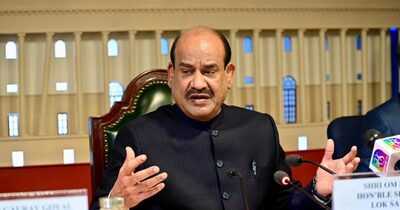
India has decided to be represented by Lok Sabha Speaker Om Birla at the swearing-in of Bangladesh’s new Prime Minister, reflecting continuity in bilateral engagement amid scheduling constraints at the highest level.
The Indian government has chosen Lok Sabha Speaker Om Birla to represent the country at the swearing-in ceremony of Tarique Rahman as Prime Minister of Bangladesh, underscoring New Delhi’s intent to maintain close diplomatic engagement with Dhaka during a sensitive political transition. The ceremony, scheduled for February 17, follows the return of electoral politics in Bangladesh after a period of interim governance and is being closely watched across South Asia for its regional implications. While Narendra Modi was formally invited, his inability to attend due to pre-existing diplomatic commitments has prompted the government to nominate a senior constitutional authority to ensure India’s presence at a significant moment in Bangladesh’s political landscape.
The decision reflects India’s calibrated diplomatic approach, balancing high-level international engagements with the importance it attaches to relations with neighboring countries. Bangladesh remains a key partner for India in areas ranging from trade and connectivity to security cooperation and regional stability. By sending the Lok Sabha Speaker, India signals respect for the democratic process in Bangladesh while ensuring continuity in bilateral engagement at a senior level, even as the Prime Minister remains engaged with major global partners.
Diplomatic Scheduling and India’s Representation at a Regional MilestoneThe swearing-in ceremony of Tarique Rahman as Bangladesh’s Prime Minister comes at a time when India’s diplomatic calendar is unusually dense. Prime Minister Modi is scheduled to meet Emmanuel Macron in Mumbai on February 17, a meeting that had been planned well in advance and carries significant strategic and economic weight. The Modi–Macron engagement is expected to focus on deepening bilateral cooperation in defence, clean energy, technology, and global governance, reflecting the growing strategic convergence between India and France.
Following the Mumbai meetings, President Macron is set to travel to New Delhi to participate in the India AI Impact Summit 2026, a high-profile international event aimed at shaping global conversations on artificial intelligence, ethical governance, and technological collaboration. Given the importance of these engagements, the Prime Minister’s Office assessed that it would not be feasible for Modi to attend the Dhaka ceremony without disrupting carefully structured diplomatic commitments.
In this context, the choice of Om Birla as India’s representative is symbolically significant. As Speaker of the Lok Sabha, Birla occupies one of the highest constitutional offices in the country, and his presence conveys India’s respect for Bangladesh’s new leadership and democratic institutions. The decision also reflects a broader diplomatic practice of deploying senior parliamentary leaders to represent the state at key international events when heads of government are unavailable.
For Bangladesh, the presence of the Lok Sabha Speaker carries its own resonance. Parliamentary diplomacy has increasingly become an important channel for strengthening bilateral ties, particularly between neighboring democracies. Birla’s participation is expected to include interactions with Bangladeshi parliamentary leaders and senior political figures, providing an opportunity to reinforce institutional linkages beyond the executive branch.
The invitation extended to Prime Minister Modi was routed through Bangladesh’s interim government, highlighting the transitional nature of the political moment. The interim administration, led by Muhammad Yunus as Chief Adviser, has sought to ensure a smooth handover of power while engaging regional and global partners to lend legitimacy and international confidence to the process. By accepting the invitation at a senior level, India aligns itself with this objective while maintaining flexibility in its diplomatic engagements.
Bangladesh’s Political Transition and Regional ImplicationsTarique Rahman’s ascent to the prime ministership marks a significant development in Bangladesh’s domestic politics. As chief of the Bangladesh Nationalist Party, Rahman’s leadership represents a return of the BNP to executive power after a prolonged period marked by political contention, legal battles, and shifting alliances. His swearing-in is expected to set the tone for the new government’s domestic agenda as well as its approach to foreign policy, particularly relations with neighboring India.
The BNP, in its initial communications, has emphasized the importance of stable and constructive ties with regional partners. Inviting heads of government from 13 countries to the swearing-in ceremony reflects Dhaka’s intent to project inclusivity and international engagement from the outset. For India, which shares deep historical, cultural, and economic ties with Bangladesh, the transition presents both opportunities and challenges.
India–Bangladesh relations have evolved significantly over the past decade, characterized by enhanced connectivity, growing trade volumes, and close coordination on security issues. Cross-border infrastructure projects, energy cooperation, and people-to-people exchanges have expanded the relationship beyond traditional diplomatic frameworks. At the same time, political changes in Dhaka have historically influenced the tone and trajectory of bilateral ties, making New Delhi attentive to signals from incoming leaderships.
By sending Om Birla, India underscores that its engagement with Bangladesh is institutional and enduring, not contingent solely on individual leaders. Parliamentary diplomacy can play a stabilizing role during periods of political transition, offering channels for dialogue that complement executive-level interactions. Birla’s presence also allows India to reaffirm its commitment to democratic processes and constitutional governance in the region.
The interim government in Bangladesh has framed the swearing-in ceremony as a moment of renewal, emphasizing continuity in governance while opening space for policy recalibration under the new prime minister. Professor Muhammad Yunus, as Chief Adviser, has been instrumental in coordinating the transition and extending invitations to international partners. His outreach reflects an understanding that regional stability and economic confidence are closely linked to perceptions of political legitimacy.
For India, the broader regional context cannot be ignored. South Asia is undergoing significant geopolitical shifts, with external powers increasing their engagement and competition in the region. Bangladesh’s strategic location and growing economy make it an important partner in India’s Act East policy and its vision for regional connectivity. Ensuring a smooth diplomatic transition and early engagement with the new leadership is therefore a priority for New Delhi.
The absence of Prime Minister Modi at the ceremony does not diminish the importance India attaches to Bangladesh, as evidenced by the seniority of the representative being sent. Instead, it highlights the complex balancing act inherent in modern diplomacy, where leaders must manage simultaneous regional and global commitments. The Modi–Macron meetings and the India AI Impact Summit illustrate India’s expanding global footprint, while the Dhaka engagement underscores its continued focus on neighborhood diplomacy.
As Om Birla prepares to attend the swearing-in, attention will be on the messages conveyed through his interactions and statements. His role will be not only ceremonial but also communicative, carrying assurances of India’s willingness to work closely with the new Bangladeshi government. The event thus becomes a convergence point for domestic political change in Bangladesh and India’s broader diplomatic priorities, reflecting the interconnected nature of regional and global politics.
The post India sends Lok Sabha Speaker to Dhaka as leadership change in Bangladesh coincides with major diplomatic engagements | Cliq Latest appeared first on CliQ INDIA.
Contact to : xlf550402@gmail.com
Copyright © boyuanhulian 2020 - 2023. All Right Reserved.