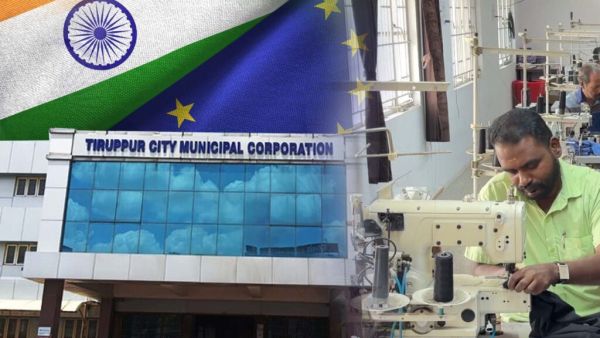
Tiruppur’s textile industry is showing clear signs of revival, with exporters saying the recent India-US and India-EU trade deals could mark a turning point for the knitwear hub.
Just weeks after the agreements were signed, this textile cluster, about 460 km from Chennai, is witnessing renewed activity across warehouses and factory floors. After months of delayed orders and uncertainty, confidence appears to be returning.
Union Commerce and Industry Minister Piyush Goyal recently indicated that India could receive textile trade benefits similar to those extended to Bangladesh under its US trade arrangement, reassuring exporters in Tiruppur.
Zero tariff boost
Under the proposed structure, Indian garment exporters could gain zero-tariff access to the US market for apparel made using American cotton, once the deal becomes operational. This could significantly improve India’s competitiveness in the price-sensitive global garment trade.
Also read: ‘Father of all deals’: Tiruppur exporters bet big on India-US trade deal
Kumar Duraisamy, CEO of Eastern Global Clothing and Joint Secretary of the Tiruppur Exporters’ Association, said export volumes are expected to rise under both trade deals. He explained that US cotton imports would attract zero duty, and products with at least 20 per cent US-origin content would qualify for zero tariffs.
Warehouses active
Across smaller clusters in Tiruppur, warehouses that once held idle inventory are now active again. Cartons are being dusted, repacked and loaded for shipment.
In one of the godowns, workers prepared consignments for the Ross brand, signalling the steady return of export orders.
Also read: Why India must take Brazil’s lead to save Tiruppur from impact of Trump’s tariffs
Several garment units have resumed shifts, with workers adapting to new stitching styles tailored for the US and European markets. In some factories, women workers who had faced weeks of slowdown are back on the floor and awaiting their first salary since operations resumed.
Targets set
The government has set ambitious goals for the sector. Goyal has urged Tiruppur’s textile industry to double exports and generate five lakh jobs over the next three years. He also announced plans for a dedicated control room mechanism that would allow exporters to submit grievances online for faster resolution.
Also read: India to get zero-tariff textile access to US similar to Bangladesh, says Goyal
However, industry leaders caution that the impact of the two trade deals may not be identical. P Muthurathinam, president of Tiruppur Exporters and Manufacturers Association (TEMA), noted that Tiruppur remains a key hub for fabric processing and value addition. He suggested that the India–EU agreement could benefit clusters more significantly than the India–US deal, particularly in terms of compliance standards and trade volumes.
For Tiruppur, these trade agreements are more than diplomatic milestones. They directly affect orders, employment and export earnings. If tariff advantages translate into sustained demand, this knitwear capital may be entering its next phase of growth.
(The content above has been transcribed from video using a fine-tuned AI model. To ensure accuracy, quality, and editorial integrity, we employ a Human-In-The-Loop (HITL) process. While AI assists in creating the initial draft, our experienced editorial team carefully reviews, edits, and refines the content before publication. At The Federal, we combine the efficiency of AI with the expertise of human editors to deliver reliable and insightful journalism.)
Contact to : xlf550402@gmail.com
Copyright © boyuanhulian 2020 - 2023. All Right Reserved.