Flipkart is changing in ways that signal strategic evolution. The Bengaluru-based major is recalibrating its growth strategy, shifting from expansion to now building a business engineered for long-term competitive advantage, as highlighted in its recent performance data.
In a statement, Flipkart revealed that it had served over 200 million ecosystem customers during the 2025 festive season, with 101 million actively transacting. This 16% year-over-year growth seems modest by the company’s own historical standards, but it is now optimising for quality of engagement.
Flipkart’s supply chain infrastructure delivered 7.3 million shipments in a single day while maintaining 99.9% uptime on peak days. Unit volumes grew 24% year-over-year, with no proportional increase in capital expenditure. This signals that the company has internalised what public markets demand.
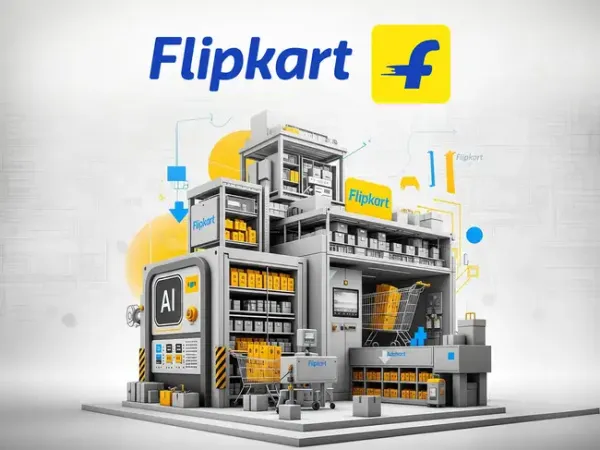
Flipkart told ET that for Minutes, it increased dark-store density in select urban clusters, with GenAI-powered orchestration optimising inventory placement and routing. Real-time geocoding predicts demand patterns at a granular level, pre-positioning inventory to minimise last-mile costs. These tech-powered microfulfilment centres mark a departure from the capital-intensive fulfilment model that defined earlier quick commerce buildouts. Flipkart now deploys modular capacity that scales in response to actual demand signals instead of building massive warehouses on speculation.
The company’s AI-led Inter-Warehouse Inventory Transfer (IWIT) system exemplifies the shift toward intelligent capital deployment. IWIT dynamically redistributes stock based on real-time demand forecasting instead of maintaining redundant inventory across the network, reducing working capital requirements while improving product availability. During the festive peak, the system managed inventory across thousands of stock-keeping units (SKUs) without significant stockouts, demonstrating operational maturity that sets institutional-grade platforms apart from growth-stage experiments.
The zero-commission model for products priced below ₹1,000 also points to the company’s approach to the hyper-value segment. It reduced seller costs by up to 30% in this category, enabling small and medium enterprises to achieve sustainable unit economics. This democratises e-commerce participation while binding sellers to the platform through value creation rather than dependence on subsidies.
Prevailing wisdom holds that forgoing commission revenue contradicts profitability goals. But the counterargument lies in lifetime value economics: merchants who achieve sustainable profitability on low-ticket items gravitate toward listing higher-margin products on the same platform. The zero-commission strategy functions as both a market penetration tool and a habit formation mechanism, creating a virtuous cycle that compounds platform value over time. This represents exactly the kind of multi-year strategic thinking that defines institutional operators rather than quarter-chasing public companies.
Flipkart claims to have cultivated succession strength through deliberate leadership development, providing additional evidence of institutional maturity. The company distributed strategic responsibilities among functional leaders with deep operational expertise rather than concentrating decision-making authority in the founder or CEO. This organisational architecture reduces key-person dependencies while creating internal accountability mechanisms that public market investors value.
Technology investments at Flipkart also reflect priorities aligned with shareholder value creation rather than the bandwagon effect, with GenAI implementations focused on demand forecasting, inventory optimisation, and customer service automation. Real-time data infrastructure enables dynamic pricing, promotional targeting, and inventory allocation with unprecedented precision. During peak periods, the system processes millions of data points per second to optimise fulfilment routing, balancing delivery speed against cost.
The 2026 IPO, should it materialise as projected, will test whether public market investors value institutional maturity as much as growth narratives. Flipkart's performance data suggests a company that has internalised this calculus, systematically trading velocity for sustainability. The 200 million ecosystem customers represent a foundation to monetise through improved wallet share and margin expansion.
Indian e-commerce is transitioning from a venture-backed land grab to a maturing industry with rational economics. Flipkart is demonstrating that measured growth built on solid unit economics could generate compounding returns. This represents a coming-of-age moment for Indian technology platforms overall, and recognition that public market success requires governance, operational excellence, and strategic patience.
Flipkart is no longer merely a retailer competing for market share. It has evolved into a tech-logistics institution, one that understands public markets reward sustainable competitive advantages. The investments in AI orchestration, supply chain density, and Tier-2 expansion are calculated moves that solidify long-term structural advantages. Whether the market rewards this institutionalisation will determine not just Flipkart's valuation, but the template for how Indian digital platforms may navigate the transition from private to public ownership.
In a statement, Flipkart revealed that it had served over 200 million ecosystem customers during the 2025 festive season, with 101 million actively transacting. This 16% year-over-year growth seems modest by the company’s own historical standards, but it is now optimising for quality of engagement.
Flipkart’s supply chain infrastructure delivered 7.3 million shipments in a single day while maintaining 99.9% uptime on peak days. Unit volumes grew 24% year-over-year, with no proportional increase in capital expenditure. This signals that the company has internalised what public markets demand.
Scale without sprawl
The institutional pivot is clearer in Flipkart's quick-commerce vertical, Minutes. The service recorded a 16-fold surge in order volumes during the second half of 2025, attracting 53 million unique visitors and building a base of 600,000 “power customers” who order weekly. This may be read as a defensive move against rivals like Blinkit and Zepto, but can also be interpreted as strategic habit formation at work, i.e., building high-frequency touchpoints that improve unit economics by increasing wallet share and lowering customer acquisition costs.Flipkart told ET that for Minutes, it increased dark-store density in select urban clusters, with GenAI-powered orchestration optimising inventory placement and routing. Real-time geocoding predicts demand patterns at a granular level, pre-positioning inventory to minimise last-mile costs. These tech-powered microfulfilment centres mark a departure from the capital-intensive fulfilment model that defined earlier quick commerce buildouts. Flipkart now deploys modular capacity that scales in response to actual demand signals instead of building massive warehouses on speculation.
The company’s AI-led Inter-Warehouse Inventory Transfer (IWIT) system exemplifies the shift toward intelligent capital deployment. IWIT dynamically redistributes stock based on real-time demand forecasting instead of maintaining redundant inventory across the network, reducing working capital requirements while improving product availability. During the festive peak, the system managed inventory across thousands of stock-keeping units (SKUs) without significant stockouts, demonstrating operational maturity that sets institutional-grade platforms apart from growth-stage experiments.
The long game in smaller cities
Over 60% of festive season orders on Flipkart last year came from Tier 2 and Tier 3 markets, a penetration level that required systematic infrastructure investments over multiple years. The company built this position through structural interventions: expanding logistics networks into these cities and towns, developing vernacular interfaces, and creating payment mechanisms suited to diverse levels of financial literacy.The zero-commission model for products priced below ₹1,000 also points to the company’s approach to the hyper-value segment. It reduced seller costs by up to 30% in this category, enabling small and medium enterprises to achieve sustainable unit economics. This democratises e-commerce participation while binding sellers to the platform through value creation rather than dependence on subsidies.
Prevailing wisdom holds that forgoing commission revenue contradicts profitability goals. But the counterargument lies in lifetime value economics: merchants who achieve sustainable profitability on low-ticket items gravitate toward listing higher-margin products on the same platform. The zero-commission strategy functions as both a market penetration tool and a habit formation mechanism, creating a virtuous cycle that compounds platform value over time. This represents exactly the kind of multi-year strategic thinking that defines institutional operators rather than quarter-chasing public companies.
Rewiring for public markets
The governance infrastructure Flipkart has built around its proposed ‘Reverse Flip’ (the redomiciliation from Singapore to India) signals intent around fiduciary oversight and compliance rigour. The move involves untangling complex cross-border ownership structures, subjecting the company to Indian securities regulations, and accepting heightened disclosure requirements. These adjustments represent a fundamental recasting of corporate governance standards to meet public market expectations.Flipkart claims to have cultivated succession strength through deliberate leadership development, providing additional evidence of institutional maturity. The company distributed strategic responsibilities among functional leaders with deep operational expertise rather than concentrating decision-making authority in the founder or CEO. This organisational architecture reduces key-person dependencies while creating internal accountability mechanisms that public market investors value.
Technology investments at Flipkart also reflect priorities aligned with shareholder value creation rather than the bandwagon effect, with GenAI implementations focused on demand forecasting, inventory optimisation, and customer service automation. Real-time data infrastructure enables dynamic pricing, promotional targeting, and inventory allocation with unprecedented precision. During peak periods, the system processes millions of data points per second to optimise fulfilment routing, balancing delivery speed against cost.
Slower growth, stronger foundations
Flipkart's current trajectory stands out from typical pre-IPO paths in that it is aligned with both operational decisions and long-term structural advantages. The shift from growth-at-any-cost to capital discipline appears in tangible operational choices: disciplined capacity additions, technology investments focused on efficiency, and market expansion driven by unit economics.The 2026 IPO, should it materialise as projected, will test whether public market investors value institutional maturity as much as growth narratives. Flipkart's performance data suggests a company that has internalised this calculus, systematically trading velocity for sustainability. The 200 million ecosystem customers represent a foundation to monetise through improved wallet share and margin expansion.
Indian e-commerce is transitioning from a venture-backed land grab to a maturing industry with rational economics. Flipkart is demonstrating that measured growth built on solid unit economics could generate compounding returns. This represents a coming-of-age moment for Indian technology platforms overall, and recognition that public market success requires governance, operational excellence, and strategic patience.
Flipkart is no longer merely a retailer competing for market share. It has evolved into a tech-logistics institution, one that understands public markets reward sustainable competitive advantages. The investments in AI orchestration, supply chain density, and Tier-2 expansion are calculated moves that solidify long-term structural advantages. Whether the market rewards this institutionalisation will determine not just Flipkart's valuation, but the template for how Indian digital platforms may navigate the transition from private to public ownership.