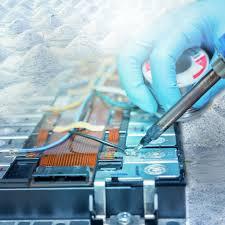
It is a very serious development of battery technology: a sodium-ion battery whose main electrode material is a natural polymer, lignin, occurring in the cell walls of plants. Developed by scientists from the Fraunhofer Institute for Ceramic Technologies and Systems IKTS and Friedrich-Schiller-University Jena, both from Germany, the innovation can open wider perspectives on the development of sustainable and cost-effective methods of energy storage.
Most of the time, lignin is considered waste because it imparts a more rigid structure to plants and is usually removed during paper and wood processing. Indeed, several million tons of this organic material are produced yearly in most pulp and paper industries, which could grant plentiful supplies from renewable resources. The research team looked at this by-product, often overlooked, and successfully turned it into a promising component for batteries.
The process consists of the thermal treatment of lignin to hard carbon in oxygen-free conditions. Carbonized material shows excellent electrical conductivity and special chemical groups, which enable repeated storage and release of electrons—a must for battery electrodes.
“The structure of this hard carbon is very suitable for the reversible storage of sodium ions,” the research team explained. “Hard carbon boasts high electrochemical performance, good cycle stability,,and low acquisition costs, especially if obtained from sustainable raw materials.”
German Researchers Power Up Sustainable Sodium-Ion Batteries with Lignin
In this project, the researchers sourced their lignin from Mercer Rosenthal GmbH, a German-based company invested in the business of cellulose, producing bioenergy, and bio-based chemicals out of wood and other renewable biomasses. The team then proceeded to process the lignin into carbon and fabricate negative electrodes for their prototype battery upon the delivery of the lignin.
The researchers manufactured the 1-ampere-hour battery cells and conducted a complex test campaign at several facilities: the Fraunhofer IKTS battery test center in Arnstadt, the Fraunhofer IKTS facility in Hermsdorf, and Friedrich Schiller University in Jena.
Early results are encouraging. Lukas Medenbach, who coordinates the research project, said the prototype proved to be very stable: “After 100 charging and discharging cycles, the lab cell shows no significant degradation.” The group has targeted demonstrating 200 full charge-discharge cycles for their 1-Ah cells by the end of the project.
According to the researchers, this lignin-based sodium-ion battery is foreseen for stationary and mobile storage applications, which cover grid-scale energy storage systems for the integration of renewable energies and portable power solutions in a variety of uses.
How Sodium and Lignin are Powering a Greener Battery Frontier?
The moment of this development is also very important. During the shift of the world to renewable energy and electric mobility, the need of batteries has soared. Nevertheless, the existing lithium-ion batteries are highly dependent on such materials as lithium, cobalt, and nickel, which are costly, have a geographical concentration in few nations and have environmental and ethical issues regarding their extraction process.
Another potential solution is sodium-ion batteries. Sodium is the sixth most common element on Earth and can be produced by taking the sea water or salt deposits, which makes it much more available and inexpensive to extract than lithium. Sodium-ion batteries would be a more sustainable and cost-effective energy storage solution when paired with sustainable electrode material such as lignin-derived hard carbon.
“The project aims to support increasing independence from critical raw materials while fostering the transition to cheaper, more sustainable, and safe batteries,” Fraunhofer IKTS stated.
Regional Industry Collaboration Accelerates Sustainable Battery Innovation
The research work is well-supported with good industry collaboration in terms of an advisory board, which is mostly made up of regional firms. These are the Thuringia-based Mercer Rosenthal GmbH, Glatt Ingenieurtechnik GmbH, IBU-tec advanced materials AG and EAS Batteries GmbH, and the Petrochemical Holding GmbH of Vienna.
This collaboration among the members of academic research and industry might aid in the speed of the process between laboratory prototype and commercial production.
Although the researchers are yet to reveal specific technical specifications of the performance features of their battery, including energy density, charging rates, or operating temperature limits, the fact of the stable cycling performance is a significant milestone.
The project shows the way in which waste products of one sector can be turned into a useful asset of another, a principle of a cyclic economy. The lignin-based sodium-ion batteries may be useful in creating a more sustainable energy future, with reduced reliance on the essential raw materials and the ability to use the renewable resources available without difficulty.
Contact to : xlf550402@gmail.com
Copyright © boyuanhulian 2020 - 2023. All Right Reserved.