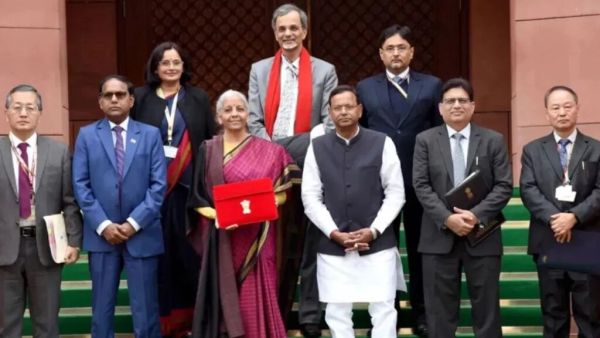
New Delhi: India’s approach to Atmanirbhar Bharat is firmly rooted in resilience, global engagement, and long-term competitiveness rather than inward-looking isolation, Chief Economic Advisor Dr. V. Anantha Nageswaran said while delivering the keynote address at a high-level policy dialogue on the Union Budget 2026–27 and the Economic Survey 2025–26.
Speaking at the discussion titled “Roadmap for Atmanirbhar Bharat in a Fragmented World with Strong Headwinds”, Dr. Nageswaran emphasised that India’s economic strategy seeks to strengthen domestic capabilities while remaining deeply integrated with global markets. He noted that recent trade engagements have helped ease external pressures and expand opportunities for Indian exporters, even amid global fragmentation and uncertainty.
Highlighting manufacturing, infrastructure development, and skill formation as central pillars of sustainable growth, Dr. Nageswaran observed that the Union Budget strengthens macroeconomic buffers while scaling up both physical and digital infrastructure. He also drew attention to the critical role of mental health and social well-being in fully harnessing India’s demographic dividend and ensuring long-term economic resilience, underscoring that investment in people is as vital as investment in capital.
Opening the dialogue, Prof. Sachin Kumar Sharma, Director General, Research and Information System for Developing Countries (RIS), noted that the Economic Survey and the Union Budget articulate Atmanirbhar Bharat as an outward-oriented development strategy aimed at enhancing competitiveness, strengthening priority sectors, and reducing economic vulnerabilities. He underlined that the Budget’s growth focus and emphasis on sunrise sectors are aligned with India’s long-term vision of Viksit Bharat 2047.
Dr. Seshadri Chari, Member, RIS Governing Council, placed the Union Budget 2026–27 within a longer-term policy continuum, highlighting its emphasis on capacity building, infrastructure-led growth, manufacturing revival, MSMEs, and sustained fiscal discipline as foundations for inclusive and durable growth.
Prof. Ram Singh, Director, Delhi School of Economics, noted that recent Economic Surveys stand out for their candid assessment of structural and institutional constraints, the critical role of states in reform, and the need for cooperative federal efforts to sustain inclusive growth.
Sectoral perspectives enriched the discussion further. Prof. Simrit Kaur, Principal, Shri Ram College of Commerce (SRCC) and Professor, Faculty of Management Studies, University of Delhi, observed that the Union Budget reinforces the foundations of sustainable and inclusive growth through strong public investment, AI readiness, workforce upskilling, and climate resilience, ensuring that India’s development trajectory remains equitable and future-ready.
From a fiscal perspective, Mr. A.K. Bhattacharya, Editorial Director, Business Standard, highlighted India’s significant progress in fiscal consolidation since the pandemic. He noted that future budgets could further accelerate growth by improving spending efficiency, strengthening state-level fiscal capacity, and creating a more supportive environment for private investment.
Focusing on agriculture, Dr. C.S.C. Sekhar, Professor, Institute of Economic Growth, pointed out that agricultural growth is increasingly driven by livestock, fisheries, and allied activities. He stressed the need to strengthen crop agriculture, improve scheme implementation, and better align subsidies to ensure long-term resilience, productivity, and sustainability.
On trade and exports, Prof. Prabir De, Professor, RIS, highlighted that India’s export strategy is marked by continuity and long-term planning. He noted that the Budget strengthens trade facilitation, customs reforms, logistics capacity, digital integration, and Centre–State coordination—key enablers for sustaining India’s trade competitiveness and growth ambitions.
Dr. Charan Singh, CEO and Founder Director, EGROW Foundation, emphasised that India’s next phase of growth will depend on strategic budgeting, fiscal stability, a strong financial system, and long-term institutional reforms to support exports, industry, and inclusive development.
Summing up the broader policy context, Mr. P. Vaidyanathan Iyer, Managing Editor, The Indian Express, observed that while high public investment remains crucial in an uncertain global environment, India’s future growth momentum will increasingly be driven by stronger manufacturing, higher private investment, cleaner and more liveable cities, and effective capital market reforms.
Overall, the dialogue offered a comprehensive and multi-dimensional assessment of how the Union Budget 2026–27 and the Economic Survey 2025–26 position India to advance the Atmanirbhar Bharat agenda while strengthening competitiveness, resilience, and inclusive growth in a rapidly evolving global economy.
Contact to : xlf550402@gmail.com
Copyright © boyuanhulian 2020 - 2023. All Right Reserved.