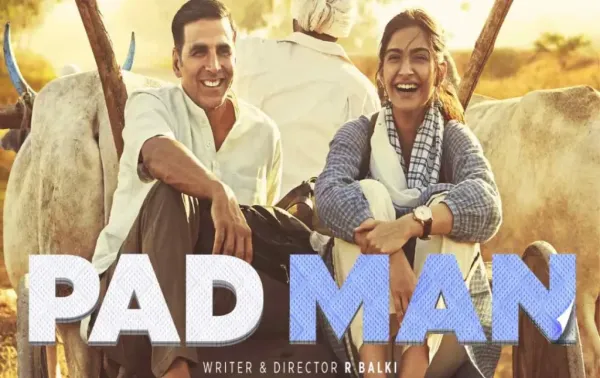
Films made on menstrual health broke the silence of the society and changed the thinking. The debate that started with films like Padman reached the Supreme Court’s decision, which linked menstrual hygiene to the right to live with dignity.
Bollywood: In a society like India, there have been some topics on which talking was considered taboo for a long time. Menstruation i.e. Menstrual Health has also been included in those topics. There was a time when even mentioning the name of periods at home would create discomfort and people would change the channel as soon as an advertisement for sanitary pads came on TV. But society has changed with time and the role of cinema has been very important in this change. Today the same topic has come out of the big screen and has become a part of courts, policies and national debate.
Supreme Court’s decision gave constitutional identity
On January 30, 2026, the Supreme Court of India delivered a historic verdict declaring menstrual hygiene as part of the right to live with dignity under Article 21 of the Constitution. This decision did not come suddenly. Behind this are years of social efforts, awareness campaigns and most importantly, the ground created by cinema, which forced the society to think. This decision of the court made it clear that periods are not a personal or shameful matter but a matter to fundamental rights.
Cinema became a medium of change
Government schemes and health department initiatives were necessary in their place, but what could not be done in decades, was sometimes done by a two-hour film. Cinema did not allow menstrual health to remain only a women’s issue, but presented it as the responsibility of the entire society. Especially some films made in the last decade played a decisive role in breaking this silence.
Padman and a revolutionary risk
Whenever there is talk of menstruation and cinema, the first name that comes to mind is ‘Padman’. Released in 2018, the film was inspired by the life of Arunachalam Muruganantham, who created a machine to make cheap and accessible sanitary pads. Making this film was not easy. It was a big risk for Akshay Kumar and Twinkle Khanna because till then no big star in Bollywood was willing to touch this subject.
A film made in the shadow of protest and fear
There were many apprehensions regarding ‘Pad Man’ in the initial phase. The filmmakers were afraid whether the censor board would approve it or it would be given an A certificate. There were protests in many rural areas during the shooting. People felt that this was a private matter for women and it was wrong to bring it on the public platform. But R Balki’s sensitive direction and the honest thinking of the film left all these apprehensions behind.
Padman changed his thinking
‘Pad Man’ did what government posters and advertisements could not do. This film made periods a part of drawing room conversation. Akshay Kumar’s dialogue that America has Superman and Batman but India has Padman became not just a film line but a social message. This was the reason why the film was appreciated and it was also made tax free in many states.
The unseen truth of rural India
Just before ‘Padman’, the film ‘Phullu’, released in 2017, showed the bitter truth of rural India. This film starring Sharib Hashmi showed how even today women in many villages are forced to use dirty clothes, ashes or sand. Directed by Abhishek Saxena, the film tells how lack of information leads to serious diseases.
Society was the aim, not box office.
Even though ‘Phullu’ could not achieve great success at the box office, it definitely served as a mirror to the society. The film succeeds in explaining that what we consider shame is actually fatal negligence. This film also showed how men, despite understanding their wife’s pain, remain silent due to fear of society.
Indian voice reached Oscar

This cinematic revolution to menstruation got international recognition when the documentary ‘Period’ was made on the women of a village in Hapur. ‘End of Sentence’ won the Oscar Award. This documentary showed how women not only became self-reliant by installing machines to make sanitary pads but also broke the stigma associated with periods.
When the whole world saluted India
When the director of this documentary, Raika Zehtabchi, said on the Oscar stage that she could not believe that a film based on periods had won the Oscar, it was not just a statement but a global acceptance of the change that has come in India. Arunachalam Muruganantham himself appeared in this documentary, which further strengthened the link between Padman and this story.
Attack on black bag mentality
There was a time when at medical stores, sanitary pads were wrapped in newspaper and given in a black bag as if it was a crime. TV commercials started talking about this taboo, but the sensibility of cinema gave it depth. Today this mentality has changed to a great extent in urban India and films have a big contribution in it.
Ayushmann Khurrana’s film ‘Doctor Ji’, released in 2022, gave a new dimension to this subject. The film showed how sensitive a male gynecologist should be towards women’s health. This film was a lesson not only for women but also for men.
Social responsibility beyond entertainment
It would be injustice to these films to look at them only from the perspective of hit or flop. These films are like sensitivity classes for men. The effect of this was that now men have started talking openly about the health of their sisters, wives and daughters.
From Muruganatham to Supreme Court
Arunachalam Muruganantham’s small machine, Akshay Kumar running on the screen with a pad and the historic decision of the Supreme Court, all these are links of the same change. Change always starts with a small voice and cinema gave a platform to that voice.
Contact to : xlf550402@gmail.com
Copyright © boyuanhulian 2020 - 2023. All Right Reserved.