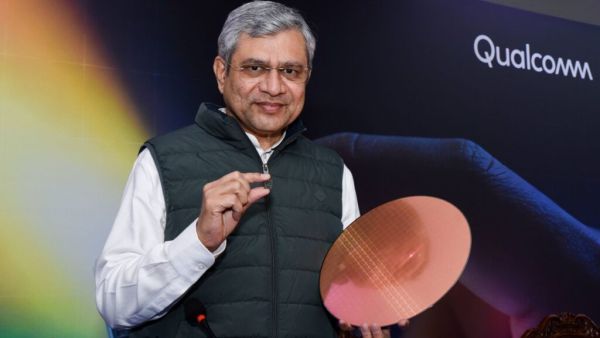
“The semiconductor ecosystem is expanding rapidly, and the talent pipeline we are building will accelerate it further,” said Ashwini Vaishnaw, Union Minister for Railways, Information and Broadcasting, Electronics and IT. He was responding to a question on whether the expansion of Qualcomm and other global tech companies in India validates the government’s long-term technology strategy. The minister was speaking at a select gathering at the Qualcomm Design Centre in Bengaluru.
Global technology giants expanding rapidly in India is more than just good news. It is a clear signal that the country’s long-term technology strategy is taking root. The IT minister welcomed Qualcomm’s rapid growth in India and described it as part of a much larger momentum building around the semiconductor ecosystem.
According to him, the combination of a strengthening talent pipeline, new fabrication plants, and ATMP units is creating a solid foundation for the industry. He added that equipment manufacturers are also expected to establish operations in India soon, which will further complete the ecosystem and accelerate innovation and manufacturing capabilities.
“…And the fab and ATMP units which are getting set up, and very soon, the equipment manufacturers will come to our country so that will be intact; that will be a good complement to our entire system,” Vaishnaw told indianexpress.com.
The message is straightforward – India is steadily positioning itself as a global hub for semiconductor design, manufacturing, and talent. What was once a vision is now turning into on-ground capacity and investment.
During his visit to the Qualcomm Design Centre, the minister unveiled two nanometre wafers and two nanometre chips. He described it as part of a series of developments where companies are now building end-to-end products in India.
“Gone are the days when most of the work done in India was limited to back-office development. Today, the entire process, from defining customer requirements to designing the final silicon, taping it out, and validating it, is carried out here. This represents a major milestone for both the country and the industry,” he told mediapersons, emphasising the evolution of India’s role in global chip development.
Qualcomm’s new milestone
Qualcomm Technologies Inc. announced the successful tape-out of its 2 nm semiconductor design, marking a milestone in advanced semiconductor design. This achievement also highlights India’s growth as a critical hub for cutting-edge semiconductor development. It also demonstrates Qualcomm’s long-term investment in building and accelerating India’s semiconductor ambitions.
The complexity of the achievement is staggering. Each die on the wafer contains approximately 20 to 30 billion transistors. To put this in perspective, Vaishnaw explained, “It’s like writing the entire Mahabharata, writing the entire Ramayana, and writing the entire Puranas on this small little chip; that is the level of complexity.”
“Qualcomm’s 2 nm chip, designed and taped out with significant engineering contribution from India, underscores the country’s growing role in advanced semiconductor design. It reflects a broader shift from support-led functions toward end-to-end chip design and system-level development. Such milestones highlight the evolution and momentum of India’s semiconductor design capabilities and its deeper integration into global value chains,” said Prabhu Ram, VP-Industry Research Group, CyberMedia Research (CMR).
Besides, India’s semiconductor talent pipeline seems to have exceeded expectations. Under the Semicon 1.0 mission, the government had set a target of training 85,000 semiconductor professionals over ten years.
“Happy to share with you that within four years, we have been able to train 67,000 semiconductor trained engineers,” Vaishnaw shared with the gathering. These engineers are now working across 315 universities and colleges equipped with semiconductor design EDA tools, designing chips and validating them at the semiconductor lab in Mohali.
AI’s impact and India’s infrastructure
The minister also briefly touched upon AI’s impact on the Indian IT sector; he acknowledged both the disruption and opportunity. “This is the time when the industry, academia, and government should fully synchronise and ensure that our students and the people who are already in jobs get the right skills which are needed for providing these solutions,” he stressed.
Meanwhile, on infrastructure development, the minister shared ambitious projections. Current committed investments in data centres stand at $70-90 billion, but Vaishnaw expects this to grow significantly. “I expect that in the coming months, this number will go beyond $200 billion,” he said, noting that this expansion is already attracting AI server manufacturing to India, with two companies planning to establish facilities.
India’s GPU capacity is also set for substantial growth. “So far, we have 38,000 GPUs as part of the common compute. Very soon, we should be adding about 50,000 more GPUs,” Vaishnaw announced, with further expansion planned under the AI Mission 2.0.
Contact to : xlf550402@gmail.com
Copyright © boyuanhulian 2020 - 2023. All Right Reserved.