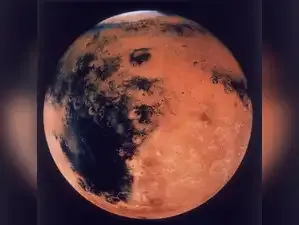
Did you know: Mars, the so-called Red Planet, might look spherical when viewed through a telescope or in images from space probes, but recent scientific analysis suggests it is not perfectly round like a ball. Instead, Mars exhibits a peculiar, elongated shape, more akin to a rugby ball or triaxial ellipsoid, making it unique among the rocky planets of the Solar System.
However, precision measurements of Mars reveal subtle but real deviations from a perfect sphere. Scientists describe its overall shape as a triaxial ellipsoid, meaning the lengths measured along its three principal axes (equatorial and polar) are all slightly different. This gives Mars a shape reminiscent of a rugby ball, albeit only marginally elongated.
The most noticeable irregularities appear around two major surface features:
a prominent bulge near the Tharsis Rise, a vast volcanic plateau, and a corresponding elevation anomaly near Syrtis Major, a large dark mark on Mars’s surface.
What makes Mars unusual is that its triaxial shape isn’t just a minor equatorial bulge; it is shaped differently along three separate axes (north-south, east-west and pole-pole), so it doesn’t conform even to a simple oblate model.
According to space scientists, this distortion is quite distinct from the mild flattening seen on Earth and hints at a more complex geological history.
The proposed moon, named Nerio in some scientific discussions, would have orbited Mars long ago. Its gravitational influence, similar to how Earth’s Moon affects Earth’s tides, may have caused bulging in the Martian crust, especially in the Tharsis region, before eventually disappearing or being ejected from the system.
While this hypothesis remains under study, it offers one plausible explanation for why Mars’s triaxial shape doesn’t match what basic gravity alone would predict.
The northern lowlands are remarkably smoother and lower in elevation, while the southern highlands are rugged and elevated, a contrast of several kilometres. This imbalance is one of the reasons scientists view Mars’s shape as more complex than that of a simple sphere.
For Mars, the deviations from a perfect sphere might tell a story of ancient moons, dramatic geological forces and an evolving world very unlike the idealised red marble often pictured in textbooks.
What Scientists Mean by “Not Round”
Most people picture planets as smooth, round spheres shaped by gravity. Indeed, gravity pulls matter inward equally from all directions, which is why large bodies like Earth and Mars generally appear spherical when viewed from space.However, precision measurements of Mars reveal subtle but real deviations from a perfect sphere. Scientists describe its overall shape as a triaxial ellipsoid, meaning the lengths measured along its three principal axes (equatorial and polar) are all slightly different. This gives Mars a shape reminiscent of a rugby ball, albeit only marginally elongated.
The most noticeable irregularities appear around two major surface features:
a prominent bulge near the Tharsis Rise, a vast volcanic plateau, and a corresponding elevation anomaly near Syrtis Major, a large dark mark on Mars’s surface.
How Mars’s Shape Compares with Other Planets
All planets are technically not perfect spheres. Because they rotate, they tend to bulge at the equator and flatten at the poles, the shape known as an oblate spheroid, but Earth and Mars are very close to that form.What makes Mars unusual is that its triaxial shape isn’t just a minor equatorial bulge; it is shaped differently along three separate axes (north-south, east-west and pole-pole), so it doesn’t conform even to a simple oblate model.
According to space scientists, this distortion is quite distinct from the mild flattening seen on Earth and hints at a more complex geological history.
What Might Have Caused This Shape?
Researchers have proposed an intriguing hypothesis: Mars might have once had a third moon that exerted tidal forces on the planet during its early formation. These tides could have stretched the planet slightly, creating uneven gravitational pull and an enduring shape distortion over geological time.The proposed moon, named Nerio in some scientific discussions, would have orbited Mars long ago. Its gravitational influence, similar to how Earth’s Moon affects Earth’s tides, may have caused bulging in the Martian crust, especially in the Tharsis region, before eventually disappearing or being ejected from the system.
While this hypothesis remains under study, it offers one plausible explanation for why Mars’s triaxial shape doesn’t match what basic gravity alone would predict.
Surface Features That Add to the Odd Shape
In addition to large bulges, Mars exhibits stark topographic contrasts between its northern and southern hemispheres, a difference known as the Martian dichotomy. This feature further contributes to overall asymmetry in Mars’s form.The northern lowlands are remarkably smoother and lower in elevation, while the southern highlands are rugged and elevated, a contrast of several kilometres. This imbalance is one of the reasons scientists view Mars’s shape as more complex than that of a simple sphere.
Why Shape Matters in Planetary Scienc
Understanding a planet’s shape isn’t just academic, it has real implications for how scientists study gravity, internal structure, tectonics and geological history. Small deviations from spherical symmetry can reveal clues about a planet’s formation, past collisions, volcanic activity, and even whether it once hosted additional satellites.For Mars, the deviations from a perfect sphere might tell a story of ancient moons, dramatic geological forces and an evolving world very unlike the idealised red marble often pictured in textbooks.