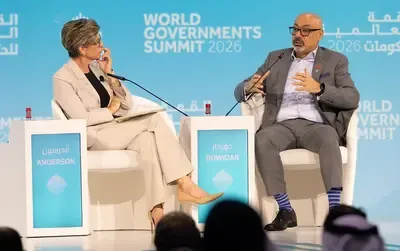
Although the UAE successfully tested a 6G pilot in 2025, but the technology may not reach general users until 2030. Hatem Dowidar, Group CEO of e&, says the next generation of connectivity is progressing quickly behind the scenes. However, mass adoption will take time as global standards are finalised and ecosystems mature.
He said that he expects formal 6G standards to be "almost finalised in the next two years," with 2028 marking a turning point for global alignment. Commercial networks would follow gradually, with consumer devices arriving around 2030. “You probably would not have in your hand a phone that shows 6G before 2030,” he said.
For users, 6G would mean faster-than-instant responses, near-fail-proof uptime, massive bandwidth, and networks that combine connectivity with sensing, local compute, and quantum-resistant security.
Stay up to date with the latest news. Follow KT on WhatsApp Channels.
Dowidar spoke on the last day of the World Government Summit 2026 in Dubai and noted that technology companies are becoming part of a larger ecosystem, offering inclusion to the unbanked. He also said e& is both a regional pioneer and a global bridge in an increasingly fragmented tech landscape.
Hatem Dowidar, Group CEO of e& (R) in conversation with Becky Anderson, Managing Editor of CNN Abu Dhabi
A bridge between East and West
As geopolitical tensions shape technology supply chains, Dowidar said the company is in a delicate balancing zone.
“We are sitting in the zone between the East and the West,” he said, noting the company works with American partners such as AWS, Microsoft and Qualcomm while maintaining visibility on Chinese technology ecosystems. “There is still a world where we can have a common standard across the world, and that’s something that we really need to push.”
He warned that diverging standards could raise costs and slow inclusion, particularly in developing regions “If we want to have the whole world connected, we need to have ubiquitous, worldwide, global standards,” he said.
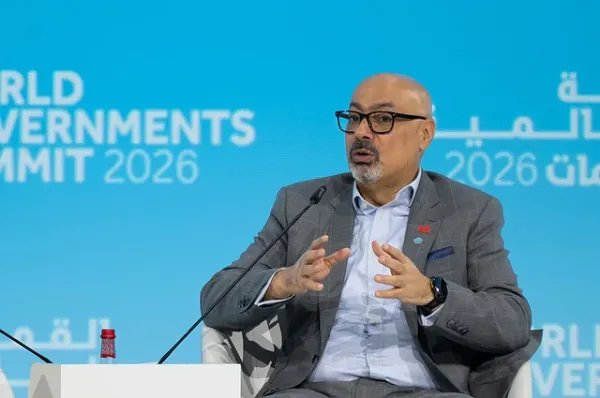
Hatem Dowidar, Group Chief Executive Officer, e& during the session, ‘Who Decides the Digital World?’ at the World Governments Summit in Dubai
Control of digital future
Dowidar rejected the idea that control of the digital future sits with a single group. Instead, he said that today’s digital economy is a “multi-stakeholder environment” involving governments, platforms, standards bodies and users themselves.
Looking ahead to the next decade, he sees telecom companies evolving into broader digital ecosystems, especially in financial inclusion. He noted that several unbanked blue-collar workers now have access to mobile wallets, microloans, and credit cards because of innovative apps.
He also said that future generations will need to learn to use AI properly. “If they are able to use AI tools to their full capacity, they will succeed,” he said. “If they fall behind, especially if their expertise is in an area that is repetitive, they can be replaced by AI.”
'New kind of humanity': UAE minister urges governments to rethink roles at WGS opening AI, uncertainty, end of fixed roles: Experts in Dubai discuss future work placeContact to : xlf550402@gmail.com
Copyright © boyuanhulian 2020 - 2023. All Right Reserved.