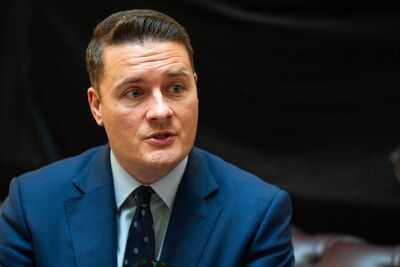
Wes Streeting has vowed to transform cancer survival rates in England - which are lagging behind much of Europe.
The Health Secretary - himself a cancer survivor - said a new National Cancer Plan will see 75% of patients to be cured or “living well” with cancerfive years after diagnosis. The Government is promising the fastest rate of improvement in cancer outcomes this century and says its plan will mean will mean 320,000 more lives saved by 2035.
Mr Streeting, who had his kidney cancer removed using state of the art robotic surgery, has vowed to expand its use across the NHS as well as catching more cancers early by expanding community diagnostic centres. These centres will in many cases operate 12 hours a day, seven days a week.
• Lung cancer breakthrough as AI arm can diagnose 'deep' tumours previously missed
• Deadly 'forgotten cancer' symptoms include heartburn - but it might be hard to spot
For some cancer types survival rates in England trail behind countries like Croatia, Poland and Romania. Mr Streetin said his surgery scars are “a badge of honour” to him because “they remind me of what I’ve been through and how lucky I am to still be here”.
He told the Mirror: “When you’ve had cancer it hits you differently. I think about friends I've lost to cancer. As a cancer survivor who owes my life to the NHS, I owe it to future patients to make sure they receive the same outstanding care I did.”
Despite scientific breakthroughs meaning that cancer survival chances have improved almost everywhere, in Britain they still lag many other European countries. The UK fell further behind during a decade-long NHS funding squeeze under the Tories which added entrenched lifestyle risk factors such as high rates of obesity and excessive alcohol consumption.
A report by Macmillan Cancer Support showed in 2024 that survival rates in Britain lagged 25 years behind some of the best performing European nations. Five year survival rates for cancers of the prostate, cervix and colon were only just reaching levels that countries such as Denmark and Sweden achieved around the turn of the century. For women with cervical cancer in England it was 61.4% and lagged 25 years behind Norway. Five-year survival rates for men with bowel cancer in England and women with colon cancer in Wales were still below what Sweden achieved by the early 2000s.
Breast cancer survival in England was also shown to be a decade behind Sweden and Denmark. Wes said: “Cancer is the canary in the coalmine for the NHS and as it was allowed to decline under the Conservatives, so cancer standards fell every single year they were in power.
“There is a massive tragedy at the heart of the UK’s cancer care because we have some of the best science in the world here and yet we lag behind other European countries when it comes to cancer survival. Cancer is more likely to be a death sentence in Britain.”
There will be a massive increase in robot assisted surgery - which Mr Streeting underwent to remove his cancer in a short two-day stay - for everything from hip replacements to heart surgery and cancer operations. Robot-assisted procedures will increase from 70,000 to half a million by 2035. They can mean smaller incicions, fewer complications and can therefore free up hospital beds.
Mr Streeting told the Mirror: “In my case I was really lucky. I went into hospital with excruciating back pain that turned out to be kidney stones and it was in the process of scanning my kidney they also noticed something which turned out to be cancer.
“I call them my lucky kidney stones because I was lucky that my cancer was caught. There aren't that many kidney cancer symptoms so there's every chance that I might be talking to you today with absolutely no idea that I had cancer and with it spreading.”
The NHS will divert £2.3 billion to deliver 9.5 million extra cancer tests by 2029. The cash will pay for more scanners and automated testing as well as keeping more community diagnostic centres open 12 hours, every day. The Government says its plan will mean 75% of patients diagnosed from 2035 will be cancer-free or living well after five years.
Currently 60% of patients survive for five years or more. Around 2.4 million people are currently living after a cancer diagnosis.
Professor Peter Johnson, NHS England’s director for cancer, said: “Almost everyone will know someone who has been affected by cancer and for many people it will be part of their own story too. “This plan sets a clear roadmap for the NHS to diagnose more cancers earlier, ensure more patients are treated on time and improve survival, so that hundreds of thousands more people live longer, healthier lives with or after cancer over the next decade.”
The plan also includes a bold pledge to ensure the NHS meets all cancer waiting time standards by 2029. The NHS has not met its central cancer performance target - that 85% of patients start treatment within 62 days of referral - since 2014. Just 70% of people in November were treated in this timeframe.
Sarah Scobie, research director at the Nuffield Trust, said: “To meet the government's target of 85% starting treatment within this timeframe by the March 2029, we'd need to see improvements of almost 0.4% every single month - that would mean the NHS improving at 30 times the rate is has managed since April. This would be an enormous feat to maintain, and we are still awaiting details on how it would be funded.
“The UK lags behind other countries in cancer outcomes and faces longstanding gaps in investment and staff, with key equipment like diagnostic scanners in short supply compared to countries like Germany, Sweden and Italy. Making the UK ‘world-leading’ on cancer will take time and the commitment of scarce resources in a health service already under pressure.”
Other cancer targets are that at least 75% of people referred will get a diagnosis or ruling out of cancer within 28 days, and at least 96% of cancer patients being treated within 31 days. Michelle Mitchell, chief executive of Cancer Research UK, said: “Too many cancer patients are waiting too long to start treatment so it's important that the UK Government has committed to meeting cancer waiting time targets by 2029. A wide range of measures will be needed for these to be met.”
Contact to : xlf550402@gmail.com
Copyright © boyuanhulian 2020 - 2023. All Right Reserved.