

Image: Polaron founders (Left to right_ Chief Scientist Sam Cooper; CTO Steve Kench; CEO Isaac Squires)
London, UK, Feb 3 – Polaron, the London-based AI startup transforming how advanced materials are characterised, designed and manufactured, has raised $8 million to build the ‘intelligence layer for materials science’. This means addressing a bottleneck in materials manufacturing: understanding the connection between how materials are made and how they perform.
The round was led by Root2an impact focused fund led by Serena and Makesense, with co-investment from Speedinvest and Futurepresentplus angel backing from senior figures across the Industrial AI ecosystem. The capital raised will enable Polaron to expand its engineering team, accelerate rollout of its generative design tools and support growing demand from customers across automotive, energy, and beyond.
Spun-out from Imperial College London after seven years of research at the intersection of AI and materials science, the company was co-founded by CEO Isaac SquiresCTO Steve Kench and Chief Scientist Sam Cooper.
The technology has already been in the hands of engineers at global manufacturing leaders, including EV makers responsible for over a third of the world’s electric vehicle production. One use case supporting the design of new battery electrodes has yielded energy density improvements exceeding 10 percent.
Isaac Squires, CEO and Co-founder of Polaronsaid: “For 150 years, industry has used machines to shape materials. Now, we are teaching machines to understand them. Polaron is building an intelligence layer powered by the world’s materials data for faster discovery, better design and a new generation of advanced materials.”
Alix Trébaol, investor at Serenaadded: “In materials, AI is commoditizing atomistic discovery. The winners will be the ones who can predict real-world industrial manufacturability. No one but Polaron knows how to do this today.”
Florian Obst, Principal investor with Speedinvest’s AI & Infra investment team: “What impressed us about Polaron is its focus on the point where materials innovation often breaks down: translating scientific insight into manufacturable reality. By grounding AI in real microstructural data and industrial constraints, Polaron is building a platform that can accelerate how advanced materials move from research into production.”
The missing intelligence layer
For more than a century, industries have automated how products are made, but understanding the materials themselves still relies on manual work, isolated tools and trial and error. Engineers are left to piece together how processing choices affect performance, often using bespoke scripts and subjective judgement.
At the heart of this challenge is a fundamental scientific relationship: processing determines structure, and structure determines performance. The arrangement of grains, pores, phases, and defects inside a material governs properties such as strength, lifetime, and failure. This structure is not abstract. It is directly observable under the microscope, where rich microstructural images capture the physical fingerprint of how a material was made and how it will behave – supporting cleaner, more efficient manufacturing at scale.
From characterisation to generative design
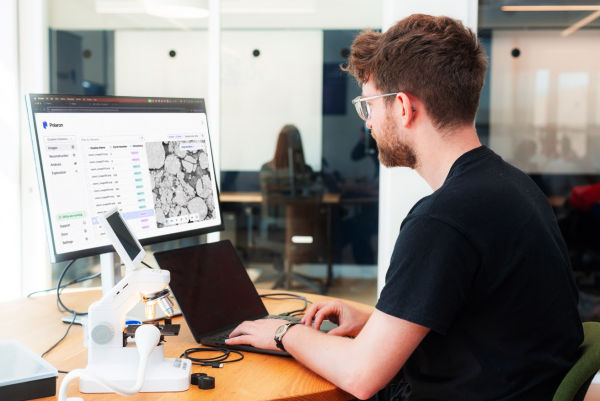
Polaron connects process, structure, and performance by training AI models on real microscopy images and measured properties. This allows machines to interpret microstructure, explain why materials behave as they do and help engineers optimise processes at unparalleled speed.
It automates material characterisation, reducing thousands of hours of manual analysis to minutes, enabling engineers to design higher-performing systems faster. Crucially, the platform unlocks insights that were previously impossible, including three-dimensional reconstructions of materials from two-dimensional images and rapid identification of complex microstructural features.
Building on this foundation, the design layer of Polaron focuses on generative design. Using learned process-structure-property relationships, the system explores the design space to identify optimal material configurations and the processing conditions required to achieve them. This capability bridges the gap between laboratory innovation and industrial manufacturability and works across metals, ceramics, polymers and composites.

Contact to : xlf550402@gmail.com
Copyright © boyuanhulian 2020 - 2023. All Right Reserved.