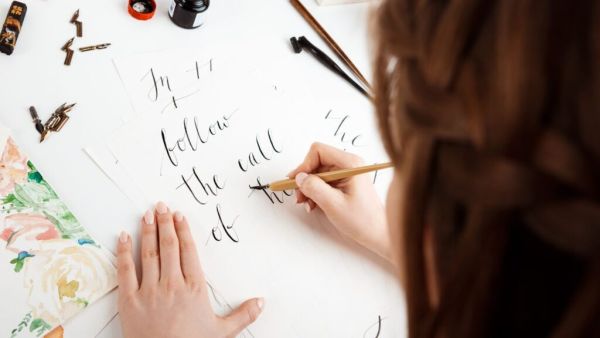
Handwriting is making a comeback in classrooms, reopening a long-running debate over cursive and whether it still has a place in an age dominated by screens and keyboards. After years of declining use, cursive is being reintroduced in some school systems, including New Jersey, which recently passed a law requiring students in grades three to five to learn the flowing, connected style of handwriting.
The move places the state alongside more than 20 others in the US that have revived cursive instruction over the past decade, even as many countries continue to move deeper into digital education.
Supporters of cursive argue that putting pen to paper does more than produce neat handwriting. They say it plays an important role in how children learn, think and remember. Critics, however, see cursive as outdated, questioning whether it deserves classroom time when typing is now a basic life skill. As the so-called “cursive wars” continue, scientists are offering new insight into what actually happens inside the brain when children write by hand.
When New Jersey signed its new education rule into law, officials pointed to possible cognitive benefits, suggesting that cursive could support learning in ways that keyboards cannot. While research does not conclusively prove that cursive itself is better than print writing, studies consistently show that handwriting, in general, activates the brain more deeply than typing, according to an article published in Nature on February 2.
What happens in the brain when we write
Neuroscientists who study learning say handwriting forces the brain to work harder. Unlike typing, which relies on repetitive finger movements, writing by hand involves fine motor control, spatial planning and constant feedback between the eyes and the hand. This combination appears to strengthen learning- brain networks.
Karin Harman James, a developmental neuroscientist at Indiana University, has spent years studying how children learn letters. In one of her early experiments, children who had not yet learned to read were asked to either write letters by hand or type them. When the children later saw images of those letters while their brains were scanned, those who had practised handwriting showed activity patterns similar to adults who can read. Children who had learned letters only by typing did not show the same response.
James says handwriting helps children build strong mental representations of letters and numbers. The physical act of forming shapes seems to support recognition, memory and comprehension in ways that pressing keys does not.
Similar findings have come from Europe. Audrey van der Meer, a neuroscientist in Norway, used sensors placed on children’s heads to measure electrical brain activity. She discovered that the act of handwriting resulted in stronger signals being produced in regions associated with learning and memory, while typing resulted in weaker and more diffuse activity. According to Van der Meer, writing by hand is a skilled motor exercise that helps the brain digest information more efficiently.
The results of these studies have caused concern in countries where schools have gone completely digital at a young age. In Norway, some teachers of first-grade students have noticed that children have difficulty holding a pencil correctly after being taught mainly on tablets.
Researchers in this country are now urging a more balanced approach between screen time and handwriting.
As schools begin to rethink how children can learn in this new age of technology, the evidence is that handwriting, whether it be cursive or print, still has a place. Although typing is a necessary skill, the simple act of writing by hand may be the best way to train the brain.
Contact to : xlf550402@gmail.com
Copyright © boyuanhulian 2020 - 2023. All Right Reserved.