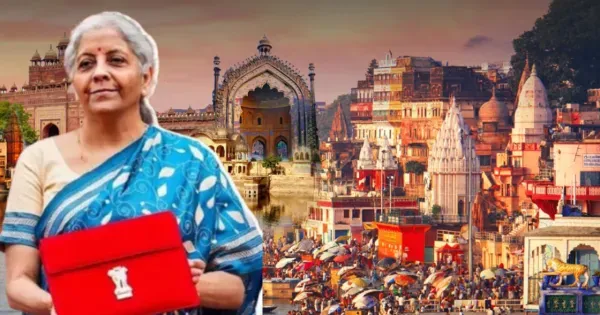
Lucknow, Read: The macroeconomic impact of the Maha Kumbh and its contribution to the Gross Domestic Product (GDP) has prompted the Central Government to take a fresh look at India’s traditional economic structure. For the first time in the Union Budget 2026–27, India’s eternal economic forms – festivity, temple tourism and town-based economy – seem to be getting clear recognition at the policy level. This is a sign that India’s development journey will no longer be limited to just industry and metros but will move forward by connecting with its cultural and civilizational roots.
Budget 2026–27 indicates that Uttar Pradesh can become the center of India’s new development model through Sanatan Economics, Town Based Development and Temple Tourism in the coming years. Policy experts believe that the Maha Kumbh successfully organized under the leadership of Yogi Adityanath made it clear that faith-based events are not only religious but also big economic catalysts. During the Maha Kumbh, hotels, transport, local trade, health services, logistics and temporary-permanent employment emerged as a strong economic ecosystem in the Prayagraj-Kashi-Ayodhya circuit. This experience helped policy makers understand that faith-based events could boost the economy at the grassroots level.
New strength to towns from City Economic Region
The announcement in the budget to develop Tier-2 and Tier-3 cities as City Economic Regions (CERs) is being considered as an extension of the idea of ’developed towns’. This scheme will revive the towns, which have been the backbone of the supply chain of the Indian economy for centuries. Farmers, artisans and traders of nearby villages will directly benefit from the empowerment of towns. Local products will get market and these towns will emerge as fulfillment centers for big cities. This will strengthen the middle link of the economy and the benefits of development will reach the last person. Uttar Pradesh, being the state with the largest number of towns and urban units, is likely to get the largest benefit from CERs.
The entry of the word ‘Temple City’ in the budget is a historical sign.
After the economic experience gained from Mahakumbh, the use of the word ‘Temple City’ in the budget speech is being considered a historical gesture. Historically, temple cities have been major centers of India’s economy. The Prayagraj–Kashi–Ayodhya circuit made it clear that if plans are made keeping temple towns at the centre, holistic development of thousands of towns and small cities is possible. This will naturally increase trade, cultural exchange and social engagement along with tourism.
UP benefits the most from Sanatan Economics
Uttar Pradesh is likely to benefit the most from the steps taken towards Sanatan Economics in the budget. Major centers of Sanatan and Buddhist traditions like Mathura, Kashi, Ayodhya, Prayagraj, Naimisharanya, Gorakhnath, Hastinapur, Sarnath and Kushinagar are located in the state. Development of tourism, service sector, local products and infrastructure in these areas will provide long-term strength to the state’s economy.
Inland Waterway gives new life to river based economy
The announcement of development of inland waterway between Varanasi and Patna in the budget will make logistics in UP cheaper and effective. Due to the extensive network of rivers like Ganga, Yamuna, Ghaghra and Rapti, Uttar Pradesh can play a leading role in road, rail and air as well as waterways connectivity.
Contact to : xlf550402@gmail.com
Copyright © boyuanhulian 2020 - 2023. All Right Reserved.