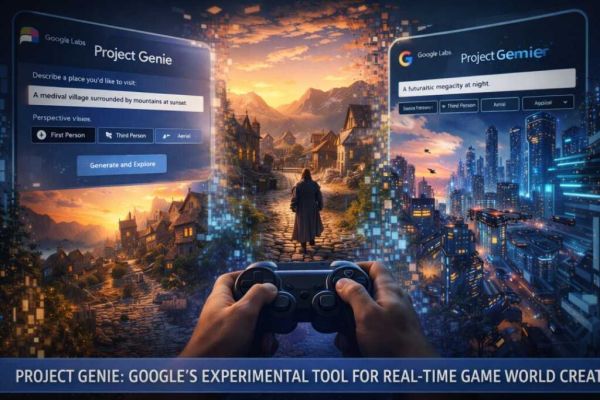
When Google quietly opened access to Project Genie, the reaction across the videogame world was immediate and intense. Developers, artists, designers, and players all tried to understand what exactly had appeared and what it might mean for how virtual worlds are imagined and built.
At first glance, Project Genie looks deceptively simple. A user types a description or uploads an image, chooses a viewpoint, and suddenly a space exists that can be explored. You can walk, ride, fly, or drive through it. The environment reacts as you move. The path ahead forms in real time. This alone raises an obvious question: if worlds can be created this way, what changes for people who have spent decades building them piece by piece?
To understand what is happening, it helps to be clear about what Project Genie actually is. It is an experimental web-based prototype released through Google Labs, available initially to a limited group of subscribers in the United States.
It is built on Google’s research into “world models,” systems designed to simulate environments and how actions affect them. Unlike earlier tools that produced static scenes or short clips, this system continuously generates what lies ahead as the user moves. The result is not a finished videogame but a living environment that responds to navigation and simple interactions.
The experience begins with what Google calls world sketching. A user describes a place or provides an image, then refines it before entering. Perspective can be chosen in advance, which shapes how the space feels once exploration begins.
This matters because point of view is one of the most important creative decisions in interactive media. First-person movement creates intimacy and tension. Third-person movement creates distance and context. Project Genie allows this choice at the very start, before the world even exists.
Once inside, the user explores. As movement happens, the environment continues to appear, adjusting to direction and speed. Unlike pre-built levels, there is no fixed boundary or map in the traditional sense. The system predicts what should exist next and builds it on the fly. Physics and interactions are simulated, though imperfectly, which means the world feels alive but not always consistent.
Objects may behave strangely. Characters can be difficult to control. These limitations are not hidden. Google has been clear that this is early research, with strict time limits of around sixty seconds per generation.
The third element is remixing. Worlds can be altered by changing the original description or building on top of someone else’s idea. This allows users to treat environments less like finished products and more like drafts that can be reshaped. Finished explorations can be exported as video, turning interactive moments into shareable media. In this sense, Project Genie sits somewhere between a sandbox, a sketchpad, and a camera.
From a technical point of view, the most important shift is how environments are produced. Traditional videogames rely on engines such as Unreal or Unity. These engines provide rules for gravity, lighting, sound, and physics. Designers and programmers then build levels and systems within those rules. Project Genie flips that order. Instead of constructing a world inside a predefined framework, the framework itself adapts to the world as it is being created. The environment is not assembled in advance; it is continuously generated as needed.
This has deep creative implications. For decades, building virtual worlds has required large teams and long timelines. Every street, hill, building, and interior had to be designed, tested, and optimized. Even with procedural tools, humans defined the boundaries. Project Genie suggests a different approach, where the act of describing replaces much of the act of constructing. The creator becomes closer to a director than an architect, shaping tone and intent rather than placing every object.
At the same time, it is crucial not to overstate what is possible today. Project Genie does not create complete games. There are no structured objectives, no non-player characters with dialogue, no scoring systems, and no long-term progression. Interaction is limited to movement and basic environmental response. Each session is short. Consistency from one moment to the next is not guaranteed. This makes the experience closer to a moving illustration than a playable title in the traditional sense.
Still, even within these limits, the tool raises uncomfortable and exciting questions for the creative process. If anyone can sketch a world and step into it within minutes, what happens to the early stages of concept art and level design? These phases have always been about experimentation, iteration, and communication. Teams produce rough visuals and grey-box levels to test ideas. Project Genie compresses that stage dramatically. An idea can be tested almost as quickly as it can be described.
This does not eliminate the need for skilled designers, but it changes where their skills are applied. Instead of spending weeks building a prototype space, creators may spend more time refining ideas, testing how spaces feel, and deciding which concepts are worth developing further. The value shifts from manual construction to judgment, taste, and direction.
There is also an impact on how stories and worlds might be imagined. Traditionally, writers and designers had to think within practical limits. A city with thousands of unique interiors was rarely feasible. Vast landscapes had to be carefully managed to avoid repetition. With systems like Project Genie, scale becomes less intimidating. The question moves from “Can we build this?” to “Should this exist, and why?” That shift encourages bolder ideas, but it also demands stronger editorial control to avoid worlds that feel empty or meaningless.
Another creative consequence lies in accessibility. Tools like this lower the barrier to entry for people who have ideas but lack technical training. Someone who cannot code or model in three dimensions can still express a vision and explore it. This echoes earlier moments in game history, such as the rise of user-generated platforms, but with a key difference. Instead of learning a specific toolset, the user interacts directly with the system through description and choice.
However, accessibility does not automatically lead to quality. A world that exists is not the same as a world that is worth spending time in. Coherent rules, intentional design, and meaningful interaction remain essential. Project Genie provides raw possibility, not finished craft. The challenge for creators will be turning these raw spaces into experiences that resonate.
There are also questions about authorship and originality. When worlds are created through description and remixing, the line between creator and tool becomes less clear. If someone builds on an existing world by altering a few details, who owns the result creatively? How much change is enough to make something new? These questions are not unique to this system, but Project Genie brings them into sharper focus by making reuse and variation so immediate.
From a technical perspective, Project Genie also exposes the difficulty of consistency. Videogames rely on predictable behavior. Players expect actions to have the same result every time. The current system produces worlds that can change unexpectedly, making it unsuitable for many types of gameplay. This is why engines like Unity still matter. They provide deterministic rules that ensure reliability across sessions and devices. Project Genie, at least for now, sits outside that space, better suited for exploration and experimentation than for finished products.
Yet even as a research prototype, its influence is already being felt. Developers are debating how such systems could fit into existing workflows. Artists are experimenting with rapid world visualization. Writers are using it to test atmosphere rather than plot. Educators are discussing its value as a teaching tool for spatial design and environmental storytelling. The conversation has shifted from whether this kind of world creation is possible to how it should be used.
Perhaps the most important impact is psychological. Seeing a world appear and respond in real time changes expectations. Once people experience that immediacy, slower methods feel heavier by comparison. This does not mean older approaches will disappear, but it does mean they will be questioned. Why spend months building a prototype when a rough version can exist in minutes? The answer will often be quality, control, and depth, but the question will not go away.
Project Genie is not the end of traditional game development, nor is it a replacement for engines, teams, or craft. It is a glimpse into a different layer of creation, one focused on speed, exploration, and possibility. Its current form is limited, imperfect, and clearly experimental. Yet even in this state, it forces the industry to rethink assumptions about how virtual spaces come into being.
Contact to : xlf550402@gmail.com
Copyright © boyuanhulian 2020 - 2023. All Right Reserved.